
Quick Answer: What Are the Top Korean Nail Trends in 2026?
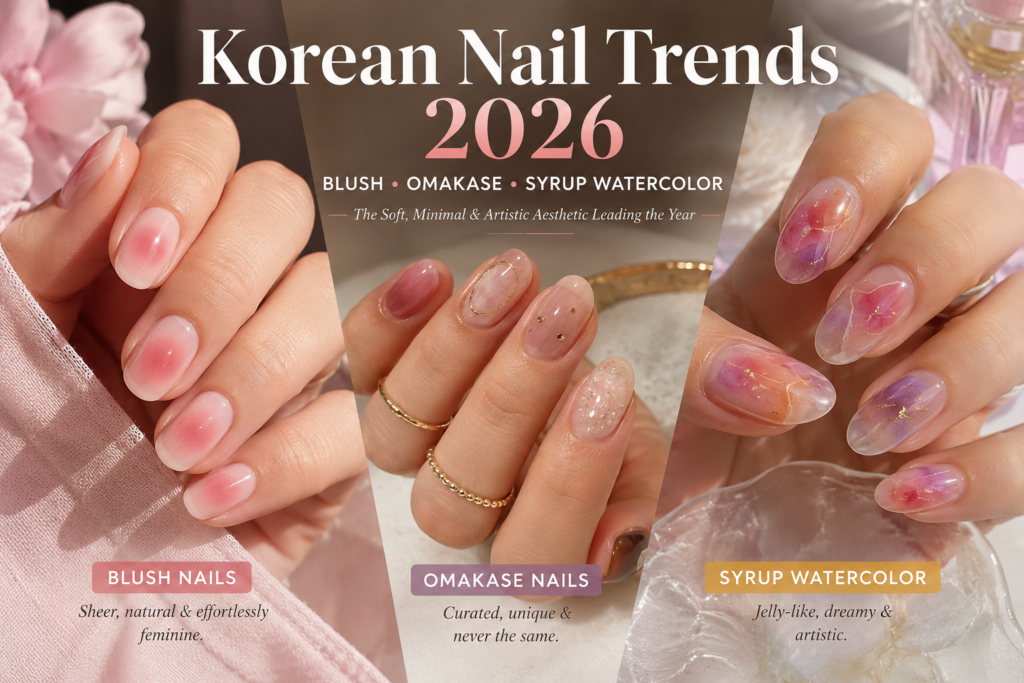
After going through dozens of Korean salon accounts and trend reports for this guide, three styles kept appearing again and again: blush nails (a soft, diffused flush of pink at the nail’s centre), omakase nails (a mismatched set where every finger is different), and syrup watercolor nails (a translucent jelly finish layered with loose, painterly colour washes). All three sit in the same Korean aesthetic family — nails that look luminous rather than coated.
There’s a reason I could scroll Korean nail Instagram for an embarrassingly long time without getting bored. Something about the way Seoul-based nail artists work — the restraint, the translucency, the tiny jewel details that somehow never look cluttered — makes every set feel like a small piece of jewellery rather than painted nails.
And in 2026, that approach has fully arrived in Western salons and, more importantly, in DIY routines. Scroll through Seoul nail artists for ten minutes and you’ll notice the same three aesthetics appearing repeatedly: blush nails, omakase nails, syrup watercolor nails. Korean nail trends in 2026 have a clear aesthetic thread running through all of them — each one looks more complex than it actually is, and each one is more achievable at home than the reference photos suggest.
This guide covers what each trend actually is, why it’s landed now, and a realistic step-by-step for doing it yourself. I’ll also flag the products and techniques where it’s worth spending a little more — and where you absolutely don’t need to.
What Actually Makes Korean Nail Trends Different?
The easiest way to spot a Korean-inspired manicure is usually from across the room. The nails don’t look painted. They look glossy, translucent, and somehow brighter than a traditional gel set — the kind of finish where you find yourself glancing back at someone’s hands twice.
When I started comparing Korean nail sets to the salon work I usually see in the UK and US, the first thing I noticed was how little colour they seemed to use. Some of them almost look unfinished at first glance, until light hits them and you see the depth layered underneath. That’s the whole point. Korean manicure technique works with the nail rather than over it — translucent bases, jelly gels built up in thin coats, a glassy topcoat that seals everything into something almost jewel-like.
That’s why so many Korean trends share the same vocabulary: jelly, syrup, glass, blush. They’re all different words for the same thing — light moving through layers rather than bouncing off a flat surface.
None of these techniques require salon-only tools — jelly gel polish, a neutral builder gel base, and a high-gloss topcoat are all accessible at beginner level and available through the same suppliers most home nail fans already use.
The 2026 Korean Nail Trends at a Glance
| Trend | The look | Difficulty | Best nail length | Key product | Lasts |
|---|---|---|---|---|---|
| Blush Nails | Diffused pink flush at nail centre | ⭐⭐ Moderate | Short to medium | Blush pigment powder + matte topcoat | 2–3 weeks with gel |
| Omakase Nails | Each nail a different design | ⭐⭐⭐ Creative | Any length | Multiple gel colours + fine detailing brush | 2–3 weeks with gel |
| Syrup Watercolor Nails | Translucent jelly with colour wash | ⭐⭐ Moderate | Short preferred | Jelly gel + nail ink or thin gel colour | 2–3 weeks with gel |
Trend 1: Korean Blush Nails

The first time I saw a proper Korean blush manicure in person I honestly thought it was airbrushed. There’s no visible edge to the colour — just a soft pink bloom sitting at the centre of each nail, fading out so gradually that the nail looks naturally flushed rather than painted.
The technique is simpler than it looks. A translucent nude gel goes down first. The blush itself is a pigment powder — not polish — applied on top of a matte gel layer and then sealed underneath a clear topcoat. That layering is why it doesn’t read as “done.” The colour is under glass, not sitting on top of it. Most pink nail looks go wrong because they start with pigment rather than ending with it.
According to Byrdie’s 2026 Korean nail trend feature, celebrity nail artist Sarah Chue — who works with K-pop and editorial clients in Los Angeles — described the technique directly: applying a blush-toned powder at the nail centre with a round brush, then diffusing outward to create the ombre circle effect. Several Western beauty outlets picked the look up around the same period, with blush nails consistently appearing in their Korean trend round-ups for 2026.
How to do Korean blush nails at home
Trend 2: Omakase Nails

The term borrows from Japanese dining culture, where omakase means “I’ll leave it up to you” — the customer trusts the chef to choose every dish. Applied to nails, it means a set where each nail carries a different design, colour, or finish. No two fingers match, but the overall set feels put-together rather than random.
Juan Alvear — the Los Angeles-based celebrity manicurist who regularly works with Blackpink’s Lisa — called out omakase nails as one of his biggest predictions in a WhoWhatWear interview: “I think freestyle mismatched nails will make a big impact this year (think omakase nails).” That was early 2025; the look has been growing steadily since and is now appearing across Korean and Western nail content in 2026.
I’d been slightly dismissive of it before I tried it — it sounded like a way of not committing to a design. It’s actually the opposite. Getting a mismatched set to look deliberate takes more forethought than a standard matched one. The individual nail errors matter less, but the composition has to be right from the start.
How to plan and do an omakase nail set
Trend 3: Syrup Watercolor Nails
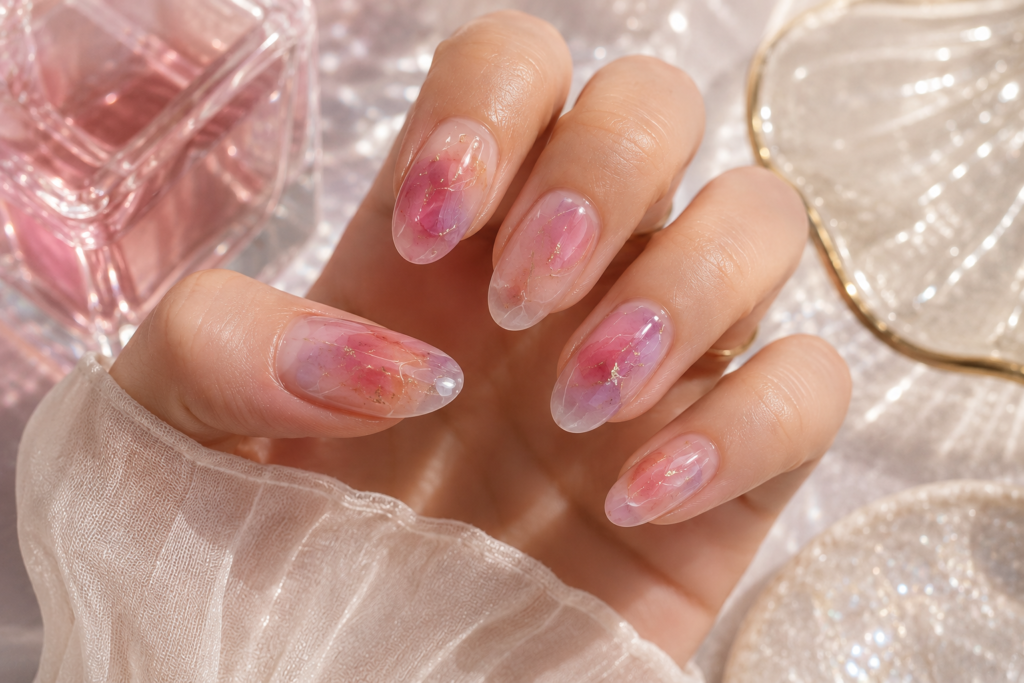
The first photo I saved of this trend sat in my camera roll for weeks before I realised it was actually a nail design and not a product shot. It looked like a close-up of a piece of sea glass — translucent, with colour floating somewhere inside it rather than sitting on the surface.
The base is a translucent jelly gel in a neutral or lightly tinted shade. Over this, thin washes of nail ink or diluted gel colour are swept across the surface in loose, uneven strokes. The colour appears to be inside the nail rather than on top of it — which is literally what’s happening once the topcoat goes down.
Jin Soon Choi — a New York-based celebrity manicurist and founder of the JINsoon nail lacquer line — spoke to Byrdie specifically about this look as one of the defining 2026 Korean nail trends. Her description: “minimalist yet elegant,” with thin strokes and small speckles of polish keeping the design subtle rather than graphic. San Sung Kim, a Seoul-trained nail artist whose work appears regularly in Korean editorial and has been credited in international trend coverage, also highlighted in the same feature that visible brushstrokes and soft wave patterns add movement without needing strong colour. The look was also visible across multiple collections at the 2026 Seoul Nail Expo, where syrup and watercolor gel finishes appeared alongside blush techniques as the dominant aesthetic direction from Korean nail brands.
How to do syrup watercolor nails at home
⚠️ The prep you can’t skip for any of these looks
All three of these trends depend on thin, precise gel application — which in turn depends on clean, oil-free, well-prepped nails. Translucent finishes are unforgiving: any lifting at the edges or bubbling in the layers is immediately visible. Dehydrate thoroughly, apply a primer if you’re prone to lifting, and work in thin coats. Five minutes of proper prep is worth more than any specific product.
Why These Korean Nail Trends Feel Different from Previous Ones
After trying all three looks, the biggest surprise was how different they felt during application. Blush nails are mostly about placement — where you put the pigment and how lightly you build it. Omakase is more about planning — getting the composition right before you start rather than improvising as you go. Syrup watercolor nails are all about patience: letting each thin layer cure fully before adding the next one.
Most nail trends I’ve covered are finish-driven. They ask you to buy a specific product — a chrome powder, a foil, a magnetic gel — and apply it. These three are different because the result depends on understanding why the technique works, not just following the steps. That’s part of why they hold up over time. Once you’ve understood how translucency and layering interact, you can carry that into whatever palette or style is trending six months from now.
There’s also something about how they photograph. When I shot blush nails next to a standard opaque pink gel in natural daylight, the blush set looked noticeably softer and more dimensional. The powder sits just beneath the topcoat rather than on top of it, and the camera picks that up. Same with syrup watercolor — the brushstroke layer has depth because the jelly base underneath is transparent. These aren’t flat-finish looks, and that shows.
Korean Nail Colour Palette for 2026
The trends above work because of the technique, but the colour choices matter too. Korean nail studios in 2026 are gravitating toward a specific set of shades — all of them translucent-friendly, most of them sitting in the soft, muted end of the spectrum rather than saturated brights.
8 Korean Nail Design Ideas for 2026
If you want to go beyond the individual techniques and see how these trends combine in practice, these are the specific looks worth saving as reference photos before your next session.
Korean Nails vs Japanese Nails: What’s the Difference?
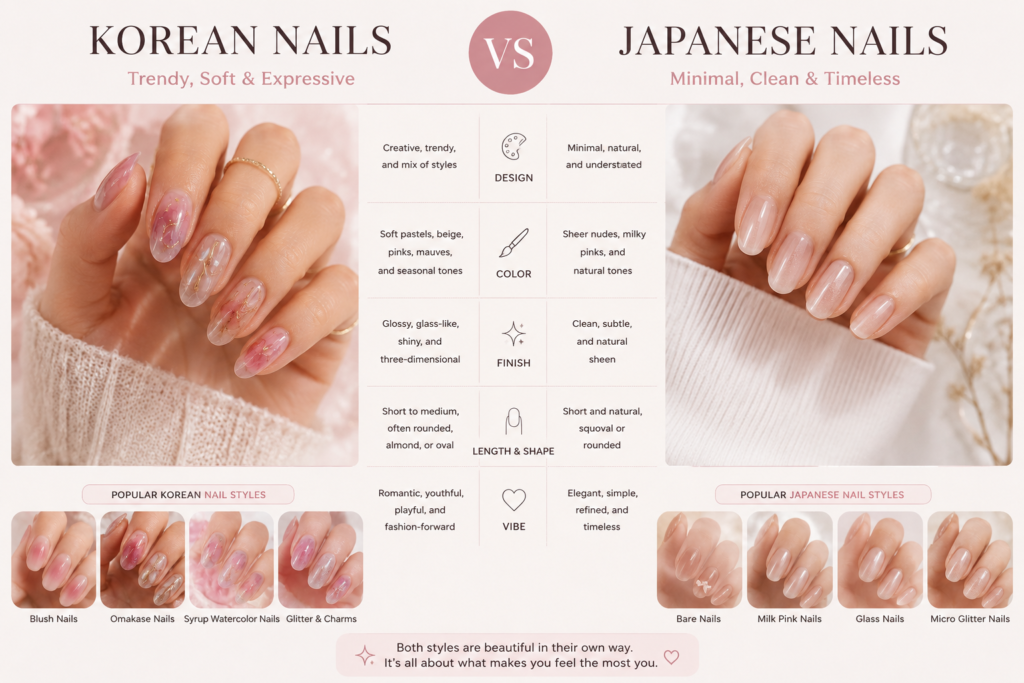
This comes up a lot, partly because some of the terminology overlaps — omakase is a Japanese word, syrup nails originated in Japan before becoming a Korean staple, and both countries share a strong nail culture with a similar emphasis on translucency and finish quality. But the two aesthetics are distinct once you know what to look for.
Japanese nail art (nail art in Japan is simply called ネイルアート, neiru aato) has historically leaned more maximalist and decorative. Gel sculpting with 3D flowers, miniature paintings, intricate hand-painted scenes across multiple nails — Japanese nail artists are known for treating the nail as a tiny canvas with its own narrative. The shapes tend to run longer, the embellishments more elaborate, and the colour stories more varied and sometimes unexpected.
Korean nail aesthetics sit closer to the K-beauty philosophy as a whole: restraint, luminosity, and the idea that the finish itself is the design. Where a Japanese set might have five nails telling five different visual stories, a Korean set typically has five nails with one shared sensibility expressed through slight variations in tone and finish. Blush nails, syrup watercolor, and the jelly-based looks that have dominated Korean studios in 2026 are all examples of this — the technique is visible, but quietly.
The overlap comes from cross-pollination. Syrup nails and jelly nails both have roots in Japanese nail culture from the early 2010s; Korean nail artists adopted and refined them with a more minimal application. Omakase as a concept comes from Japan, but the Korean version applies it differently — tighter tonal control, less visual maximalism per nail. The two aesthetics are in genuine conversation with each other, which is why some looks get attributed to both depending on who’s describing them.
What’s Coming After These Trends
While going through Korean salon accounts for this guide, two styles kept appearing in my saved folder that haven’t really shown up in Western trend roundups yet. One is douyin nails — a Chinese-origin aesthetic that’s started crossing into Korean studios, built around high-glitter layered jelly finishes with a slightly more maximalist energy than the looks above. The other is fruit peel nails: abstract designs that mimic the texture of fruit skin using thin, irregular brushstrokes over a jelly base. Think fig skin or peach fuzz — not literal fruit art, more like the suggestion of it. Both appeared in pre-season coverage from Korean nail industry accounts ahead of the 2026 Seoul Nail Expo, and Korean nail brands including Yogurt Nail Kr. have been releasing gel collections in this direction since late 2025.
Both sit in the same family as syrup watercolor nails, so if you get comfortable with jelly bases and thin colour washes, moving into either of those looks is a short step rather than a complete restart.
Which Korean Nail Trend Should You Try First?
If a friend asked me which one to try first this weekend, I’d say blush nails. The product list is short, the technique is learnable in a single session, and the result looks much more considered than the effort involved would suggest. Once the blush technique is solid, the layering logic for syrup watercolor nails clicks into place much more quickly.
The set I’d personally wear most often is syrup watercolor. It’s the one I kept going back to in my reference photos, and it’s the one that held up best across multiple wears. Omakase I’d save for when you’ve accumulated a few gel colours and feel ready to think about composition rather than just application.
Trend references: Byrdie (Korean Nail Art Trends 2026, expert quotes from Sarah Chue, Jin Soon Choi, and San Sung Kim), WhoWhatWear (K-Pop Nail Trends 2025, expert quote from Juan Alvear). Additional: Bustle K-Beauty Nail Trends 2026; Seoul Nail Expo 2026 trend reporting; Yogurt Nail Kr. (Korean nail brand, product coverage via Yahoo Beauty 2026).