
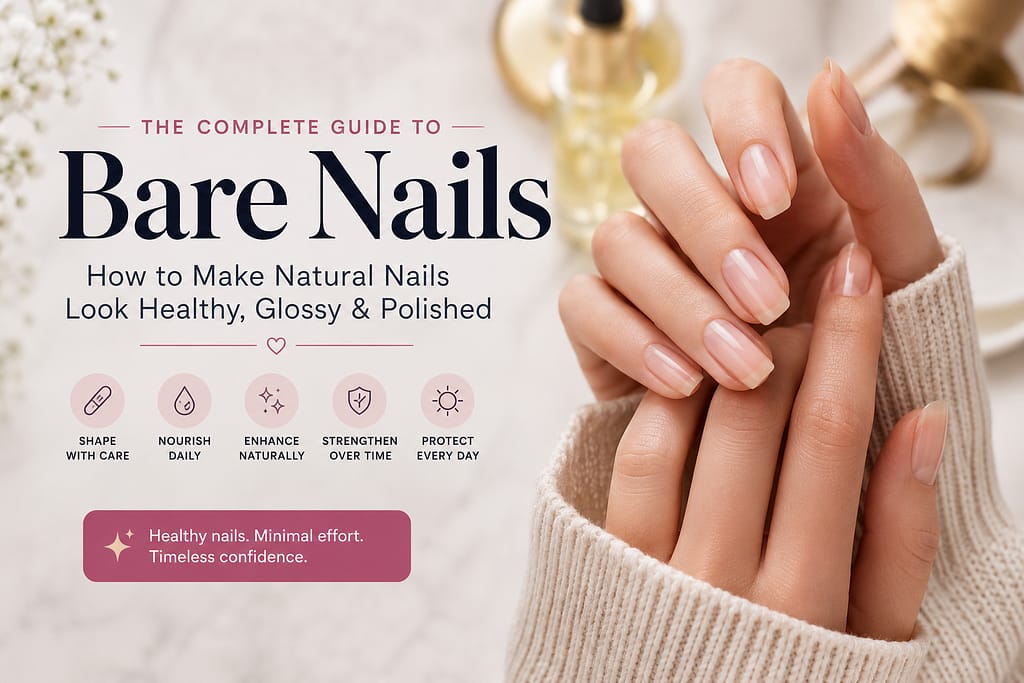
What Are Bare Nails — and Why Does Everyone Suddenly Want Them?
Bare nails refers to clean, polish-free natural nails that are shaped, buffed, and nourished to look their absolute best without any colour coating. The trend has grown steadily across clean beauty culture and celebrity style circles, driven by the “clean girl” aesthetic and a renewed interest in Japanese manicure techniques. The goal isn’t neglected nails — it’s deliberately groomed, luminous, healthy nails that look polished without a single drop of lacquer. If your nails are currently dry, ridged, or thin from years of gel or acrylics, this guide will walk you through exactly how to restore and maintain beautiful bare nails for the long term.
I’ll be honest: I resisted the bare nails movement for a long time. My fingers felt naked without at least a sheer pink on them, and I genuinely didn’t believe natural nails could look finished. Then I took a three-week polish break after a particularly brutal gel removal that left my nail plates looking like crumpled tissue paper — and everything changed.
What I discovered during that break, and have since dived deep into researching, is that bare nails done properly are one of the most sophisticated nail looks you can wear. They require discipline, the right tools, and an understanding of what your nails actually need to thrive. This guide covers all of it: the science behind nail health, the step-by-step routine, the best products, and the honest truths nobody tells you about going polish-free.
What Are Bare Nails? Understanding Your Nail Plate
Before you can care for your bare nails effectively, it helps to understand what you’re actually working with. The visible part of your nail — the bit you file and buff — is called the nail plate. According to the National Institutes of Health, 📖 NIH: Structure of the Nail (NCBI) the nail plate is primarily composed of keratin, a hard structural protein that gives nails their rigidity and strength. The plate sits on the nail bed, attaches at the matrix beneath your cuticle, and grows outward at a rate of roughly 3mm per month.
Keratin is, in fact, the same protein that makes up your hair and the outer layers of your skin. The American Academy of Dermatology’s nail care guidance — 💅 AAD: Dermatologist Tips for Healthy Nails — consistently emphasises that nail health reflects overall body health, and that maintaining the nail’s structural integrity starts with understanding what you’re caring for. In the nail specifically, keratin layers are densely compacted into three interlocked strata, which is what makes healthy nails feel smooth and resilient rather than brittle and layered.
Why does this matter for bare nails? Because when you understand that your nail is a protein structure — not dead, inert matter — you start treating it accordingly. Hydration, nutrition, gentle handling, and the right topical treatments all directly influence how your keratin behaves. Bare nails that look luminous and strong are, at the biological level, nails with well-maintained keratin integrity.
This guide is ideal for anyone transitioning off gel or acrylic extensions, trying a polish detox, embracing the clean girl aesthetic, or simply wanting to improve the underlying health of their nails before their next colour application.
Why the Bare Nails Trend Is More Than a Passing Aesthetic
The naked manicure isn’t new — Japanese manicures have championed buffed, polish-free nails for decades — but its current mainstream moment feels genuinely different. It’s arrived alongside a broader cultural shift toward intentional minimalism in beauty: fewer products, higher quality, more focus on the thing underneath. In nail terms, that means treating your actual nails rather than hiding them under layers of product.
There’s also a chemical conversation happening. As awareness grows about sensitising ingredients in traditional nail products, many people are actively choosing to spend more time with nothing on their nails. Whether that’s a permanent lifestyle shift or a periodic reset doesn’t really matter — the techniques for maintaining beautiful bare nails are the same either way.
Going bare between manicures isn’t just aesthetic — it’s strategic. Polish-free periods can help reduce brittleness and dryness, let you spot early signs of fungal infection or nail psoriasis that colour hides, and reset the nail surface for better adhesion when you do return to polish or gel.
The “clean girl” nail movement on social media has also democratised the look. You don’t need a salon appointment to have great bare nails. You need five minutes every other day and the right understanding of what your nails respond to.
The Bare Nail Care Routine: A Step-by-Step Guide
This is the core of the guide. I’ve structured it as a weekly and daily practice, because bare nails aren’t a one-and-done treatment — they’re a maintenance habit. Nail health, like skin health, compounds over time.
Use a glass or crystal file, not a metal or cheap emery board. File in one direction only — sawing back and forth creates micro-tears in the keratin layers that lead to splitting. Decide on your shape: oval and squoval are the most forgiving for bare nails because they reduce snag points at the corners. Aim for a consistent length across all ten fingers before moving on.
Soak your fingertips in warm water for 3–4 minutes to soften the skin, then use a rubber or wooden cuticle pusher to ease the cuticle back. Never cut living cuticle tissue — it’s your nail’s primary seal against bacteria and fungal infection. Apply a dedicated cuticle remover product if you have significant overgrowth, and always follow with cuticle oil immediately after.
This is what separates bare nails from simply neglected ones. A good three-way or four-way buffer will smooth out surface ridges, remove any residual dry skin from the nail surface, and create a literal shine on the nail plate without any product. Start with the coarsest side and work toward the finest. Don’t over-buff — once a week maximum, and only a few passes per nail or you’ll thin the plate over time.
Even without colour polish, a clear strengthening treatment adds a protective layer and feeds the nail plate with active ingredients. Look for formulas containing hydrolysed keratin, calcium, biotin, or panthenol. Apply on bare nails and layer without removing between applications across the week — this builds up a cumulative treatment effect.
This is non-negotiable for beautiful bare nails. Cuticle oil applied morning and evening to both the cuticle and the entire nail surface keeps the keratin layers hydrated, reduces brittleness, and creates that luminous, healthy glow that makes bare nails look intentional rather than unfinished. Jojoba, vitamin E, and argan oil are excellent carriers. Keep a bottle at your desk and one by your bed.
The condition of the skin around your nails is just as important as the nail plate itself for the bare nail look to work. Dry, peeling skin around the nail bed immediately undermines even the most perfectly buffed nails. Keep a rich hand cream by every sink — the application takes five seconds and makes an enormous difference to how your hands photograph and feel.
Before bed, apply a generous amount of cuticle oil to each nail and rub it in with your thumb. Then apply a heavy hand cream and sleep in thin cotton gloves if you can manage it. Two weeks of this ritual will transform the condition of even severely dehydrated nails.
The Best Products for Maintaining Beautiful Bare Nails
No specific brands are recommended here — the right product for you depends on your nail type, budget, and sensitivity. Instead, these are the three product categories that make the biggest difference, with guidance on exactly what to look for when you shop.
The single most impactful upgrade you can make to your bare nail routine is ditching your old emery board for a glass file. The difference isn’t subtle. Glass files seal the keratin layers as they cut, which means a dramatically reduced rate of peeling, splitting, and layering at the nail tip. I’ve been using one for three years and I cannot imagine going back.
The other advantage is longevity: a good glass file lasts years with proper care (rinse, dry, store in its sleeve). They’re also gentler enough to use in any direction, though one-direction filing remains best practice. Czech-made glass files are widely regarded as the best quality; look for ones with a medium grit — too fine and they take forever, too coarse and they’re hard to control for precise shaping.
One caveat: glass files are not indestructible. Drop one on a tile floor and it’s finished. But kept at home and used with care, a good glass file is genuinely one of those beauty purchases that pays for itself over and over.
If I could only recommend one product in this entire guide, it would be cuticle oil — applied consistently, twice a day, every day. The reason bare nails look dull or unfinished for most people isn’t because they’re unattractive; it’s because they’re dehydrated. Keratin, for all its toughness, needs moisture to remain flexible and reflective rather than matte and brittle.
The best cuticle oils use penetrating carrier oils that actually reach the nail bed rather than sitting on the surface. Jojoba oil is structurally the closest to the nail’s own sebum and absorbs exceptionally well. Sweet almond, argan, and vitamin E are excellent secondary ingredients. Avoid thick mineral oil-based formulas for daily use — they feel moisturising but mostly just coat the surface.
Roller balls and precision pens are worth the extra cost for everyday use: they make the 10-second application so frictionless that you’ll actually do it. I keep a pen form at my desk and a larger dropper bottle by my sink. This dual-location approach sounds fussy but completely removes the “I forgot” problem that kills most nail routines.
A clear nail strengthener occupies an interesting middle ground in the bare nail world — it’s technically a product on the nail, but an invisible one. Think of it as a scaffold while your keratin rebuilds. After gel or acrylic removal, the nail plate is almost always thinner and more porous than it should be; a strengthener provides a protective topcoat while the matrix regenerates healthier cells.
The best formulas combine hardening agents (like calcium or formaldehyde-free cross-linking polymers) with conditioning actives that penetrate the plate rather than just coating it. The layering approach — applying every two or three days without removing between applications — builds up a cumulative treatment. Just make sure you do a full removal once a week with an acetone-free remover so you’re not sealing in old product indefinitely.
Once your nails are back to full health, you can rotate between a strengthener and going completely bare product-free. Many people find they only need the strengthener in winter, when nails are more prone to dehydration from central heating and cold air, and can go fully uncoated in summer.
📊 Bare Nail Product Category Impact Score
Bare Nails vs. Other Minimalist Nail Options — Quick Comparison
| Option | Polish Used? | Nail Impact | Maintenance | Shine Level | Best For |
|---|---|---|---|---|---|
| Bare / Buffed Nails | None | Positive | Daily oil + weekly buff | Natural / medium | Detox, minimalists |
| Naked Manicure (clear/nude) | Yes (clear) | Neutral | Weekly reapplication | High gloss | Polished look, events |
| Japanese Manicure | No | Very positive | Monthly salon visit | High natural | Nail health focus |
| BIAB (Builder Gel) | Yes | Strengthening | 3–4 week infills | Very high | Thin, weak nails |
| Clear Gel | Yes | Neutral to negative | 2–3 week removal | Very high | Durability seekers |
If your nails show significant white spots, pitting, separation from the nail bed, or unusual thickening, do not simply start a bare nail routine and hope for the best. These can be signs of nail psoriasis, fungal infection, or nutritional deficiencies that require professional diagnosis. A bare nail period is an ideal time to inspect your nails closely — if anything looks unusual, consult a dermatologist before adding any treatments.
Feeding Your Bare Nails from the Inside Out
External products can only do so much. The cells that become your nail plate are formed in the nail matrix, and they’re built from whatever nutrients your body has available. If you’re chronically deficient in certain vitamins and minerals, your nails will show it — and no amount of cuticle oil will fully compensate.
The nutrients most directly linked to nail quality are: biotin (vitamin B7), which supports keratin infrastructure; zinc, which plays a role in protein synthesis and cell division in the nail matrix; iron, where deficiency often shows up as spoon-shaped or ridged nails; and silica, which contributes to the density of the keratin matrix. Amino acids — particularly cysteine, methionine, and proline — are the literal building blocks of keratin and are found in eggs, meat, legumes, and nuts.
Biotin (vitamin B7) supplements are heavily marketed for nail and hair health, and there is some evidence supporting their use in people with genuine biotin deficiency. However, high-dose biotin supplementation can interfere with thyroid function blood tests and troponin assays used to diagnose heart attacks. Always inform your GP if you’re taking biotin supplements and never assume more is better.
Hydration matters too — and it’s the most underrated factor in nail health. Chronically dehydrated nails become brittle, peel at the tips, and develop horizontal ridges. Drinking adequate water is, unglamourously, one of the most effective things you can do for beautiful bare nails.
Common Bare Nail Problems — and How to Fix Them
Peeling and Layering at the Nail Tip
This is usually caused by one of three things: over-filing (especially with a rough emery board), dehydration, or chemical exposure from cleaning products without gloves. Switch to a glass file immediately. Add cuticle oil to the nail tip twice daily in addition to the cuticle itself. And wear rubber gloves for any prolonged water or chemical contact — hot water is particularly damaging because it expands and contracts the keratin layers repeatedly.
Horizontal Ridges (Beau’s Lines)
Horizontal ridges that span the full width of the nail are often caused by a temporary disruption to nail growth — illness, high stress, or nutritional disruption. They’re essentially a record of a period when your nail matrix wasn’t growing optimally. They grow out on their own over several months. Gentle buffing can minimise their appearance in the interim; a ridge-filling treatment applied under any strengthener smooths the surface visually.
Vertical Ridges
Fine vertical ridges running from cuticle to tip are extremely common and often increase with age. They’re largely caused by decreased moisture retention in the nail plate as we age, and by slight irregularities in the nail matrix. Regular buffing (not over-buffing), daily oil, and a ridge-filling base coat will manage them well. They’re not a health concern in most cases.
Using your nails as tools (opening cans, scraping labels), picking at gel or acrylic that’s lifting, soaking in hot baths without protecting nails with oil first, and using acetone-based removers too frequently are the fastest routes to damaged bare nails. None of them are occasional slip-ups — they all become bad habits that systematically thin and weaken your nail plate over months.
Yellow Staining After Polish Removal
Yellowing after dark or red polish removal is nearly always staining rather than a health issue. A gentle buff will often resolve surface staining completely. For deeper discolouration, a diluted lemon juice soak (5 minutes) followed by intensive moisturising can lift staining naturally. If yellowness persists without a history of dark polish use, it’s worth having a fungal infection ruled out.
Final Verdict — Bare Nail Routine at a Glance
Bare nails are one of those beauty choices that reward patience and consistency in a way that instant-gratification treatments never quite do. The first week might feel underwhelming. By week six, if you’ve been religious with your oil and gentle with your files, you’ll have nails that genuinely look better unpolished than they ever did under gel. That’s the goal — and it’s absolutely achievable.
Frequently Asked Questions About Bare Nails
Yes — in many ways, bare nails are the healthiest option for the nail plate. Without any polish or coating, the surface is free from chemical exposure and easier to monitor for early signs of problems such as discolouration, pitting, or separation. That said, “bare” doesn’t mean “no care”: bare nails still need regular shaping, cuticle oil, and hand moisture to stay strong. Neglected bare nails will be just as brittle and fragile as nails damaged by overuse of gel products.
The key is in the preparation: shape consistently with a glass file, use a three-way buffer to smooth ridges and create a natural sheen, apply cuticle oil and push back cuticles gently, and finish with a rich hand cream to nourish the skin around the nail. Well-buffed nails with a healthy natural shine and neat, uniform length genuinely look finished and intentional — the goal is a “your nails but better” effect rather than bare skin.
This is one of the most persistent nail myths. Nails do not get oxygen from the air — they receive their oxygen and nutrients from the bloodstream, through the nail bed beneath the plate. The concept of nails “breathing” between gel manicures is not scientifically accurate. However, taking a break between gel sets is still worthwhile for other reasons: it allows you to assess the condition of the nail plate, address any damage from the removal process, apply rehydrating treatments, and reduce cumulative chemical exposure — all genuinely valuable even if the breathing metaphor is technically wrong.
Once a week is the recommended maximum, and less is often better. Every time you buff, you remove a very thin layer of the nail plate surface. Over-buffing — or buffing too aggressively — can thin the nail plate over time, making nails more prone to bending, peeling, and breaking. Use a fine-grit buffer for surface shine rather than a coarse one, and make only a few light passes per nail. If your nails already feel thin or flexible, skip the buffer for a few weeks and focus on strengthening treatments instead.
For bare nails in particular, cuticle oil is as close to non-negotiable as nail care gets. Without any top coat or polish to seal the surface, bare nails are more directly exposed to environmental drying factors — central heating, frequent hand washing, cold air, cleaning chemicals. Cuticle oil applied twice daily helps counteract this by maintaining flexibility in the keratin layers and reducing the brittleness that leads to peeling and breaking. It also dramatically improves the visual appearance of bare nails, giving them the healthy, luminous look that separates a groomed bare nail from an unfinished one.
Most people notice a visible improvement in surface texture and hydration within two to three weeks of consistent care — the cuticle area typically responds fastest. For more significant concerns like peeling, layering, or thinness from gel damage, expect four to eight weeks before you see meaningful improvement. This is because the nail grows roughly 3mm per month, meaning newly formed healthy cells take time to reach the visible free edge. Patience is built into the process — but the results are cumulative and lasting if you keep up the routine.