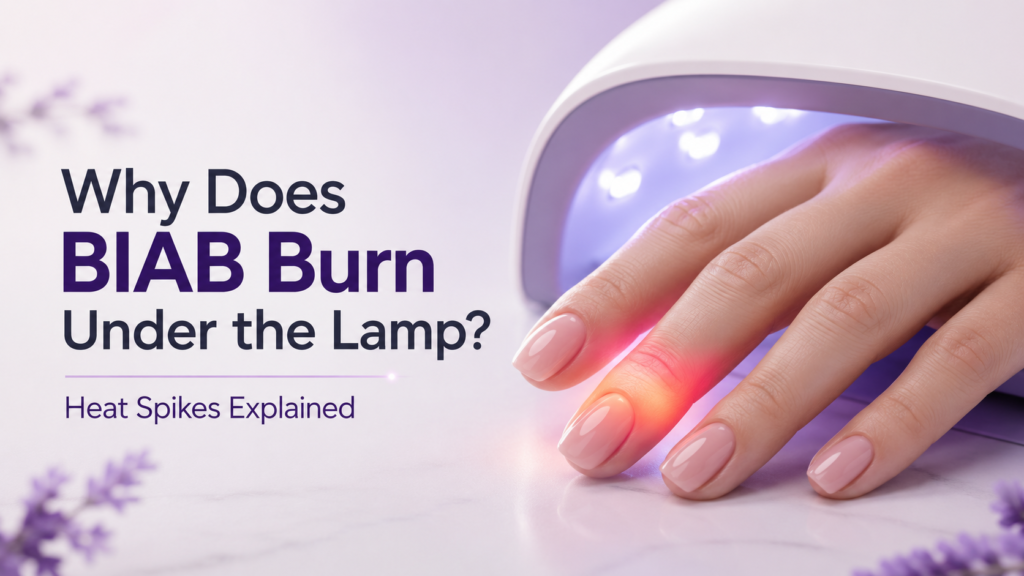
Why does BIAB burn under the lamp? That sudden hot flash in your fingertips during curing has a name — a heat spike — and it isn’t a sign that you’re “just sensitive.” It has specific, fixable causes, and none of them require you to give up builder gel.
Heat spikes are a commonly reported problem during BIAB curing. They are sometimes dismissed as normal sensitivity, although the cause is usually related to application thickness, curing conditions, or the condition of the natural nail plate.
BIAB burns under the lamp because curing is an exothermic chemical reaction — the gel releases heat as it hardens. The thicker the layer, the more heat is released at once. The most common causes are applying BIAB too thickly, curing too fast or with an incompatible lamp, and a thin or over-filed nail plate. All three are preventable.
What Is a Heat Spike?
When BIAB cures under a UV or LED lamp, the small liquid molecules in the gel (monomers) link together into long, solid chains (polymers). That’s what turns a gooey layer into a hard, glossy overlay.
This reaction releases energy — heat — as a by-product. Every gel product does it to some degree. With a whisper-thin layer of regular gel polish, the heat is so mild most people never notice it.
BIAB behaves differently because it’s a builder gel: it goes on thicker and contains a denser concentration of reactive ingredients than standard gel polish. More reacting material in one spot means more heat released in a shorter window. When that heat outpaces what your nail can absorb, you feel it — anywhere from a brief warmth to a burning sensation that makes you pull your hand out.
The lamps themselves are not the problem. The FDA’s overview of nail care products covers how gel systems and curing lamps are regulated in the US, and curing lamps are considered low risk when used as directed. The heat you feel comes from the chemistry inside the gel, not from the light itself. That’s good news, because it means the fix is controlling how much reaction happens at once — not avoiding lamps.
The 5 Reasons Your BIAB Burns
1. The gel was applied too thick
This is the number one cause. BIAB is self-levelling and pleasant to work with, so it’s tempting to build the whole structure in one generous coat. A thick layer means a large volume of gel curing simultaneously — and all of that heat reaches your nail at the same moment.
The professional approach is to build in thin, controlled layers, curing each one before adding the next. Same final thickness, same strength, a fraction of the heat per cure. If your technician applies one heavy coat and you consistently experience burning, the application technique may be the cause.
Thick application causes other issues too. It’s one of the most common builder gel application mistakes, and it’s often the hidden reason a set that burned during application also lifts within two weeks: product that’s too thick can cure incompletely at its base, which undermines adhesion.
2. The lamp is curing too fast for the product
Faster curing means the same amount of heat compressed into a shorter burst. Some modern lamps cure gel in 30 seconds, which is efficient for a salon but rough on heat control.
Wattage alone doesn’t determine how aggressively a lamp cures, though. Wavelength, light intensity, LED placement, and how well the lamp matches the gel’s photoinitiators all matter. Gel formulas are tested around specific lamps, and a random lamp-and-gel pairing can push the cure faster — or slower — than the formula was designed for.
Where possible, use the lamp recommended by the gel manufacturer. A low-heat or gradual-curing mode can also help spread the reaction over a longer period and reduce the intensity of the heat spike.
3. The nail plate is thin or over-filed
Heat sensitivity varies from person to person. One important factor is the thickness and condition of the natural nail plate.
A healthy plate sits between the curing gel and the sensitive nail bed underneath, and its thickness affects how much of the heat you actually feel. If the plate has been thinned — by aggressive filing, rough gel removal, back-to-back sets with no recovery, or picking off old product — more of that heat reaches the nerve-rich tissue below.
This is why heat spikes often show up after a bad removal. If you’ve been peeling or filing off product at home, your next set may burn even though nothing else changed. Learning to remove BIAB at home safely — or leaving it to a professional — helps preserve the thickness of the natural nail plate and may reduce sensitivity during future curing.
4. The first coat was too heavy
The first BIAB layer may feel hotter than later layers because it sits directly on the natural nail plate, with no cured gel underneath to buffer the heat. Once that layer is cured, it becomes part of the insulation for the layers above it.
A thin slip layer is commonly used as the first coat before the structural layers are applied. The exact method and curing time should follow the product manufacturer’s instructions. A heavy first coat makes a burn far more likely.
5. The formula and shade behave differently under light
Not all BIAB shades cure the same way. Highly pigmented formulas interact differently with curing light: depending on the formulation and the lamp, they may cure unevenly or need a specific curing time. “Speed cure” products marketed for quick services also compress the reaction into a shorter window.
If burning begins after changing to a different shade or formula, check the manufacturer’s curing instructions for that specific product rather than assuming every shade cures identically.
Heat Spike Causes at a Glance
| Cause | How to spot it | The fix |
|---|---|---|
| Too-thick application | Burning on most coats; gel looks bulky before curing | Thin layers, cured individually |
| Lamp/product mismatch or fast cure | Sharp burn within the first seconds of every cure | Low-heat mode; use the recommended lamp |
| Thin nail plate | Burns even with careful application; recent rough removal | Gentle prep, gentle removal, recovery time |
| Heavy first coat | Only the first coat burns badly | Sheer slip layer first, fully cured |
| Shade or formula change | Burning started when you changed product or color | Follow that product’s curing instructions |
What to Do Mid-Burn
Remove your hand from the lamp as soon as the heat becomes painful. Pain should not be ignored or treated as a normal part of curing.
- Pull your hand out the moment it burns. Don’t wait for it to peak. Repeated intense heat spikes should not be ignored — clinical sources link severe or repeated heat exposure during curing to onycholysis, where the nail plate separates from the nail bed.
- Let it settle for a few seconds. The reaction slows dramatically once you’re out of the light, and the heat dissipates fast.
- Go back in on low-heat mode. If your lamp has one, use it. The gel still needs its full cure — it just doesn’t need it all at once. If there’s no low-heat mode, follow your brand’s flash-curing protocol: short bursts under the lamp with brief pauses between.
- Regain the lost seconds. Undercured gel is soft, cloudy, and prone to lifting and sensitivity issues. Make sure the total cure time is completed, just in gentler installments.
- Tell your technician it burned. The technician should adjust the layer thickness, curing mode, or application method before continuing.
Undercured BIAB isn’t just weak — uncured material inside it can stay in contact with your skin and nail. The acrylate ingredients in gel systems are documented skin sensitizers, and a peer-reviewed review of nail product composition notes that allergic reactions to these ingredients have been reported since the 1950s. Acrylate sensitization may persist long term and can restrict which gel, adhesive, and cosmetic products you can safely use in the future.
How to Prevent Heat Spikes
At the salon
At a salon, pay attention to how the product is applied. BIAB should be placed in controlled layers rather than one unusually thick coat. If you see a single heavy application, it’s reasonable to raise it before curing begins.
Two questions worth asking before your appointment: “Do you apply BIAB in thin layers?” and “Does your lamp have a low-heat setting?” A trained technician should be able to explain the application method, lamp settings, and curing protocol used.
If you already have thin, damaged, or freshly recovered nails, say so upfront. A thoughtful tech will adjust — sheerer first coat, flash curing, maybe a different base approach entirely. Solid nail prep fundamentals matter here too: prep should refine the surface, never thin the plate.
At home
Apply a very thin slip layer first and cure it fully. Then build structure in two or three controlled layers according to your brand’s instructions, concentrating volume only where the apex needs it — never in one thick coat. Start each cure on low-heat mode if your lamp has one, or use the manufacturer’s flash-curing protocol. Total cure time stays the same; peak heat drops dramatically.
Buff lightly during prep — you only need to remove the shine from the nail surface, not thin it. A nail plate that bends easily or appears unusually thin may be more sensitive during curing. In that situation, avoid further aggressive filing and allow the natural nail to recover before applying another enhancement. Product choices support this: knowing the difference between a nail primer and a dehydrator helps you get adhesion without extra buffing.
Is the Burning Dangerous?
A brief, isolated warmth during curing is common and unlikely to cause lasting damage. The concern is repeated or severe heat spikes — the kind that make you flinch.
Intense heat delivered to the nail bed over and over can contribute to onycholysis. You’d notice a white or discolored patch spreading from the free edge where the plate has lifted from the bed. It usually resolves as the nail grows out, but that takes months, and the detached area is vulnerable to moisture and infection in the meantime.
Incomplete curing presents a separate concern. Reactive gel left in contact with the skin can increase the risk of acrylate sensitization. If you notice itching, redness, or lifting skin around the nail — not just heat — our guide to HEMA sensitivity and nail products covers what allergy warning signs look like and what to do next.
If every appointment burns regardless of tech, lamp, or product — or you’re seeing white patches under the nail after your sets — take a break from enhancements and let your nail plate recover. If there’s any visible skin reaction, see a doctor or dermatologist rather than self-diagnosing. Nothing in this article replaces medical advice.
Why Does BIAB Burn More Than Regular Gel Polish?
Regular gel polish goes on in very thin coats, so there isn’t enough reacting material per layer to generate noticeable heat. BIAB is a structural product — it builds strength and an apex, which requires volume, and volume means more monomers curing per second. Builder formulas are also denser in the reactive components that make them strong. Strength and heat come from the same chemistry.
If you’re still sorting out the vocabulary, start with what BIAB actually is — a soak-off builder gel applied from a bottle, sitting between gel polish and hard gel in both strength and thickness. And because a proper structure concentrates product at the stress zone of the nail, the apex area is often where the burn is felt most sharply. That’s not a flaw in the product; it’s a reason to build that volume gradually, as our guide to the nail apex explains.
Burning does not automatically mean that BIAB is damaging the natural nail or that the product is defective. Applied in thin, individually cured layers, BIAB generates barely any noticeable heat. The burn is a symptom of how it’s being applied — which is exactly why it’s fixable. If the finished overlay also cracks or feels unusually rigid, the causes overlap with the ones covered here; see our guides to builder gel cracking and builder gel that cures too hard.
Frequently Asked Questions
Keep Troubleshooting
The following guides cover related problems, including lifting, cracking, and gel sensitivity:
Anyone who feels burning during BIAB or builder gel curing — salon clients wondering if it’s normal, home users trying to fix their routine, and new techs who want clients to stop flinching in the lamp. If your issue is itching or skin reaction rather than heat, start with our HEMA sensitivity guide instead.
- U.S. Food & Drug Administration — Nail Care Products: regulation of gel nail systems, methacrylate monomers, and curing lamps.
- Peer-reviewed review (PMC/NIH) on nail product composition and (meth)acrylate sensitization, documenting allergy reports since the 1950s.
- Manufacturer curing and application instructions for the builder gel system you use — always the final authority on layer count, lamp pairing, and cure times.
This article is educational and reflects commonly taught professional technique. It is not medical advice. Persistent pain, skin reactions, or nail changes should be assessed by a qualified professional.