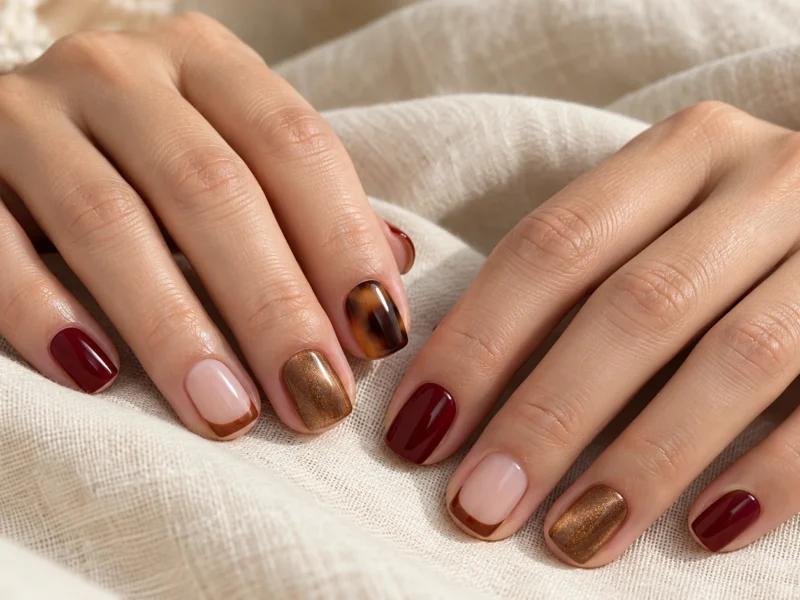
Quick answer: Thanksgiving designs built on colour carry into December far better than ones built on motifs. Cranberry jelly and tortoiseshell need little seasonal adjustment. A cinnamon French or an olive set can feel more festive with gold detail, while switching a painted motif or a magnetic colour takes more work. On short nails, keep detail thin, place it near the tip or the cuticle, and leave some of the nail plate open.
A turkey on your ring finger has a shelf life of about four days. Most people book one manicure for late November and hope it sees them into December, which means the design has to make sense on both sides of 1 December. This list skips the food drawings and looks at eight short-nail designs with one question in mind: if you want the set to feel more like December, how much has to change?
Three rules for short nails
Anything you put on a short nail reads larger than it would on a long extension, so a design that looks delicate on a stiletto can look crowded on your own nail plate.
Put detail at the ends. A line at the free edge or a curve at the cuticle leaves the centre open, and that open space makes the nail look longer. Dense, full-coverage patterns can make a short nail look crowded.
Watch line weight. A stripe that is a little too thick will take over a nail that is only a centimetre long. If you paint your own art, a long, thin liner does most of the work; our guide to the best nail art brushes for short nails compares sizes that hold a fine line.
Use one accent per hand, often the ring finger, and let the other nails carry a plain colour.
For the wider seasonal palette, see our autumn BIAB nails 2026 roundup.
1. Cinnamon micro French
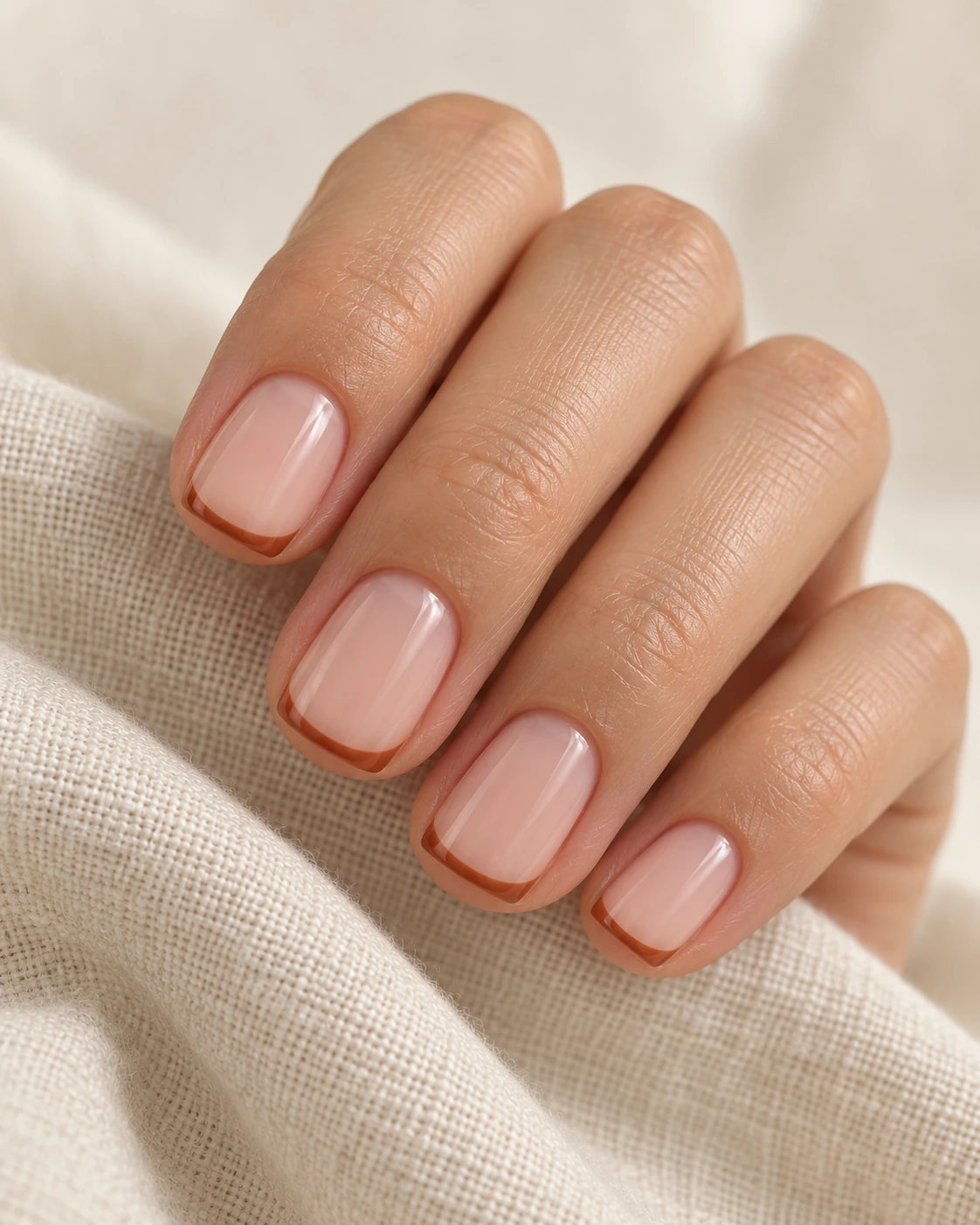
A micro French is a French tip cut down to a sliver along the free edge. There is no fixed size that suits every short nail; the shorter the visible nail bed, the slimmer the tip should be. Swap the usual white for a warm cinnamon or terracotta over a sheer pink or milky base.
Keep the smile line shallow. A deep curve takes up too much of a short plate and the tip starts to look like a band.
In December: it works as it is. For something more festive, a hairline of gold along the smile line can be added at your rebalance, or you can choose a brick or garnet tip from the start.
2. Cranberry jelly
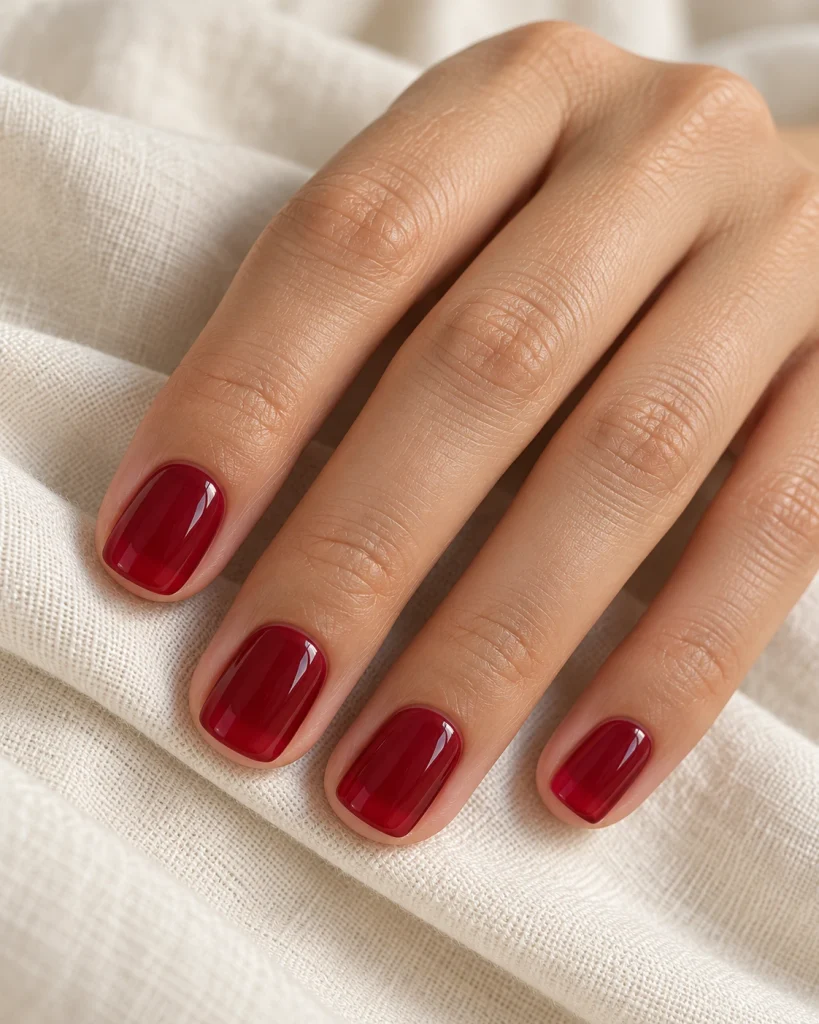
Jelly finishes are semi-sheer colour built up in layers, so light passes through and the nail looks glassy. How many coats you need depends on the product’s pigmentation; a thinly pigmented jelly may need several layers to reach a true cranberry, while a denser one gets there faster and turns almost black if you keep going.
Because you can see through the colour, the line where the free edge separates from the nail bed may show as a paler band near the tip. Some people like that depth. If it bothers you, build the colour a little more opaque or pick a cream instead.
In December: cranberry already fits the season. If you want sparkle, a shimmer topper can be added over two or three nails at a rebalance.
3. Tortoiseshell accent
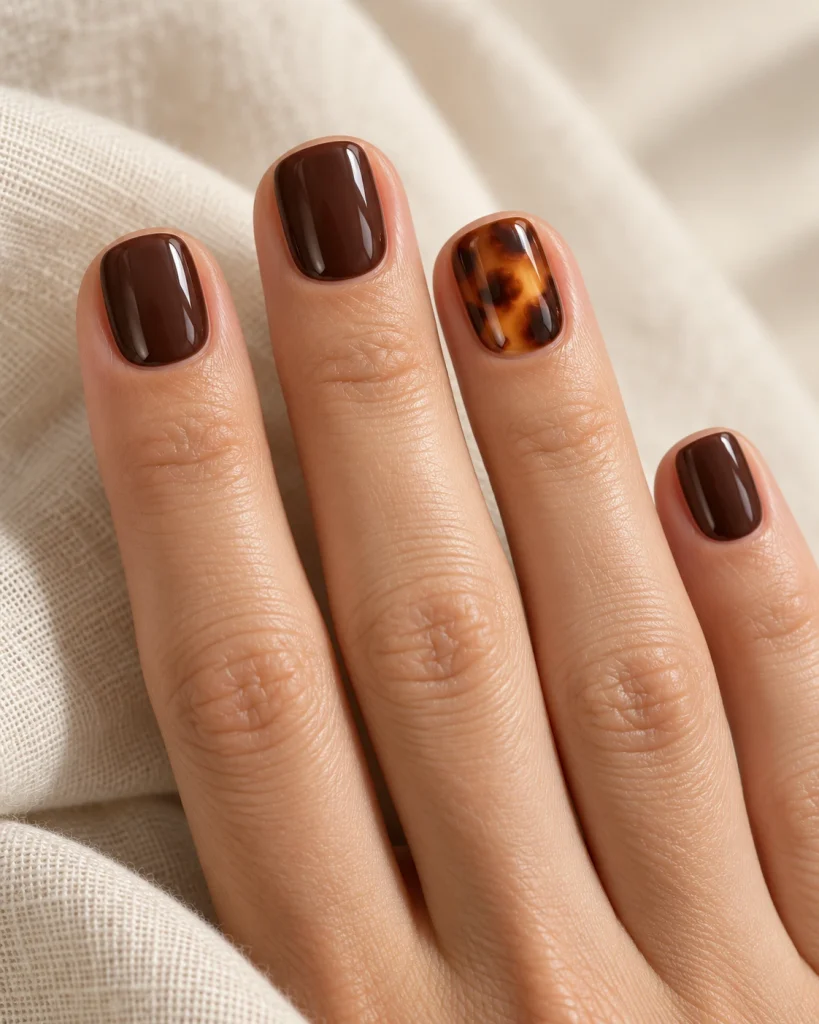
Tortoiseshell is built from translucent amber and brown blotches layered over each other, then sealed with gloss. The pattern is meant to be irregular, which makes it more forgiving than it looks. On short nails, one or two tortoise accents next to a plain espresso or nude is easier to wear than a full set.
Keep enough amber showing. If the brown patches cover most of the nail, the effect turns muddy and reads as a dark brown nail with spots.
In December: nothing in tortoiseshell is tied to November. Gold leaf can be added, but on a finished set that means your tech removing the shine from the accent nail, applying a fresh layer to hold the leaf, and sealing it, so treat it as a rebalance job rather than a quick add-on.
4. Ochre half moon
A half moon places the detail at the cuticle; you may also see similar cuticle-line designs called a reverse French. A small arc of mustard or ochre at the base, with deep brown or a sheer neutral over the rest, draws the eye toward the cuticle and makes the nail bed look longer. A lighter version leaves the moon bare and outlines it with a thin ochre line.
On very short or wide nail beds, a full coloured moon can look like a second, smaller nail. The outline version avoids that.
In December: the regrowth area is where the moon sits, so it can be redrawn during maintenance. That is a convenient point to switch the ochre for gold foil or chrome if you want to.
5. Flannel stripe accent
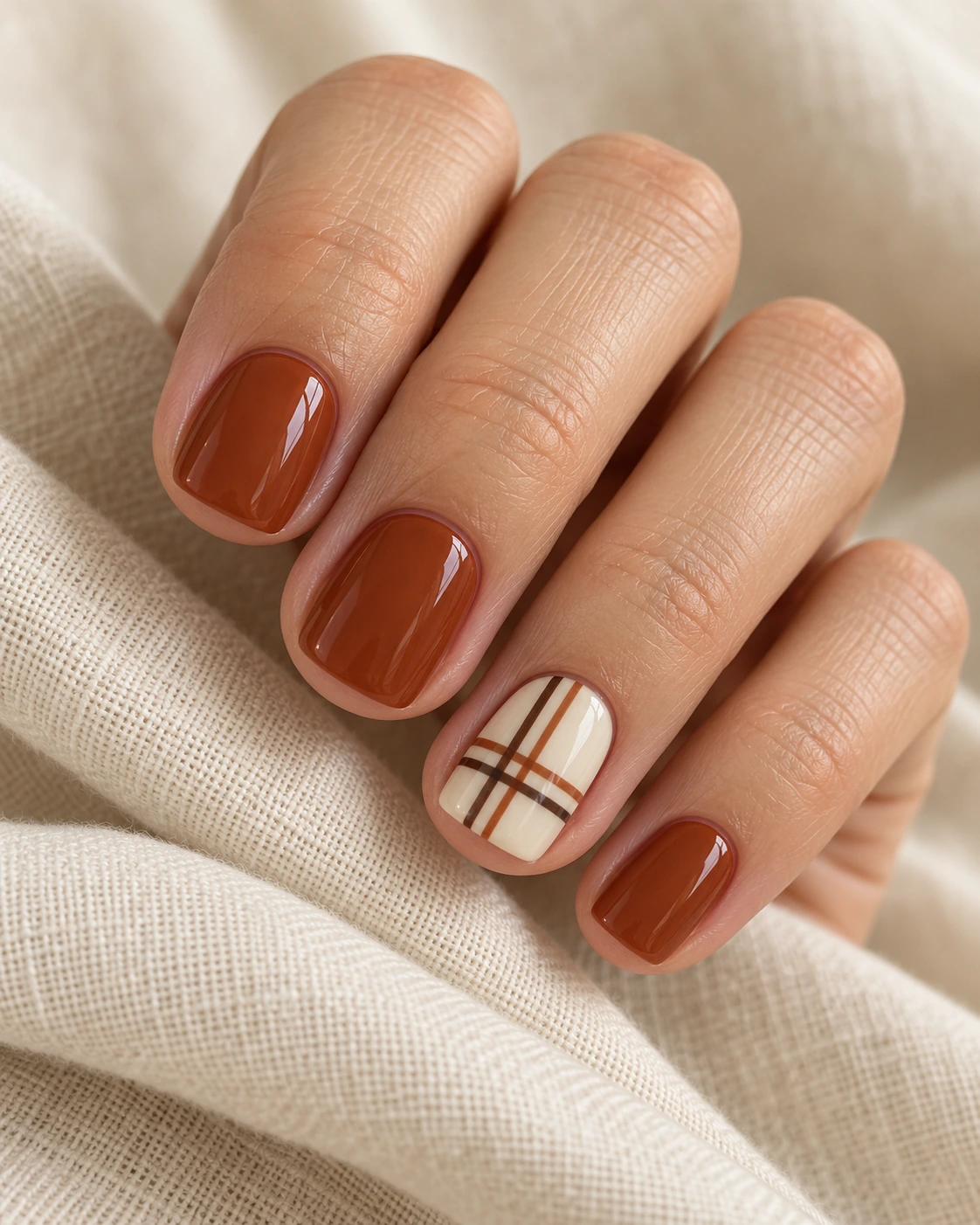
A simplified flannel, two crossing stripes each way in rust, cream and brown, reads as plaid without crowding a short nail. Full tartan with six colours and a dozen lines does not fit at this size. Keep it to one accent per hand.
On a nail this small, uneven spacing between stripes is easy to notice, which makes this the hardest design here to paint yourself.
In December: rust and cream flannel still suits cold weather. Changing the stripe colours later means repainting the accent, so if you want a more holiday look across both months, use red, forest green and cream stripes from the start and keep the surrounding nails brown. Next to the brown, the red and green look muted enough for late November.
6. Matte olive with a single line
A matte top coat over olive gives a soft, suede look. Add one thin line in gold or cream, across the centre or diagonally from a corner, on two nails.
Matte shows wear sooner than gloss. Daily contact at the free edge polishes the surface back toward a sheen, so the tips start to look shiny while the rest stays flat. That patchy finish is the main reason to choose something else if you are hoping for a long gap between appointments.
In December: matte olive can stay as it is. A gloss top coat at your rebalance changes the finish, not the colour, but olive under gloss looks richer and less autumnal than olive under matte. It also removes the shiny-tip problem. Your tech can turn the line into a tiny four-point star or add one small stud near the cuticle at the same time.
7. Milky nude with a hand-painted sprig
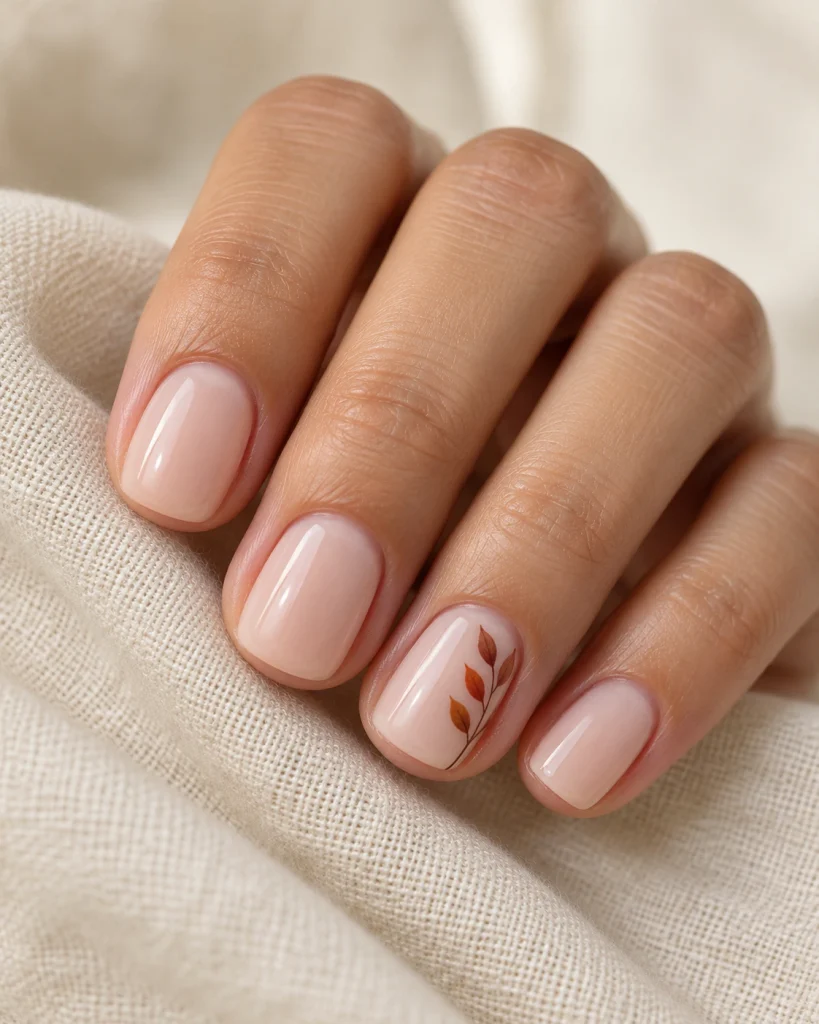
This is the only design on the list with a botanical motif. Paint a small sprig of wheat or a few leaves in brown and rust on a milky base, near one corner or along one side. On a short nail, keep it to about a third of the plate.
Each leaf is a single stroke: press down, then lift as you pull so the line tapers. If the leaves come out as blobs, a longer liner or less product on the brush is often worth trying.
In December: wheat in brown and rust looks distinctly autumnal. The same stroke in green, with two or three tiny red dots, becomes holly or a pine twig, but that means painting over the autumn sprig. Another option is to paint autumn sprigs on one hand and winter ones on the other, using the same base and placement. Whether you like that pairing is a matter of taste, so try it on a nail tip or paper first.
8. Caramel velvet
Velvet nails use magnetic gel with fine reflective particles. Instead of pulling the particles into one sharp line, the magnet is swept or angled so they spread across the nail as a soft shimmer; the result depends on the gel and the magnet used. Caramel or warm bronze suits autumn knitwear and hides small surface flaws well. On short nails, velvet often looks better than a single cat eye line, which can sit off-centre on a narrow plate.
In December: caramel can stay. It reads warm and golden, while champagne or soft silver velvet reads lighter and cooler, closer to frost and party lights. If you prefer the second look, choose it at the start: switching from caramel to silver generally means replacing the colour layer rather than adding a small accent.
All eight at a glance
| Design | Thanksgiving version | December option | Changing it later |
|---|---|---|---|
| Micro French | Cinnamon tip, sheer base | Gold hairline under the tip | Small addition at rebalance |
| Jelly | Cranberry | Same, shimmer optional | Little or none |
| Tortoiseshell | Amber and brown accent | Same, gold leaf optional | Little or none |
| Half moon | Ochre arc or outline | Metallic gold moon | Can be redrawn during maintenance |
| Flannel stripe | Rust, cream, brown | Red, green, cream | Repaint accent |
| Olive line | Matte with gold line | Gloss with star or stud | Small addition at rebalance |
| Sprig | Wheat or autumn leaves | Holly or pine sprig | Repaint sprig |
| Velvet | Caramel | Champagne or silver | New colour |
Planning your November and December appointments
Thanksgiving falls on the fourth Thursday of November. A set done the week before it will usually be ready for maintenance somewhere in the first half of December, which is also the most useful moment to change the design.
Rebalance, then decide
A rebalance, sometimes called an infill, fills the regrowth area and rebuilds the structure without removing all the product. Many people book one around two to three weeks after the original set, though how long yours lasts depends on your nail growth, your hands’ daily work and the product used. At that appointment you can keep the design, add one of the details above, or switch colour entirely.
Which designs hide regrowth
Nails grow from the cuticle, so the gap at the base is what dates a manicure. Designs with a sheer or nude area near the cuticle, such as the micro French, the sprig on a milky base and the outlined half moon, make that gap less obvious. Solid dark colours like cranberry and olive show it sooner.
Product choice
BIAB and builder gel add a structured layer that tends to resist flexing better than standard gel polish, which is why they are a common choice for longer wear on natural nails. If you are using gel polish alone, plan on an earlier appointment.
Free edge care
Short nails take most of their knocks at the tip. Capping the free edge during application, meaning running a thin layer of product along the very edge, gives that area extra protection. Gloves for cleaning help, and cuticle oil keeps the surrounding skin from drying out and catching.
For fully festive designs once this set comes off, see our Christmas BIAB nails 2026 collection.
FAQ
Can the December update be done at home?
It depends on what you add. Regular nail polish or a removable press-on detail can go over a gel set at home and comes off with polish remover, though remover can dull some top coats. A lasting gel update is different: adding gel on top of cured gel or BIAB means preparing the surface first, usually by removing the shine from the top coat, then using a product from a compatible system and curing it under the right lamp. Skipping the prep is a common reason for new layers peeling off. If your set was done in a salon, the safer route is to make the change at your rebalance.
Are French tips flattering on short nails?
A slim one is. Keep the tip slim in proportion to the visible nail bed and the smile line shallow. A thick, deeply curved tip makes short nails look shorter.
Related reading