This article contains affiliate links. As an Amazon Associate, we earn from qualifying purchases at no additional cost to you.
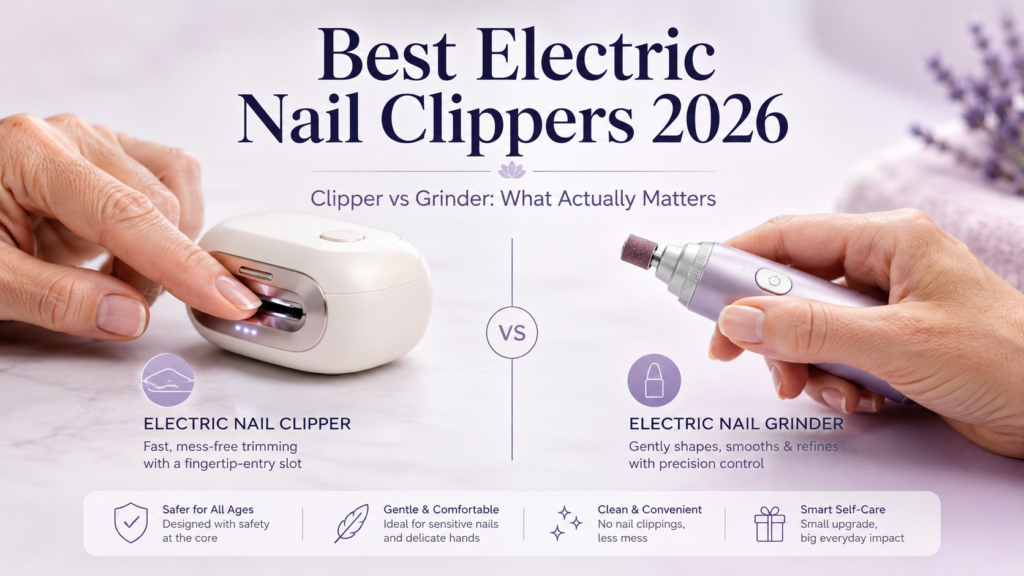
Here’s the single most useful thing to know before you spend anything in this category: most products sold as electric nail clippers are not clippers. They’re grinders. A little rotating sanding drum that files the nail down rather than cutting through it — a completely different tool, with a completely different result. The best electric nail clippers for someone with arthritic hands and the best device for thick, hardened toenails are often not the same product, and the listing titles won’t tell you which is which.
That confusion is worth taking seriously, because demand in this category is climbing fast. UK Google Trends data across the last three months shows searches for “electric nail clippers for seniors” up around 90%, and in the most recent one-week window that same term rose a further 60%. Meanwhile plain “toe nail clippers” fell roughly 40% over three months. People aren’t looking for a better manual clipper anymore. They’re looking for a way out of manual clippers entirely.
This guide compares six of the most visible options in that space. It’s a research comparison, not a hands-on test — the methodology section below sets out exactly what it’s built on, and what it can’t tell you.
This is a desk-based comparison, not a lab or hands-on review. It draws on manufacturer specifications and official product documentation, the mechanical differences between clipping and grinding tools, published pricing and consumable costs, use-case suitability, and UK Google Trends data for August 2026. Health and safety guidance is attributed to clinical sources rather than presented as personal opinion. Where a claim depends on individual nail condition, that’s stated plainly rather than smoothed over. Specifications and prices change frequently — always confirm current details on the retailer listing before buying.
🏆 Best Electric Nail Clippers 2026 — At a Glance
| Product | Mechanism | Power | Clipping catcher | Consumables | Best suited to |
|---|---|---|---|---|---|
| ClipDifferent Pro | True clipper — motorised blade | Rechargeable | Yes, sealed | None routine | Reduced grip strength, arthritis |
| ClipDifferent Lil’ Nipper | True clipper — narrow gate | Rechargeable | Yes, sealed | None routine | Infants and small nails |
| Beurer MP62 | Rotary grinder, multi-head | Mains powered | No | Replacement heads | Thick or ridged toenails |
| Amope Pedi Perfect | File, shape, buff heads | Battery / mains by model | Partial | Replacement heads | Shaping and finishing only |
| Bosidin Electric Nail Clipper | Rotary grinder, compact | USB rechargeable | Small chamber | Often non-replaceable | Fingernails, lower budgets |
| Zoomlie Electric Nail Trimmer | Rotary grinder, small head | USB rechargeable | Small chamber | Often non-replaceable | Travel and quick maintenance |
What Are the Best Electric Nail Clippers in 2026?
On mechanism alone, the ClipDifferent Pro is the strongest choice for anyone who has lost grip strength, because it’s one of very few devices in this category that genuinely cuts the nail with a motorised blade rather than grinding it — no squeezing force is required. For thick or hardened toenails, the Beurer MP62 is the better answer, since a rotary grinder removes material gradually where a blade may stall or split the nail.
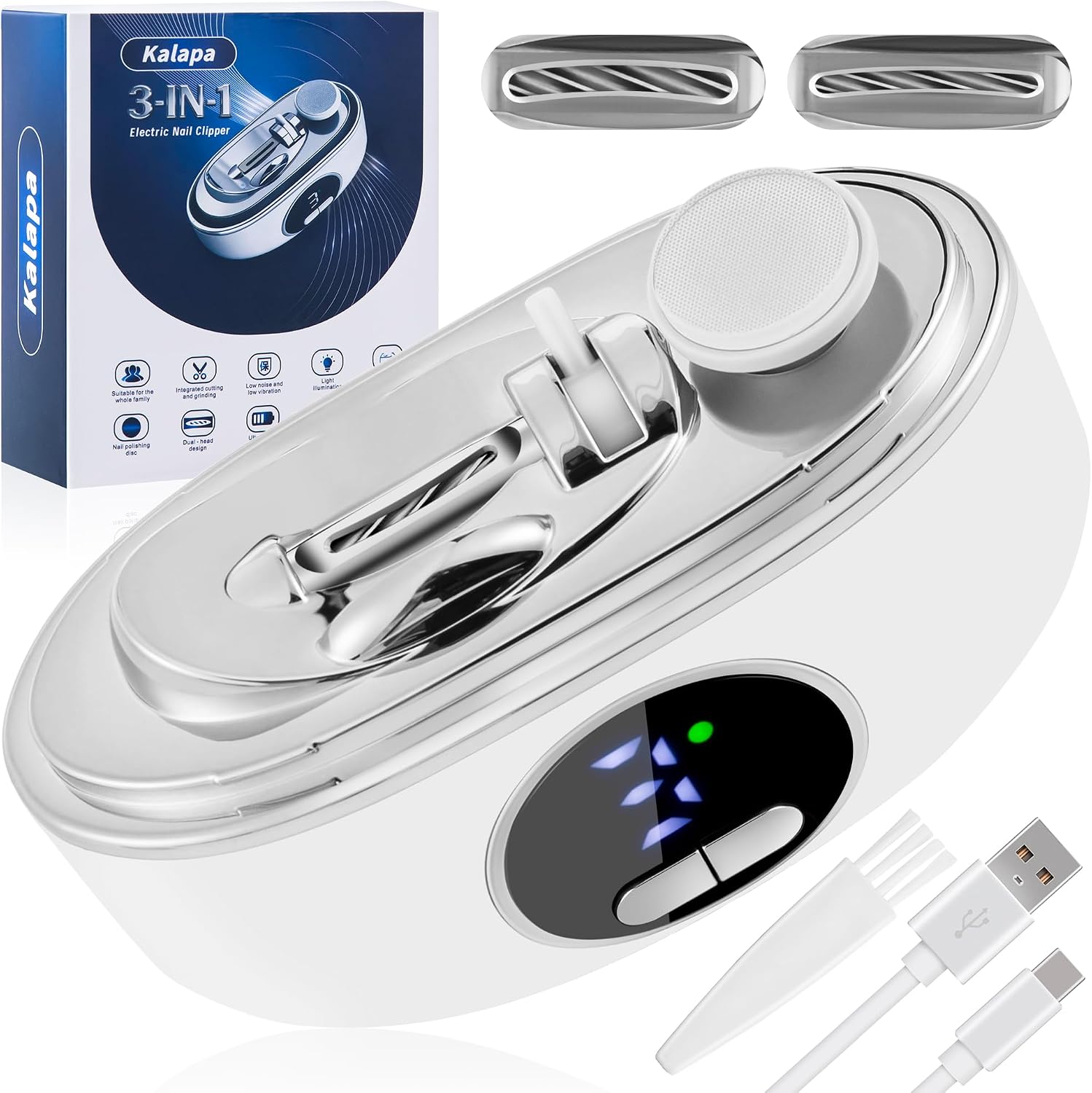
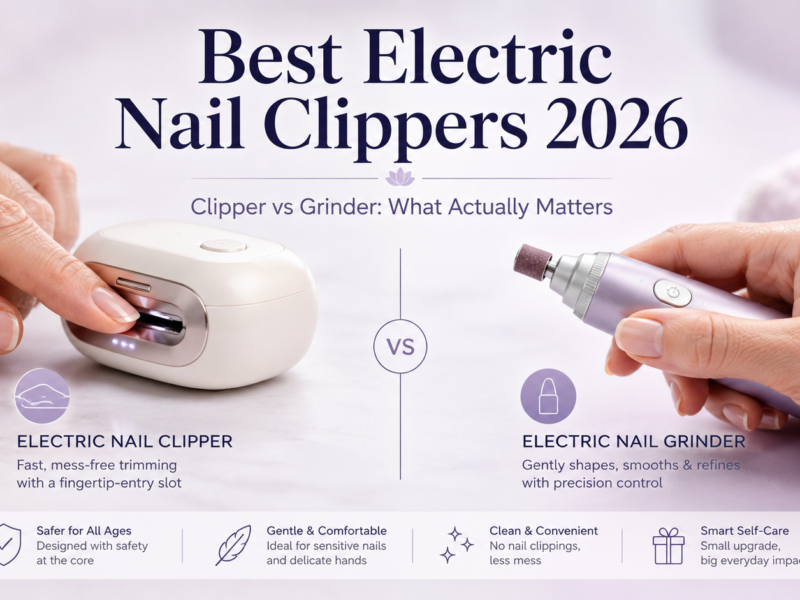
Search “electric nail clipper” and the majority of results are grinders. Sellers use the word “clipper” because that’s the phrase with the search volume behind it, not because the product clips. Before buying, ignore the title and look at the product photography: a visible rotating sanding drum means you’re buying a file. A slot you insert a fingertip into means you’re buying a cutter.
The 6 Options Compared
1. ClipDifferent Pro
A genuine clipper, not a grinder
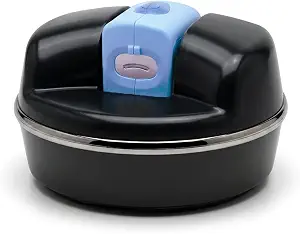
The Pro is built around an unusual idea: the user slides a fingertip into an opening, and a motorised stainless steel blade does the cutting. There’s no squeezing, no aiming, and no angle to judge. For someone whose pinch strength has gone — the same person who now struggles with jar lids and ring-pull cans — that removes the actual barrier rather than working around it.
The trade-offs are structural rather than about build quality. Because the blade takes a conservative, straight bite, you’ll typically feed a nail through more than once, and you can’t shape a curve with it. Thick toenails are the known weak point of any blade-based mechanism: the harder and deeper the nail, the more likely a motorised clipper stalls. Most households buying this for an older relative will still want a grinder for feet. It also sits at the top of the category on price, which is a real consideration when cheaper grinders start at a fifth of the cost.
The sealed catch chamber deserves more attention than it usually gets. Clippings collect inside the device instead of scattering, which stops mattering the moment you’re the one bending down to sweep them up — and starts mattering enormously if you aren’t.
2. ClipDifferent Lil’ Nipper
Same mechanism, infant scale
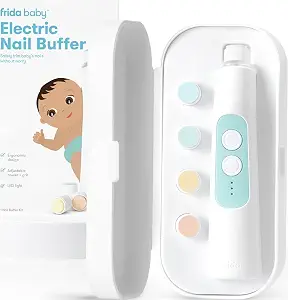
The Lil’ Nipper applies the Pro’s blade mechanism to a much smaller opening, sized for infant nails. The design intent is that the gate is narrow enough that the blade can’t reach fingertip skin, which addresses the specific anxiety that makes so many parents avoid the job altogether.
The honest limitation is the usable window. Children outgrow the opening — once nails widen past what the gate accepts, the device stops being useful. For a single child, that’s a premium price for a fairly short period of service. For a family expecting more than one, or for a nursery setting, the arithmetic changes considerably.
3. Beurer MP62
The serious grinder
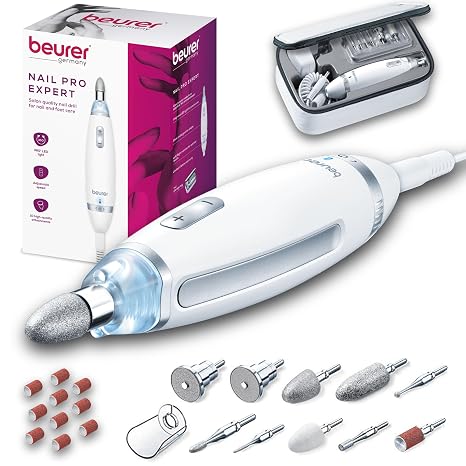
Beurer is a German health and wellbeing device manufacturer, and the MP62 sits closer to the medical-device end of this market than the general gadget end. The specification covers ten sapphire and felt attachments, variable speed, and a rotation direction switch — a feature that sounds trivial until you’re working on someone else’s feet, or working left-handed, and the drum keeps pulling the wrong way.
This is the mechanism for nails a blade genuinely can’t manage. Thickened, ridged or opaque toenails — common with age, and common in distance runners — resist clipping because the blade either can’t close or fractures the nail into shards. A grinder sidesteps the problem by reducing height gradually. That gradualness is also the cost: a full set of toes is a twenty-minute job, not a two-minute one.
Two things count against it. There’s no dust extraction, so nail powder goes wherever gravity takes it and you’ll want a towel underneath. And the sanding heads are consumables — budget for replacements, which Beurer sells as a separate set, because a device whose heads have gone dull is a device that’s stopped working regardless of how well the motor still runs. Worth noting too that the MP62 runs from the mains rather than a battery, so it needs a socket within reach of wherever the job actually gets done — relevant if that’s an armchair rather than a bathroom.
4. Amope Pedi Perfect Electronic Nail Care System
A finisher, not a cutter
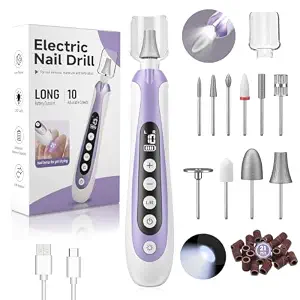
Amope’s nail system follows a three-stage logic: file, shape, then buff. The buffing stage is the interesting one — it produces a polished natural nail surface without varnish, which suits anyone who wants nails to look cared-for without acetone, drying time, or a salon appointment.
It cannot, however, take a long nail down to short in any sensible timeframe. That’s not a fault so much as a category boundary: this is finishing equipment. Positioned as the second half of the job, after a clipper or grinder has done the bulk removal, it makes sense. Positioned as a replacement for clippers, it will disappoint within the first use.
Softened nails and grinders don’t mix well. Nail plate that’s absorbed water tends to smear across a sanding surface rather than powdering off it, which clogs the head and slows the work. A blade-based clipper behaves the opposite way — softened nail cuts more cleanly and is less prone to splitting. So the standard “soak first” advice is correct for one of these mechanisms and counterproductive for the other.
5. Bosidin Electric Nail Clipper
The realistic budget entry
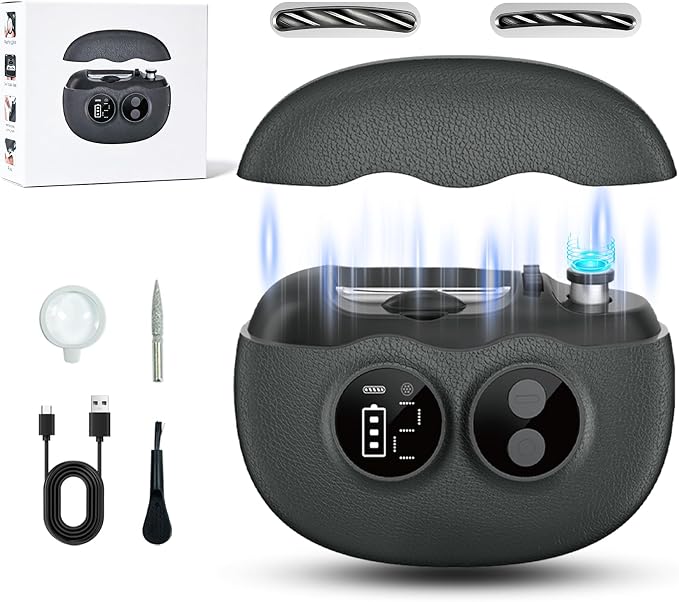
This is where most of the category’s actual sales volume sits, so it’s worth assessing on its own terms rather than against devices costing five times more. Bosidin’s unit is a compact USB-rechargeable grinder with an internal chamber that captures a portion of the dust, and it’s light enough not to fight an unsteady hand.
The constraint at this price point is torque. Small motors slow, then stall, under sustained load — which is exactly what a thick toenail applies. Fingernails and already-thin toenails are within its range; hardened toenails generally aren’t. The other thing to check before ordering is whether the sanding surfaces are replaceable, because on many units in this bracket they aren’t, which makes the device disposable once they dull. Judged as a two-to-three year purchase, that’s reasonable value. Judged as a permanent solution, it isn’t.
6. Zoomlie Electric Nail Trimmer
Narrow remit, small footprint
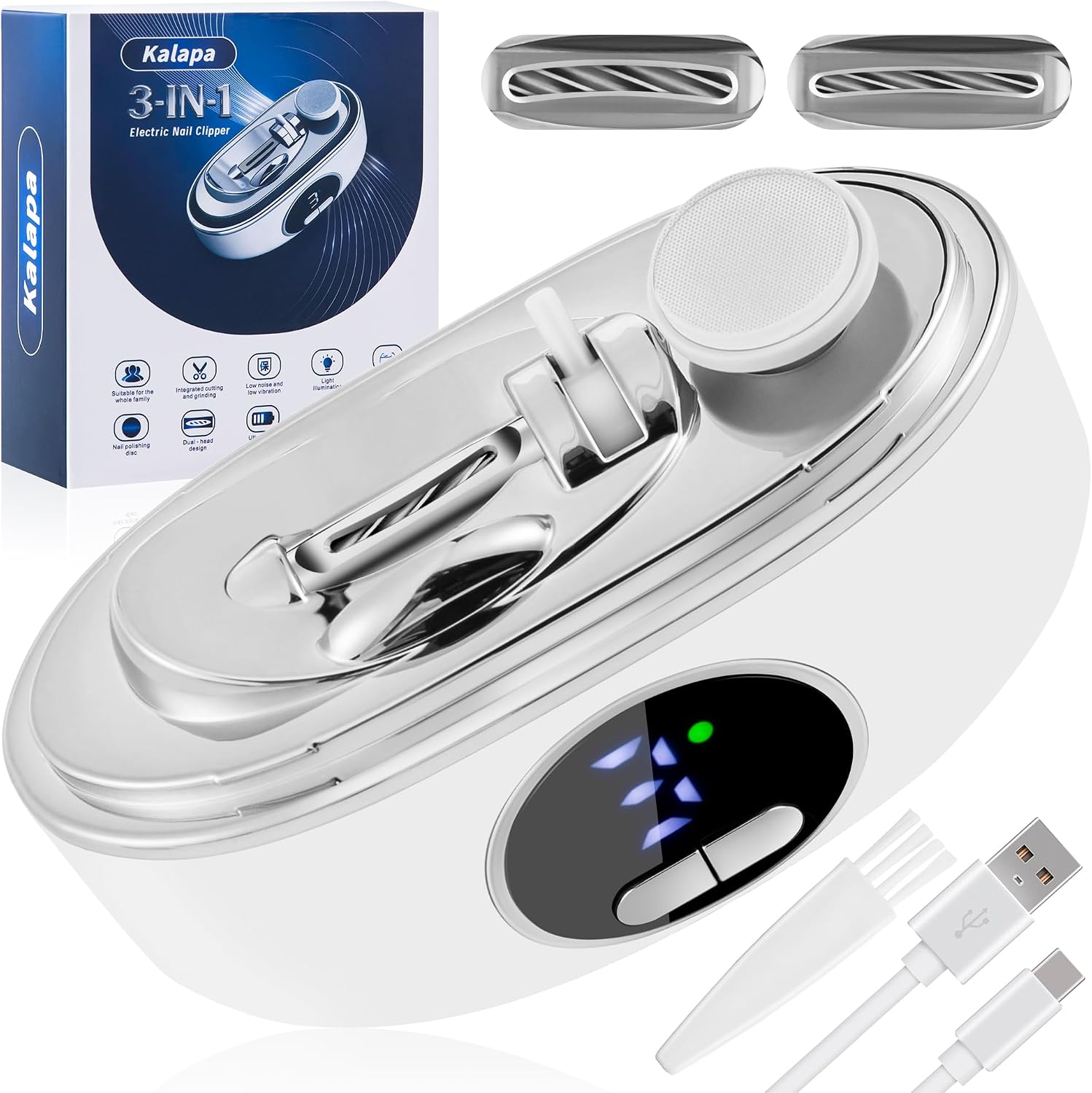
Roughly lipstick-sized, USB-charged, and quiet enough not to be intrusive. For fingernail maintenance between fuller sessions — or for a carer moving between visits who needs something that lives in a bag without shedding nail dust through it — that’s the entire specification and it’s adequately met.
Toenails are outside its scope. The motor isn’t sized for that load, and the small head means you’re working across a wide thumbnail in strips, which takes longer than the size suggests. Worth buying as a supplementary device, not a primary one.
Suitability scores by criterion
NHS diabetes footcare guidance is explicit that some people with diabetes should not cut their own toenails at all without podiatry advice, and that nails should be cut or filed following the curve of the toe rather than down the sides. NIDDK similarly advises trimming straight across, avoiding the corners, and smoothing with a file rather than cutting further. Where neuropathy has reduced sensation, an injury may not be felt at the time it happens. If diabetes, poor circulation or numbness is part of the picture, speak to a GP or podiatrist before using any electric device on the feet.
How to Choose: A Six-Point Buying Guide
- Clipper or grinder? Answer this before anything else. Clippers cut in one motion and suit reduced grip and fingernails. Grinders file gradually and suit thick, hard or irregular toenails. Buying across the wrong category is the most common cause of disappointment here — not build quality.
- How much grip strength is genuinely available? Be pessimistic. If opening a jar is difficult, anything requiring sustained squeezing is out — including some electric models that still need a button held firmly for the duration of a cut.
- Where do the clippings and dust go? Sealed catch chambers read as a gimmick until the person using the device can’t easily bend down to clear up. Grinder dust is finer and travels further than clippings; plan on a towel underneath regardless of what the packaging claims.
- Can it be operated one-handed? Frequently overlooked. After a stroke, or with arthritis affecting one side only, a device needing two hands solves nothing.
- What does year two cost? Grinding heads wear out. Cheap units often have non-replaceable surfaces. A £25 device rebought annually is worse value than a £70 one that lasts six years with £8 of heads.
- Does noise or vibration matter here? For someone with dementia, sensory sensitivity, or simply a low tolerance for buzzing near their hands, a quieter grinder beats a faster one — because it determines whether the device gets used at all.
Keep Reading
Splitting the job — one hand or one foot per sitting rather than all twenty nails at once — tends to work better for anyone with limited stamina or attention. It sounds inefficient. In practice it’s often the difference between a task that happens fortnightly and one that gets deferred for months because it feels like a project.
What the Search Data Shows
The Google Trends picture for the UK is unusually consistent across every timeframe examined. Over one week, one month and three months, “electric nail clippers for seniors” led the category each time. In the seven-day window it registered maximum relative interest with a 60% rise; over three months it was up around 90%. “Best electric nail clippers for seniors” appeared as a breakout term — growth steep enough that a percentage figure isn’t assigned.
Against that, “toe nail clippers” declined roughly 40% over the same three-month period. Read together, those two lines describe a category migrating rather than growing evenly. Demand isn’t shifting toward better manual tools; it’s shifting away from manual tools. Given that the people with the greatest need here are frequently the people least able to operate the traditional design, that’s a coherent pattern rather than a fashion.
Read the product photography, not the title. Listings in this category routinely describe grinders as “electric nail clippers” because that phrase carries the search volume. Look for a rotating drum (grinder) versus a slot the fingertip enters (clipper). A large share of one-star reviews in this space come from buyers who received a functional product from the wrong category.
Summary by Use Case
If the decision has to come down to one combination, the pairing that covers the widest range of need is a true clipper for hands plus an inexpensive grinder for feet. That’s a slightly annoying answer — two devices instead of one — but it follows directly from the mechanics. No single product in this category currently does both jobs well, and any listing suggesting otherwise is worth a second look at the photographs.
Are electric nail clippers safe for elderly hands?
For most people, yes — and often safer than manual clippers, since there’s no squeezing force, no exposed blade to control, and less need to see the cutting edge clearly. The significant exception is anyone with diabetes, neuropathy or poor circulation, who should follow clinical footcare guidance and seek podiatry advice first.
Do electric nail clippers work on thick toenails?
Blade-based clippers frequently struggle. A rotary grinder handles thickened nails better because it reduces material progressively rather than attempting to close a blade through the full depth at once.
How long do grinding heads last?
It depends on nail thickness and frequency of use, but replacement is a normal ongoing cost rather than a fault. Confirm that replacements are available for your chosen model before buying — several budget units don’t offer them.
Can these be used on gel or acrylic nails?
No. Removing gel or builder gel requires a proper e-file, the correct bit, and control over pressure and heat. Consumer grinders used on enhancements risk thinning and damaging the natural nail plate underneath.
Clipper or grinder — which should I buy first?
If the main difficulty is grip strength, buy the clipper. If the main difficulty is nail thickness, buy the grinder. If both apply, most people end up owning one of each.
Sources
Diabetes footcare guidance: NHS Diabetes My Way — Footcare Advice and Kent Community Health NHS Foundation Trust — Diabetes footcare advice. Nail trimming technique: NIDDK — Diabetes and Foot Problems. Search interest: Google Trends, United Kingdom, one-week, one-month and three-month windows to 15 August 2026.
This is a research-based comparison built on manufacturer specifications, published documentation and publicly available data. It is not a hands-on test, and no claim of personal use is made or implied. Specifications, pricing and availability change frequently — confirm current details on the retailer listing before purchasing. As an Amazon Associate, this site earns from qualifying purchases at no additional cost to you. Nothing here is medical advice; consult a GP or registered podiatrist for guidance specific to your circumstances.