This article contains affiliate links. As an Amazon Associate, we earn from qualifying purchases at no additional cost to you.
As an Amazon Associate, NailStyleLab earns from qualifying purchases. The picks below are based on published product information, not hands-on testing, and commission played no part in choosing them.
On a nail that ends a millimetre or two past the fingertip, a French edge has almost nowhere to go. Load a liner too heavily and the white line that looked delicate on the palette takes up more of the nail than you meant it to. A tiny daisy loses its shape when the brush puts down more colour than the petal has room for.
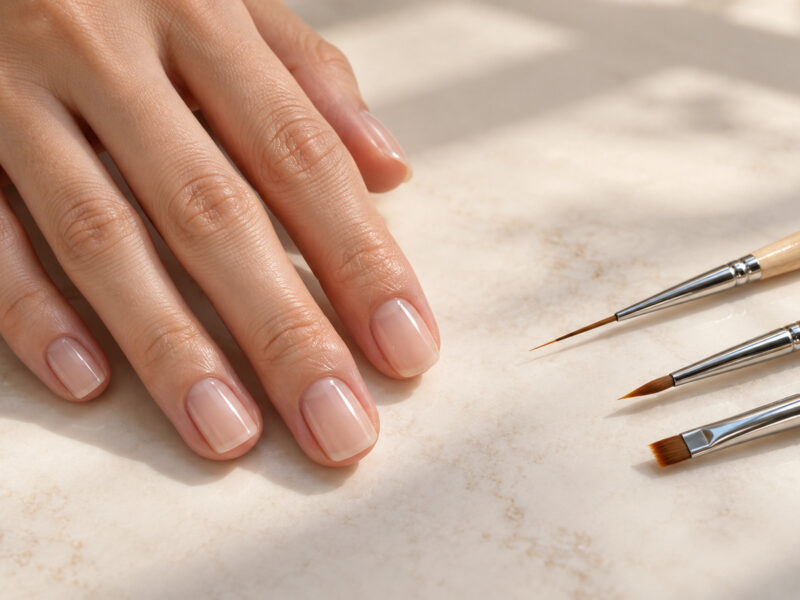
That is why the best nail art brushes for short nails are chosen by the mark you want to make, not by how many pieces come in the box. A slim French edge, a curved line and a small painted leaf each ask something different of the brush, and a bigger kit does not make any of them easier.
How these brushes were selected
This shortlist is deliberately short. Of the sets researched, only three had an identifiable Amazon.com listing and published enough detail, such as bristle lengths, tool types or fibre, to match them to a specific job. Sets that offered only a piece count were left out instead of padding the list.
No products were tested. A listed length describes the bristles, not the line they draw; tip shape, paint consistency and how much pressure you use all affect the result. The notes below explain what each set is built for. Prices and stock change, so check the selected variant before buying.
Three brush sets to consider
Makartt 3-Piece Liner Set: for French edges and straight lines
Listed bristle lengths: 7, 9 and 11 mm
This is the set to start with if linework is the whole plan. The three lengths cover the range most short-nail lines fall into. The 7 mm suits small strokes near the cuticle, the 9 mm carries enough paint for a curved French edge, and the 11 mm suits a straight line from base to tip. There are no application brushes to pay for and leave unused.
Its limit is at the fine end. There is nothing shorter than 7 mm, so if you want a very compact tip for tiny details, you will need another brush.
Beetles 5-Piece Liner Set: adds a 5 mm tip for tiny details
Listed bristle lengths: 5, 7, 9, 11 and 20 mm
The 5 mm brush is the reason to pick this set over the Makartt trio. A shorter tip holds a smaller amount of paint, which helps with small leaves, hearts and dots placed by hand on a narrow nail. The 7, 9 and 11 mm lengths are the same everyday range found in the three-piece set.
Beetles sells more than one five-piece set, and its own site lists a 7/11/15/20/25 mm version. Make sure the variant you select shows the 5–20 mm lengths. The 20 mm brush is useful for long sweeping strokes; on short nails, you may reach for it rarely.
MelodySusie 6-Piece Nail Art Set: when you need more than liners
Two liners, flat, angled, gel and carved brushes, dotting tool · nylon bristles (listing)
This kit covers what the two liner sets leave out. The angled and flat brushes clean up a French edge or a sidewall, and the dotting tool handles round accents. If your designs mix lines, dots and cleanup, one kit like this replaces several separate purchases.
The trade-off is the liners themselves. The listing does not give their lengths, and the gel and carved brushes are designed for working with product rather than for fine art. For French edges alone, a liner-only set is the more direct choice.
Choose the brush by the detail
Thin French edges and fine lines
A fine liner nail brush is a narrow bundle of bristles that tapers to a point. Shorter liners hold less paint and bend less, which makes compact strokes easier to control. Longer liners carry more paint, so a straight line can run its full length without breaking.
The shortest brush is not always the easiest. A very short tip can leave a French edge choppy if it runs dry halfway across. If the line comes out too heavy, reduce the paint on the brush and press more lightly before switching to a shorter length; that usually makes the bigger difference.
Tiny flowers, leaves and hearts
For small motifs, you want a nail detail brush that holds a small bead of paint you can press and lift into shape. On short nails, motifs should be smaller and fewer, so a compact tip helps. A liner can outline a petal, while a slightly fuller pointed brush fills it.
A dotting tool is not a brush: it is a rod with a ball end that places round marks of a consistent size, and it cannot draw a line. Our micro polka dot nails guide shows how far a short nail can go with dots alone.
Flat and angled brushes
Flat and angled brushes are for shaping and cleanup, not fine painting. A small one, dipped in the remover your product’s maker recommends and wiped nearly dry, can sharpen a French line before curing. Check the intended use first, though: a brush sold for gel application is often larger than the cleanup brush you have in mind.
A small starter selection
For thin lines and French edges, one liner set is enough to start. Add a dotting tool if your designs are built around dots. Buy a mixed kit only if you know you will use the flat and angled shapes; owning two near-identical liner packs adds little.
When you try a new brush, change one thing at a time on a practice tip. That way you can tell whether a better line came from the brush or from loading less paint.
If you would rather skip brushes for simple details, our guide to how nail art pens work explains what the different pens can and cannot do.
On BIAB or another builder-gel overlay, art brushes work over the finished, prepared surface. They are not meant for applying the builder layer itself.
Caring for fine brushes
Makartt’s guidance for its liners is a good baseline: rinse straight after use, clean with a nail brush cleaner, then wipe the bristles on a paper towel. Silcare likewise recommends a dedicated brush cleaner for its nylon art brushes.
Beyond that, follow the instructions for the medium you painted with. Gel paint, acrylic paint and regular polish clean up differently, so do not assume acetone suits every brush. Store fine liners capped or lying flat so the tip keeps its point.
Short-nail brush questions
What liner length should I choose for short nails?
A 7 to 9 mm liner is a practical starting range for French edges and straight lines. Add a 5 mm tip if you paint very small motifs. Remember that bristle length is not the same as line thickness.
Is a longer liner unsuitable for a short nail?
No. The bristles do not have to fit inside the nail. A longer liner touched lightly can still draw a fine line; it simply carries more paint and flexes more.
Can I use the same brush for gel and regular polish?
Only if the brush maker says it is compatible with both and gives a cleaning method for each. If you use both often, keeping separate brushes is simpler.