

Most people get about three to four weeks out of a BIAB set before it needs attention. That figure gets repeated so often it has started to sound like a rule, and it isn’t one. It’s an average drawn from average nails on average hands, and it tells you nothing about whether your particular set needs a straightforward infill, a proper rebalance, or taking off entirely so someone can look at the nail underneath.
The better question isn’t how many weeks have passed. It’s what the product is doing.
Most BIAB infills are needed every three to four weeks. Faster nail growth, longer nails, lifting or heavy hand use can mean you need an earlier appointment. If the existing BIAB is still firmly attached and structurally sound, an infill or rebalance may be enough; significant lifting, cracks, pain, discolouration or excessive thickness can make full removal the better option.
How Often Should BIAB Be Redone?
Three to four weeks is the window most salons work to, and for good reason. By week three the regrowth gap is usually visible, and by week four the balance of the nail has often shifted enough that the apex — the raised strongest point of the overlay — is sitting further forward than it should be. That’s the real reason for the timeline. It isn’t about the polish looking tired.
But the calendar is a prompt, not an instruction. If you notice a lifted edge at day twelve, that’s your appointment trigger. If you catch a nail on a car door and hear that dull crack, you don’t wait out the fortnight. Waiting is how a small repairable problem turns into a full removal.
Equally, some people are genuinely fine at four weeks and a bit. Short nails, a light-handed job, a technician who prepped the nail properly and kept the product thin — that set has fewer places to fail. BIAB is primarily used as a strengthening overlay on natural nails, although the exact uses and removal method depend on the product system. Applied well on a natural-length nail, it tends to age gracefully rather than dramatically.
Don’t wait for a fixed appointment date if you notice lifting, cracking, pain, discolouration or any sign of moisture beneath the product.
What Does “Redoing BIAB” Actually Mean?
People use “getting them redone” to cover three fairly different appointments, which is where a lot of confusion at the booking stage comes from.
BIAB Infill
The regrowth area at the base is prepped, the existing product is refined and thinned where needed, and fresh product is applied to fill the gap. The rest of the overlay stays put. It is usually a more straightforward appointment than full removal and reapplication, and it’s only appropriate when the existing product is properly attached and structurally sound.
BIAB Rebalance
A rebalance goes further. As the nail grows, the apex travels forward with it, which means the strongest part of the overlay is no longer sitting over the stress area. A rebalance corrects that — filing the structure back, repositioning the apex, redistributing weight. Long nails need this more urgently than short ones, and short nails often get away with something much closer to a simple infill.
Full BIAB Removal and Reapplication
Everything comes off, the natural nail is inspected, and a new set is applied if the nail is in good enough condition. It takes longer than an infill, but it also gives the technician a clear view of the natural nail before another application.
| Service | What happens | Usually chosen when |
|---|---|---|
| Infill | Regrowth is filled and the surface refined | Product is secure and structurally sound |
| Rebalance | Apex and structure are corrected | The nail has grown and weight distribution has shifted |
| Full removal | Existing product is taken off completely | There’s lifting, damage, product breakdown, or the natural nail needs inspecting |
How Often Should You Get BIAB Infills?
Most people get BIAB infills every three to four weeks. Around week three, the regrowth gap is usually obvious enough to justify maintenance, while by week four the growing nail may have started to move the apex and weight of the overlay further towards the free edge.
That doesn’t mean everyone should wait exactly three or four weeks. Fast-growing nails can need an infill closer to two or three weeks, particularly if the nails are long or the regrowth is beginning to affect the balance of the set. Short nails with secure, well-applied product may comfortably reach four weeks.
The condition of the existing BIAB matters more than the date. If the product is firmly attached and the main issue is normal regrowth, an infill may be all that’s needed. If the structure has shifted, a rebalance is more appropriate. Lifting, cracks, excessive thickness, pain or suspicious discolouration can mean the product should be removed rather than filled.
About 3–4 weeks is common, but your own nail growth and the condition of the existing product should decide when you book.
Signs You Need a BIAB Infill
The obvious one is the growth gap at the base. Dark colours give this away far sooner than nudes do — a deep burgundy set will look overdue at two and a half weeks while the same growth on a sheer pink barely registers. That’s cosmetic, not structural, and it’s worth knowing the difference so you’re not booking early for the wrong reason.
More useful signals: the nail starts to feel slightly top-heavy, the free edge has crept longer than you’d choose, or you catch yourself noticing your nails when you type. A well-balanced set is largely unnoticeable.
- The product is still firmly attached along every edge
- There are no cracks or lifted corners
- The nail feels comfortable with no sensitivity
- The natural nail underneath looks healthy
- The main issue is simply visible regrowth
How Often Should BIAB Be Completely Removed?
BIAB does not need to be completely removed at every appointment, and there is no universal number of weeks or infills after which full removal suddenly becomes necessary. If the existing product remains secure, thin enough to manage and structurally sound, it may be maintained with infills and rebalancing instead.
Full removal becomes more appropriate when the condition of the product or natural nail makes another infill a poor choice. The decision should be based on what is happening on the nail rather than following a fixed removal schedule.
Widespread Lifting
One tiny lifted corner can sometimes be filed back and repaired. Lifting across several nails, or lifting that’s travelled well down the nail plate, is a different matter. Filling over it seals the gap in — and gaps collect moisture. If you’re seeing this pattern repeatedly, it’s worth understanding why BIAB lifts in the first place, because the cause usually sits in prep or aftercare rather than the product.
Cracks Through the Structure
A crack running through the apex or stress area has compromised the whole overlay. Adding product on top doesn’t rejoin it. Cracking in builder gel often points to a set that’s too thin in the wrong place or too long for the natural nail supporting it.
Moisture or Discolouration Under the Product
Green, yellow or darkened patches, or anything that looks damp under the overlay, mean it comes off. Not later — that appointment.
Pain, Heat or Pressure
Discomfort under an overlay is never something to fill over. Persistent heat during application is a separate issue worth reading about if it happens to you, since the burning sensation under the lamp has its own causes.
Product Has Become Too Thick
Infill on infill on infill, and eventually you’ve got a set with visible bulk at the cuticle and a strange chunky profile from the side. Thickness makes the nail heavier, harder to file down safely, and more likely to lever off at the free edge.
The Natural Nail Needs Inspection
Even without an obvious problem, periodic removal may be useful when the product has been repeatedly infilled and the natural nail has not been fully inspected for several appointments.
Suspicious discolouration, trapped moisture, pain or damaged nail tissue should not be covered with another layer of BIAB. The product needs removing so the nail can be assessed properly.
How Many BIAB Infills Can You Have?
There’s no fixed number, and anyone quoting you one is quoting a habit rather than a fact. Some sets can be rebalanced several times before removal makes sense. Others need taking off after two, because the product has thickened or the client’s nails grow so quickly that structural correction stops being efficient.
What actually decides it: adhesion, thickness, the integrity of the structure, the product system in use, and the condition of the natural nail. A technician working with a thin, flexible system will make different calls from one using a stiffer builder gel.
There is no universal “three infills maximum” rule. The decision rests on adhesion, thickness, structure and the state of the natural nail.
BIAB Maintenance Timeline: When to Get an Infill
| Time after application | What you may notice | Recommended action |
|---|---|---|
| Week 1 | Minimal regrowth, full gloss | Normal aftercare |
| Week 2 | A small growth gap starts to show | Keep an eye on edges and free edge |
| Week 3 | Regrowth clearly visible; balance beginning to change | Typical BIAB infill window begins |
| Week 4 | Larger growth gap and more leverage on longer nails | Common upper end of the infill window; assess for infill, rebalance or removal |
| Beyond week 4 | Greater risk of imbalance, catching and hidden lifting | Don’t delay inspection simply to stretch the wear time |
Treat that as a rough map rather than a deadline. Fast-growing nails, longer lengths or physically demanding work can shorten the interval considerably.
What Can Make You Need an Earlier BIAB Appointment?
Nail growth rate varies more than most people realise, and it shifts with season, health and age. Beyond growth, the main culprits are length and hands-on work. Longer nails act as levers: the same knock that a short set absorbs will flex a long one at the stress point. Flexible or naturally thin nails move differently from the product sitting on them, which puts strain on the bond.
Then there’s exposure. Frequent washing-up, swimming, cleaning products, hand sanitiser several times an hour — none of these will destroy a well-applied set on their own, but they will find and worsen any edge that’s already slightly lifted. Gloves make a genuine difference here.
Picking is the one that undoes everything. So is using nails to open packaging, prise off lids, or scrape labels. And if prep was rushed at application, lifting can appear well before the normal maintenance point — that’s a technique issue, not a wear issue.
| Factor | Why it matters |
|---|---|
| Fast growth | The apex moves forward sooner |
| Longer nails | More leverage on the stress area |
| Flexible nails | Nail and product move at different rates |
| Water exposure | Existing lifted areas worsen |
| Heavy hand use | Free-edge wear and impact damage |
| Poor prep or product mismatch | Lifting appears early |
What Happens If You Leave BIAB on Too Long?
The apex ends up sitting too far forward, so the thickest, strongest part of the overlay is no longer protecting the point that needs protecting. Weight shifts towards the free edge. Small cracks appear. A lifted edge that started as a hairline gap grows, and at some point you’ll feel it snag on a jumper or catch a strand of hair — which is genuinely how a lot of people discover their set has failed.
The other cost is invisible. Left long enough, you simply can’t see what the natural nail is doing.
Can You Remove BIAB and Reapply It on the Same Day?
Usually, yes — provided the natural nail is in good shape. If there’s thinning, sensitivity, damage or peeling after removal, a break is the sensible call, or at least a lighter, thinner application.
The “nails need to breathe” line comes up constantly here. The visible nail plate is made from dead keratin cells and does not need to absorb oxygen from the air. Whether to take a break should be based on the condition of the nail plate and surrounding skin.
Natural nails do not need to “breathe,” but they do need to be healthy enough for another application.
Should BIAB Be Soaked Off or Filed Off?
It depends entirely on the system. Some BIAB-style gels are formulated to soak off in acetone. Others are designed to be filed down, or filed most of the way and then soaked. Guessing wrong wastes time and, more importantly, encourages the kind of prolonged acetone soaking and aggressive filing that thins the nail plate.
Check the manufacturer’s guidance, or ask what system your technician uses. If you’re attempting it yourself, read up properly on removing BIAB at home before you start rather than halfway through.
How to Care for BIAB Between Appointments
- Use cuticle oil daily — it keeps the surrounding skin flexible and the set less prone to stress at the base. Whether oil actually speeds nail growth is a separate debate, but it earns its place regardless.
- Wear gloves for cleaning and washing-up.
- Never pull at a lifted edge, however satisfying it looks.
- Don’t glue a crack back together at home.
- Keep nails out of the role of screwdriver, letter opener and lid remover.
- Book early if something feels wrong.
Aftercare cannot repair lifting or cracks. It helps maintain a sound set, but damaged product needs professional inspection or safe removal.
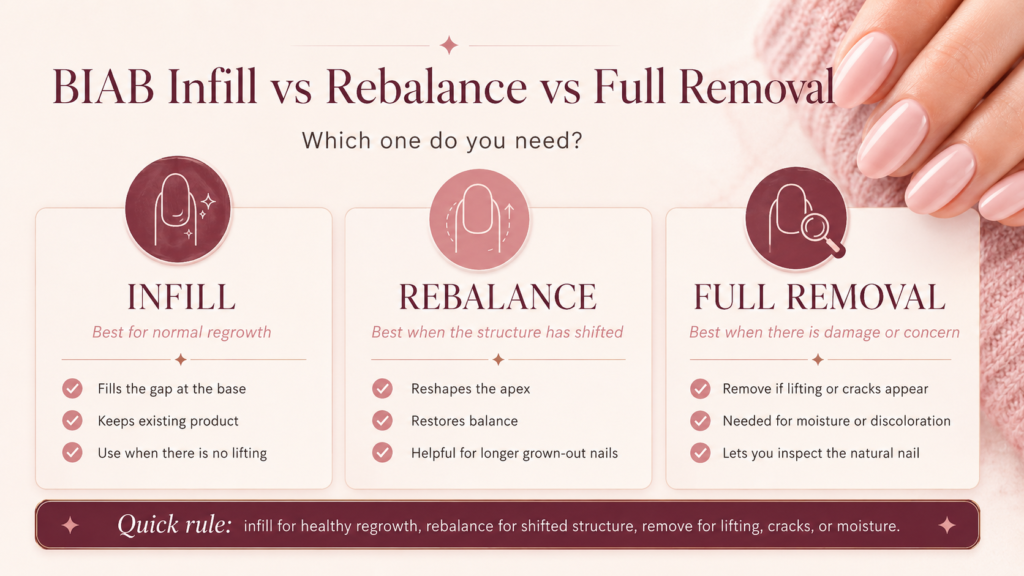
BIAB Infill vs Full Removal: Which One Do You Need?
| Nail condition | Better option |
|---|---|
| Secure product, normal regrowth | Infill |
| Structure has shifted but product is attached | Rebalance |
| One small repairable chip | Repair plus maintenance |
| Multiple lifted areas | Full removal assessment |
| Crack through the structure | Removal or major repair |
| Discolouration or trapped moisture | Full removal |
| Pain or sensitivity | Remove and assess |
| Excessive thickness | File down or full removal |
Common BIAB Maintenance Mistakes
- Booking purely by the calendar and ignoring what the nails are doing
- Filling over product that has already lifted
- Adding more and more product without ever thinning it back
- Skipping the rebalance, so the apex drifts forward set after set
- Peeling product off at home
- Covering discolouration with colour
- Treating four weeks as a guaranteed wear time
- Pushing appointments back repeatedly because the set still looks fine
- Mixing product systems that weren’t designed to work together
Frequently Asked Questions
Most people get BIAB infills every three to four weeks. Faster nail growth, longer nails, lifting or heavy hand use can mean you need an earlier appointment.
A three-to-four-week interval is common, but the condition of the existing product matters more than following a fixed calendar.
No. Three weeks is a perfectly normal interval, and for quick-growing nails it may be the better rhythm.
It can, particularly on short nails with careful aftercare. Lasting longer isn’t the same as remaining structurally balanced.
There’s no set limit. It depends on thickness, adhesion, structure and the condition of the natural nail.
No. BIAB can often be maintained with infills and rebalancing while the existing product remains secure and structurally sound.
There is no fixed removal schedule. Full removal is usually based on lifting, cracks, excessive thickness, product breakdown or the need to inspect the natural nail.
Not over the lifted area. Lifted product should be filed back or removed rather than sealed underneath fresh BIAB.
Widespread lifting, cracks through the structure, discolouration, trapped moisture, pain or excessive thickness are all reasons to assess the set for removal.
Often yes, if the nail underneath is healthy. If it’s thin, sore or damaged, a break or lighter application may be more appropriate.
Not automatically, but leaving an increasingly unbalanced set in place can make lifting, cracking and impact damage more likely.
Usually nothing dramatic in the short term. Check for lifting, cracks, catching or imbalance, and rebook sooner if you notice any of them.
Most BIAB infills are needed every three to four weeks, but the manicure should decide rather than the diary. Secure product with ordinary regrowth can usually be infilled or rebalanced. Lifting, cracks, pain, moisture, discolouration or excessive thickness are reasons to consider removal and inspect the natural nail before applying more product.