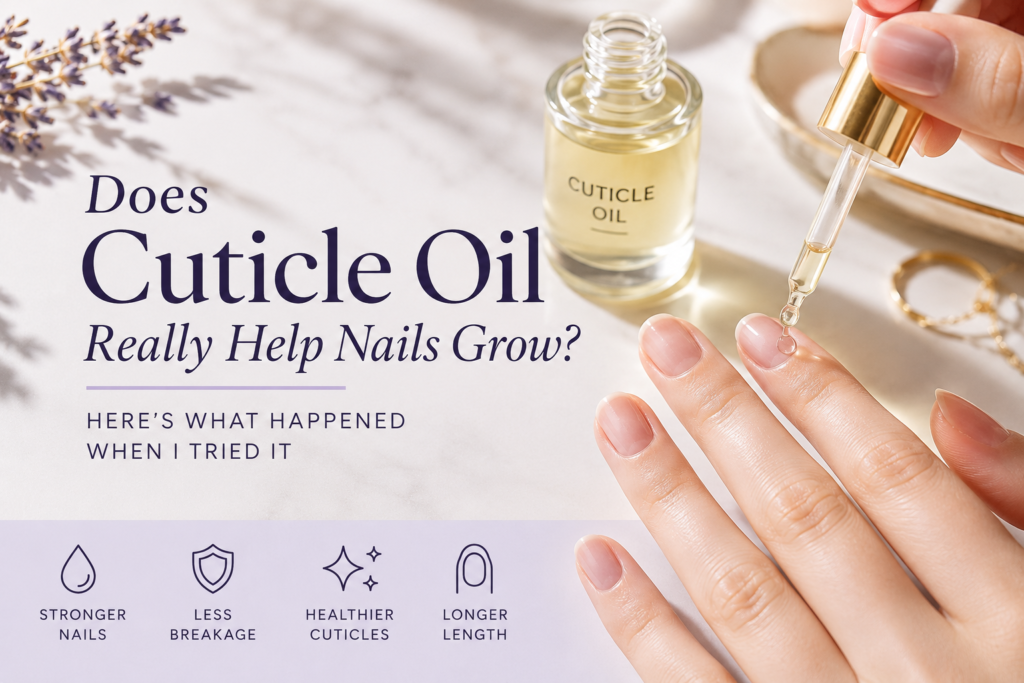
Cuticle oil does not make nails grow faster — growth speed is set by the nail matrix under your skin, and no oil changes that. What cuticle oil genuinely does is reduce breakage, peeling, and splitting, so your nails keep the length they grow. After eight weeks of daily use, my nails weren’t growing faster — they were finally not breaking before they got anywhere.
- Cuticle oil doesn’t speed up nail growth — that’s biologically fixed at the matrix
- It does dramatically reduce breakage and peeling, which looks like faster growth
- Real changes took 3-4 weeks of daily use to show, not days
- Jojoba-based oils penetrate the nail plate best; heavier oils mostly sit on top
- Biggest surprise: my gel manicures started lasting noticeably longer
I’ll be honest about why I started this experiment: I was sceptical. Cuticle oil always felt like the thing nail techs upsell at the end of an appointment — a nice-smelling bottle of “you should really be using this” that goes home, gets used twice, and dies in a drawer.
But my nails were peeling at the free edge, snapping the moment they grew past my fingertip, and I kept reading that cuticle oil was the answer. So I committed properly: one drop per nail, twice a day, every day, for eight weeks. No other changes to my routine.
Here’s what actually happened — and what the marketing gets wrong.
1. What Is Cuticle Oil, and What Does It Actually Do?
Cuticle oil is a blend of moisturising oils — usually jojoba, sweet almond, avocado, or grapeseed — often with vitamin E added. Its job is simple: rehydrate the cuticle, the surrounding skin, and the nail plate itself.
That last part matters more than people realise. Your nail plate is made of keratin layers, and when those layers dry out, they separate — that’s the peeling you see at the free edge. They also become rigid, and rigid nails don’t bend under impact. They snap. Research on nail plate structure has long noted that the water content of the nail is a key factor in its flexibility and resistance to splitting — the science of nail hydration backs up what most people learn the hard way: a dehydrated nail is a brittle one.
So the mechanism isn’t mysterious. Hydrated nails are flexible nails, and flexible nails survive daily life — typing, dishes, keys, the car door — in a way brittle ones don’t.
What cuticle oil is not is a growth serum. There’s no ingredient in jojoba oil that signals your body to produce nail faster. Anyone claiming otherwise is selling something.
2. So… Does It Actually Help Nails Grow?
Not exactly — and this is where I think people get confused. I realised there were actually two different things going on.
Nail growth happens at the matrix, the living tissue hidden under the skin at the base of your nail. Growth rate there is determined by genetics, age, circulation, and overall health. The average is roughly 3mm per month, and no topical product meaningfully changes it. The nail you can see is already dead tissue — oil can condition it, but it can’t make it grow.
But there’s another side to it. If your nails break every time they reach 2mm past the fingertip, your effective growth is zero. You’re growing nail and losing it at the same rate. Stop the breakage, and suddenly all that growth starts accumulating.
That’s exactly what happened to me. Around week five, I realised my nails were the longest they’d been in years — not because they were growing faster, but because for the first time they weren’t snapping off before getting anywhere. The oil didn’t speed anything up. It stopped the losses.
I realised my nails had never actually stopped growing. I was just losing the length as fast as I gained it — and the oil was the thing that finally let it add up.
Cuticle oil doesn’t make nails grow faster. It helps you keep the length you already grow by reducing the breakage and peeling that usually cuts it short.
3. What Changed Week by Week
Since “I tried it” is the whole point of this post, here’s the honest timeline.
| Timeframe | What I Noticed |
|---|---|
| Week 1 | Cuticles visibly softer and less ragged. Nails themselves — no change. |
| Week 2 | Hangnails mostly gone. The dry, flaky skin around my thumbnails cleared up. |
| Weeks 3-4 | Peeling at the free edge noticeably reduced. Nails felt less “dry” when tapped. |
| Weeks 5-6 | First time in years all ten nails passed my fingertip without a single break. |
| Weeks 7-8 | Visible new growth looked smoother and less ridged than the older nail above it. |
Two honest caveats. By the end of week two I almost gave up — the cuticles looked better but the nails themselves hadn’t budged, and it felt like rubbing oil on a problem that didn’t care. I’ll admit I even skipped a couple of days around then out of sheer “what’s the point.” Then around week five something shifted, and it was only looking back at photos that the difference became obvious. If I hadn’t committed to eight weeks upfront, I’d have quit by day ten and written the whole thing off — which I suspect is exactly what most people do.
4. How to Apply Cuticle Oil So It Actually Works
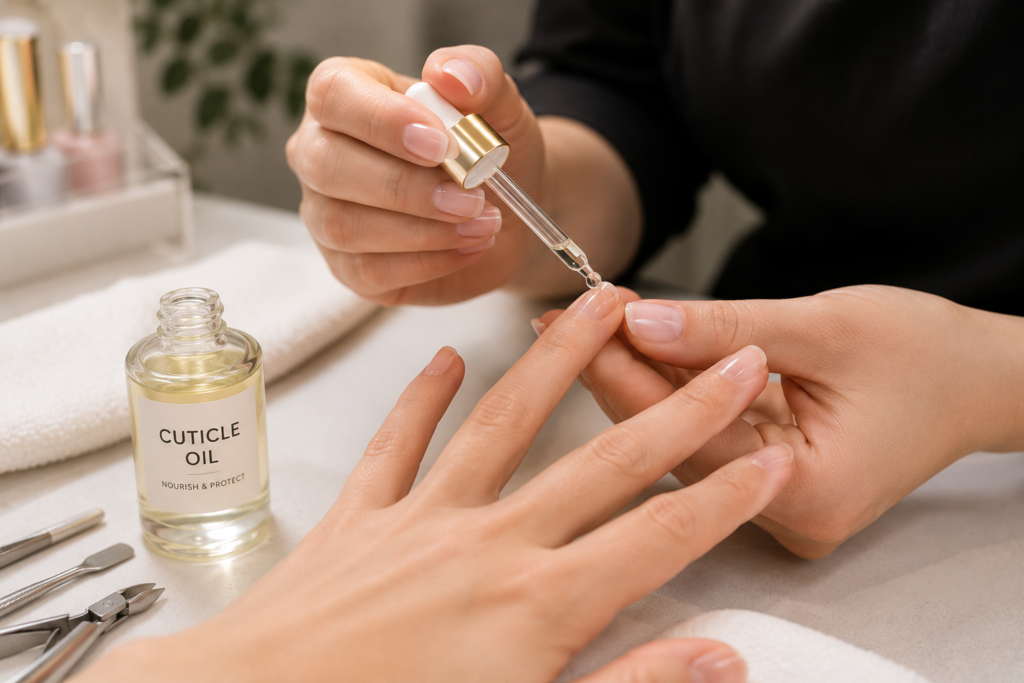
For the first few days I was basically dabbing it on and walking away, and it took me embarrassingly long to realise that was the least effective way to use it. What actually made the difference was massage.
A drop on each cuticle, then thirty seconds of actually rubbing it into the cuticle, the skin at the sides, and the nail plate itself. The massage does two things: it pushes the oil where it needs to go, and it stimulates circulation at the base of the nail — the one area where blood flow genuinely matters, since that’s where the living matrix sits.
Timing matters too. The two moments that worked best for me were right before bed (hours of undisturbed absorption) and right after washing my hands or showering, when nails have just lost moisture to water exposure. Water is surprisingly hard on nails — they swell, then contract as they dry, and that cycle weakens the keratin layers over time. It’s the same mechanism behind why BIAB nails peel after a shower — repeated water exposure without rehydration. Oiling immediately after locks moisture back in.
If you’re prepping for a manicure, the order matters as well — oil goes after the appointment, never right before, because residue on the nail plate stops product from bonding. Our nail prep guide covers why a clean, dehydrated plate is non-negotiable before gel goes anywhere near your nails.
5. Which Ingredients Actually Matter
I went through the ingredient lists of every cuticle oil I could find while choosing one, and the differences come down to molecule size and absorption.
Jojoba oil is the one worth prioritising. Technically a wax ester rather than a true oil, its structure is close enough to skin’s natural sebum that it penetrates the nail plate instead of sitting on the surface. If a cuticle oil lists jojoba first, that’s a good sign.
Vitamin E supports the surrounding skin and acts as a natural preservative for the oil blend itself. Sweet almond and avocado oil are solid supporting players — richer, more occlusive, better at sealing moisture in than penetrating deeply.
Mineral oil, on the other hand, is a filler. It sits on the surface, feels moisturising for an hour, and does very little for the nail plate itself. Cheap cuticle oils lean on it heavily, which is why the bargain bottle often disappoints.
Fragrance-heavy formulas can irritate the very skin you’re trying to heal, especially if your cuticles are already cracked. If your cuticles sting when you apply, switch to an unscented or lightly scented option — stinging is not “it’s working.”
6. Can Cuticle Oil Fix Damaged Nails?
This is the question I get most, and I wish the answer were simpler, but it isn’t. Cuticle oil can’t repair a damaged nail, but it can create the conditions for a healthy one to replace it.
The nail you can see is dead keratin. Once it’s peeling, ridged, or split, no oil un-splits it — that damage grows out with the nail over the following weeks. What oil does is protect the new nail forming at the matrix, and stop the damaged nail above it from getting worse while it grows out. I think this is where a lot of people get disappointed. The damage that’s already there doesn’t magically disappear. You’re really just taking care of the nail that’s going to grow in next.
For peeling specifically — the most common complaint — hydration genuinely helps, because peeling is largely a dehydration problem at the keratin layers. Consistent oil plus reduced water exposure is the standard advice for a reason. For deeper structural weakness, oil is one part of a bigger picture that includes diet, reduced harsh chemical exposure, and patience.
7. Thicker Nails, Toenails, and What Happens If You Stop
I kept getting the same three questions while I was testing this, so here’s the short version of each.
Can cuticle oil make nails thicker? Not the nail plate’s actual thickness — that’s determined at the matrix. But hydrated nails feel and look more substantial because they’re not peeling into thin, flaky layers at the edge. If your nails seem to be thinning, oil won’t rebuild them, but it will stop the layer separation that makes them worse.
Does cuticle oil work on toenails? Yes, and it’s underrated there. Toenails grow slower and get less natural moisture inside shoes, so they’re prone to dryness and thickening. The same daily-drop routine applies. If you get pedicures or wear gel on your toes, the lifting-prevention benefit carries over exactly the same way.
What happens if you stop using it? This one I can answer from experience — I ran out for about ten days around week seven and, honestly, forgot to reorder. The cuticles were the first thing to go: dry and ragged again within a week. The nails held up longer, since the improvement there was structural, but the peeling started creeping back at the edges by the time I restarted. What that little accidental break taught me: the cuticle benefit fades fast and needs constant upkeep, while the nail benefit is slower to build and slower to lose.
8. What Dermatologists Actually Say
Before I completely trusted my own experience, I wanted to see what dermatologists actually say — because the beauty industry and the dermatology world don’t always agree.
Dermatologists broadly support the core idea: moisturised nails are healthier nails. Most recommend thick moisturising products — creams and ointments — for the best results, and the American Academy of Dermatology has long pointed to something as simple and cheap as petroleum jelly as an effective way to care for cuticles. Cuticle oil is a lighter, more absorbable version of the same principle.
The one point dermatologists are firm on: don’t cut your cuticles. The cuticle is a seal that protects the nail matrix — the living tissue where new nail forms — from bacteria and water. Cutting it opens the door to infection and can actually disrupt nail growth. Oil softens the cuticle so you can gently push it back if you want a cleaner look, without ever needing to cut. That’s the safe version of cuticle care, and it’s where oil earns its place over the nippers.
9. The Unexpected Bonus: My Gel Manicures Lasted Longer
This was the result I didn’t see coming. About six weeks in, I noticed my BIAB sets were holding on noticeably longer before showing any lifting at the edges.
It makes sense once you understand why gel lifts in the first place. Dry, rigid nails flex differently under the gel than the gel itself does, and that mismatch creates micro-separation at the edges — which grows into visible lifting. Hydrated, flexible nails move with the product rather than against it. If lifting has been your recurring frustration, our breakdown of why BIAB nails lift goes deeper into the causes, and daily oil addresses one of the sneakier ones.
Nail technicians have been saying this for years, and I’d always assumed it was part of the upsell. It isn’t. If you invest in gel or BIAB manicures, a bottle of cuticle oil is genuinely the cheapest way to extend them — our guide on how to make BIAB last longer puts daily oiling near the top of the list for exactly this reason.
10. So — Is Cuticle Oil Worth It?
For me, clearly yes. But it’s worth being precise about what “yes” means, because the honest version is less exciting than the marketing and more useful.
Cuticle oil will not transform your nails in a week. It will not make them grow faster, whatever the bottle implies. What it will do — reliably, boringly, cumulatively — is stop the small daily damage that keeps most people’s nails permanently short. Less peeling, fewer annoying breaks, and cuticles that finally stopped catching on everything. And if you wear gel, sets that hold on longer. It’s also the single best thing you can do for your nails right after a manicure comes off — our BIAB removal guide puts a generous cuticle oil treatment as the non-negotiable final step, because acetone leaves the nail plate stripped and thirsty.
The only real requirement is the one nobody wants to hear: consistency. A drop twice a day, every day, massaged in properly. The bottle that lives on your desk or nightstand gets used; the one in the bathroom cabinet doesn’t. That placement decision did more for my routine than any ingredient list.
Eight weeks in, mine’s still on the nightstand.
Frequently Asked Questions
Not directly. Growth speed is set by the nail matrix under the skin, and no topical oil changes that rate. What cuticle oil does is reduce breakage, splitting, and peeling — so nails keep the length they grow. The result looks like faster growth, but it’s actually better length retention.
Softer cuticles show within the first week of daily use. Visible differences in the nails themselves — less peeling, fewer breaks — typically take three to four weeks, roughly the time it takes for the nail plate to rehydrate and new growth to come through.
Once or twice daily — before bed at minimum, and ideally after washing hands or showering, when nails have just lost moisture. Consistency matters far more than quantity.
Jojoba oil is the standout — its structure is small enough to penetrate the nail plate rather than sit on the surface. Vitamin E, sweet almond, and avocado oil are effective supporting ingredients. Mineral oil is mostly filler.
Yes. Hydrated nails stay flexible and move with the gel rather than against it, reducing the micro-separation that leads to lifting at the edges. Many nail technicians recommend daily oil specifically to extend gel and BIAB wear.