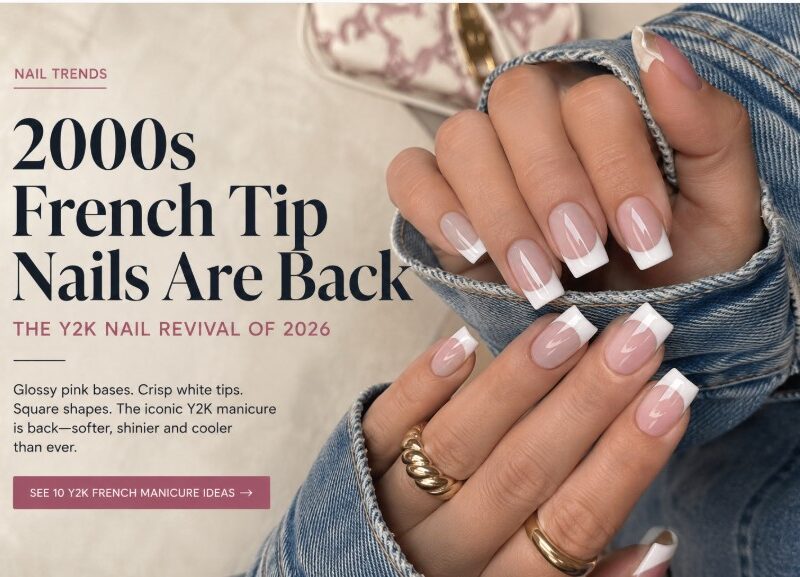
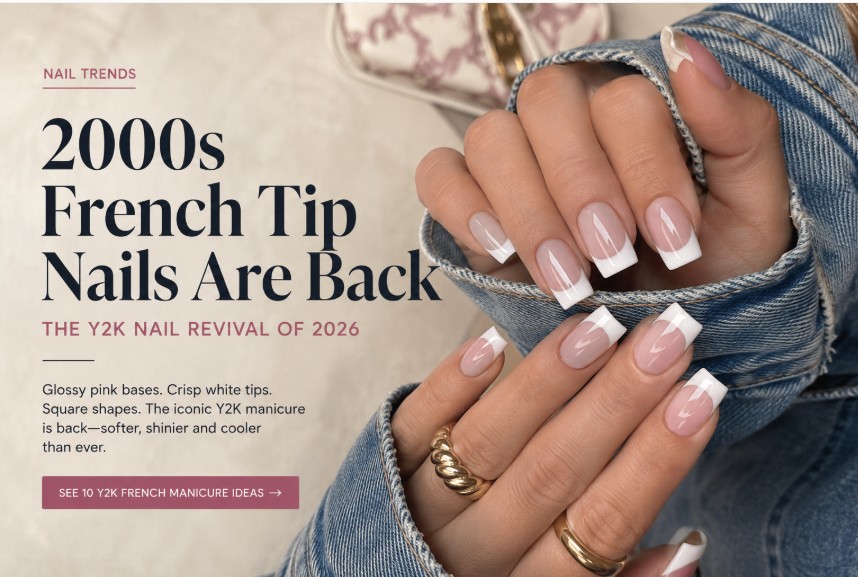
The 2000s French tip nail revival is bringing one of the most recognizable Y2K manicures back into focus. Think glossy pink bases, crisp white tips and the square nail shapes that dominated the early 2000s — only this time, the look is being softened with milky finishes, micro tips and modern almond shapes.
The references circulating now look remarkably close to manicures from the early 2000s: square shapes, pink bases and deliberately thick white tips. Not an interpretation of the era. The actual thing.
Which is a bit funny, because for most of the last decade the thick white tip was shorthand for a dated manicure. Now it’s the point.
What Did French Tips Look Like in the 2000s?
Let’s be precise about this, because “2000s French” gets flattened into a vibe when it was actually a very specific formula.
The nails were square. Not squoval, not soft square — properly flat across the top with sharp corners you could feel. Length sat somewhere between medium and “how do you text with those.” The base was a pink or beige acrylic overlay, usually with visible depth to it, and the smile line was drawn high and thick. Not a whisper of white. A statement.
The white itself matters too. Many salon French manicures from the era used pink-and-white acrylic systems, which helped create the opaque, high-contrast tips strongly associated with the early-2000s look. Painted French manicures existed too, so acrylic wasn’t the only way the style was worn — but the built version is the one most people picture.
Then there was the finish. High-gloss topcoat, the kind that reflects a ring light like a mirror. And the extras: a single rhinestone near the cuticle, a tiny hand-painted flower, sometimes airbrushed pink fading into white. If you had a 2004 prom, you know exactly the manicure I mean.
If you have shorter nail beds, the classic 2000s proportions can crowd the nail. You’ll get a better result from the micro or almond variations further down rather than the full chunky white tip.
Why Are 2000s French Tips Coming Back?
Partly it’s just the twenty-year cycle doing what it always does. Low-rise jeans came back. Butterfly clips came back. Nails were never going to sit that one out.
But there’s something else going on, and it looks like a reaction to how minimal nails got. We had years of bare, barely-there manicures — the sheer milky nail, the “your nails but better” thing. Beautiful, but quiet. After a while, quiet gets boring.
Search interest is moving with the aesthetic, too. In Google Trends’ worldwide rising-search data checked in August 2026, the query “2000s French tip nail revival” showed a sharp breakout-style increase. That doesn’t necessarily mean the phrase has large search volume yet — a small base can produce a dramatic percentage jump — but it does suggest people are beginning to search for the look by name rather than describing it.
The 2000s French is loud in a very specific way. It’s high contrast and unapologetic about being a manicure. You can see it from across a room. That’s the appeal.
There’s also the nostalgia layer, which is worth mentioning because it changes who’s asking for it. A lot of people requesting this look now weren’t wearing it the first time around. They’re recreating something they saw in music videos and magazine spreads as kids. Which means they want the idea of the 2000s French — not necessarily a museum-accurate reproduction.
Authentic 2000s tips used a warm, slightly ivory white. Modern French products lean cool and stark blue-white, which reads as 2019 minimalism no matter how thick you paint it. If your Y2K French looks off and you can’t say why, it’s usually the white.
2000s French Tips vs Modern French Nails
This comparison is where most people figure out what they actually want. The two looks share a name and almost nothing else.
| Element | 2000s French | Modern French |
|---|---|---|
| Nail shape | Square, sharp corners | Almond, oval, soft square |
| Tip thickness | Thick — 4–6mm of white | Micro — 1–2mm |
| Smile line | Deep, curved, high on the nail | Shallow, follows the free edge |
| Base colour | Opaque pink or beige | Sheer milky, nude, or bare |
| White tone | Warm, chalky, fully opaque | Cool, crisp, sometimes translucent |
| Finish | High gloss | Gloss, matte, or chrome |
| Overall read | Built, glamorous, deliberate | Clean, understated, editorial |
Neither is better. But if you ask for “a French” in a salon in 2026, you’ll get the modern version by default. You have to be specific about the 2000s one — bring a photo, honestly.
10 2000s French Tip Nail Ideas to Try in 2026
Some of these are period-accurate. Some are cheats. Both are noted below.
1. Classic Chunky French
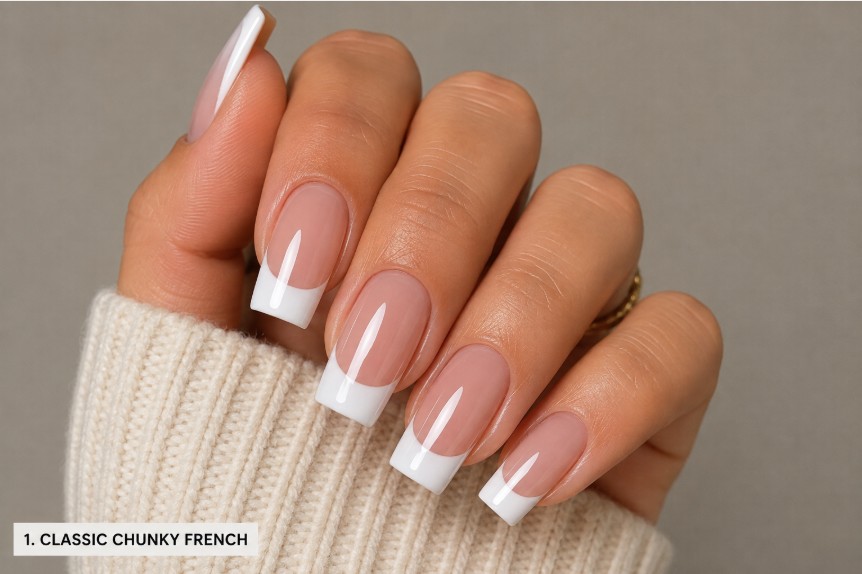
The original
Full-thickness white tip, deep smile line, pink base, glossy top. This is the reference point everything else deviates from. It looks best at medium length — too short and the white eats the whole nail.
Fair warning: it’s the least forgiving version. Any wobble in the smile line is immediately visible.
2. Square French Tips
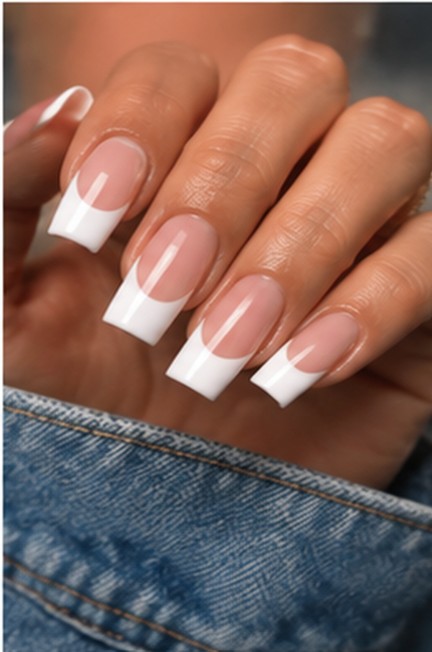
Shape-first approach
Same idea as above, but you let the shape do the heavy lifting and keep the white a touch thinner. Good compromise if the full chunky version feels like too much commitment.
3. Pink-and-White Acrylic French
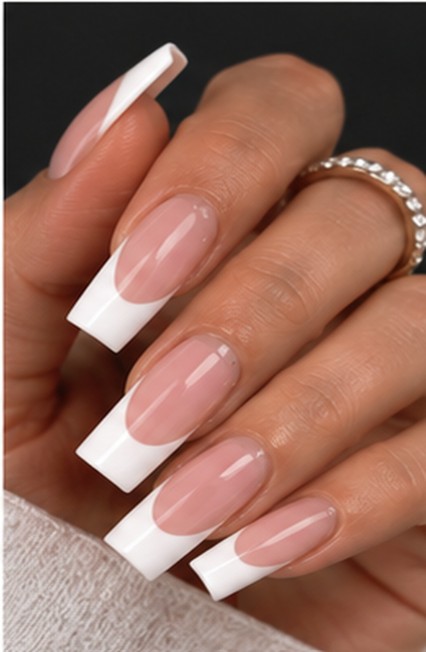
Salon standard, revived
The acrylic version — pink powder on the bed, white powder on the extension, buffed and glossed. Structurally different from a painted French, and it’s why 2000s nails had that particular depth. Costs more, lasts longer, grows out beautifully if the blend is done right.
4. Milky Y2K French
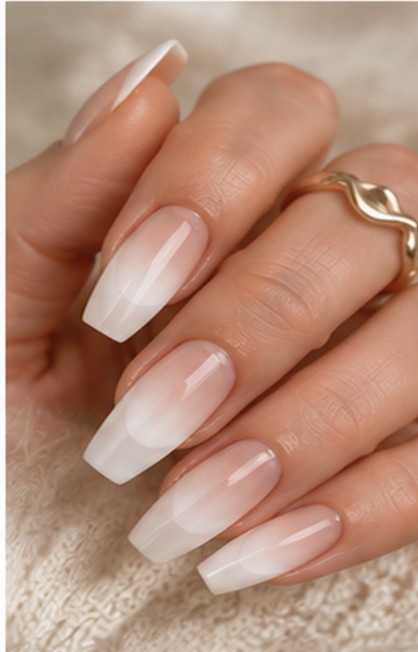
Of the modern variations, this is probably the easiest one to wear day to day. It’s barely a design change either — you just swap the opaque pink base for a milky white-pink and keep the tip thick.
What happens is the contrast drops. Suddenly the whole thing goes soft and slightly hazy, and it stops shouting. People who love the Y2K shape but find the original harsh usually land here and stay. It also photographs better than almost anything else on this list, if that matters to you.
5. Micro French
A hairline of white at the very edge. Technically the least Y2K thing here — but pair it with a square shape and a proper pink base and it still reads correctly.
6. Chrome French
Metallic tip
Chrome powder over the tip instead of white. Silver reads futuristic in a very 2000s way — that whole era was obsessed with looking like the future, which is funny in hindsight since the future turned out to be mostly phones.
One catch: chrome needs a no-wipe gel top coat to sit properly. It won’t work with regular polish, and no, you can’t fake it with metallic nail art paint.
7. Rhinestone French
One stone at the cuticle on the ring finger. That’s the whole 2000s formula, and adding more usually tips it into costume territory.
Use flatback crystals and seal the edges with builder gel or they’ll be gone by Thursday.
8. Baby Pink French
Cool-toned pale pink base, medium white tip. The office-safe version, and the easiest one to do yourself at home.
Not exciting. Genuinely nice on everyone, though.
9. Almond French
Take the thick 2000s white and put it on an almond nail. Nobody was doing this in 2003 — almond wasn’t really a mainstream shape yet — so it’s a hybrid rather than a revival.
But it works, and arguably better than the authentic version for most people. The curve of the shape softens the smile line automatically, so a thick tip that would look heavy on a square nail reads as elegant instead. It also elongates the finger, which square emphatically does not.
If you have short or wide nail beds and you’ve been told the 2000s French “won’t suit you,” this is the answer. Same nostalgia, different geometry.
10. Colourful Y2K French
Tips in every shade
Baby blue, lilac, hot pink, lime. One colour per nail or all matching — both were done at the time, and the mismatched version has aged surprisingly well.
This is where the trend gets genuinely fun. It’s also the version that seems to travel furthest among people who weren’t around for the original — which tells you something about how nostalgia actually works.
How to Make Y2K French Tips Look Modern
Here’s the thing — a straight copy of the original can read as costume. A few adjustments keep it firmly in 2026.
- Rethink the shape before the colour. Moving from square to soft square or almond does more modernising work than any polish change. The shape is what dates a manicure fastest.
- Warm up your white. Cool blue-whites look clinical against skin. A warm, slightly creamy white sits better and feels intentional rather than dated.
- Cut the length by a third. The 2000s ran long. Shortening the free edge keeps the proportions of the thick tip without the whole thing feeling like a throwback costume.
- Pick one texture, not four. Original 2000s nails piled on gloss plus glitter plus stones plus airbrush. Choose a single effect and let it carry the look.
- Keep the sidewalls clean. This is the unglamorous one, but nothing separates a modern manicure from an old one like precise cuticle work. Same design, completely different result.
Paint the white first, let it cure fully, then apply your sheer base colour over the whole nail. It blends the smile line edge automatically and hides small wobbles far better than painting white on top of pink.
Long square extensions create more leverage at the free edge, so an impact near the tip transfers more force back toward the natural nail. If your nails are prone to lifting or breakage, keeping the extension shorter reduces that leverage — a square shape at medium length is meaningfully sturdier than the same shape long.
Best Nail Shapes for the 2000s French Look
Shape isn’t a small decision here. It’s most of the outcome.
Square
The authentic choice. Sharp corners, flat top, maximum period accuracy. Best on longer nail beds — on short beds it can make fingers look stubby, which is worth knowing before you commit.
Soft square
Square with the corners gently filed. You keep almost all of the Y2K silhouette and lose the snagging problem. For anyone who likes square nails but dislikes sharp corners, this is the easier everyday compromise.
Almond
Not remotely period-accurate, but it works beautifully with a thick white tip and it’s the most flattering shape for the widest range of hands. Modern-retro hybrid.
Squoval
The safe middle. Flat top, rounded edges, low drama. If you want the manicure to be the statement rather than the shape, this is your pick.
These shapes fight the look entirely. A deep smile line on a stiletto point creates an awkward triangle, and coffin tips distort the white into a shape that reads 2018 Instagram, not 2003.
What Polish Colours Work Best?
Base first. You’ve got three real directions: opaque pink for period accuracy, milky white-pink for the soft modern version, or a warm beige nude if you want the tip to be the only contrast. Sheer pink works, but it needs two or three coats to avoid looking streaky over the white edge.
For tips, white is obviously the classic — go warm, not stark. Beyond that, baby blue and lilac read most authentically Y2K. Silver chrome works. Hot pink works if you commit to it fully.
What doesn’t work: dark tips. Black or deep burgundy on a French turns gothic fast, and while that’s a look, it isn’t this one.
The 2000s French depends almost entirely on smile line precision — that curve is the whole design. Because the tip is deliberately thick and high-contrast, even small asymmetries become far more visible than they would on a micro French, where there simply isn’t enough white for the eye to measure. If your nail tech works freehand rather than with a form or brush guide, ask to see their previous French work first. It’s the single technique where skill difference shows most obviously, and there’s no fixing a crooked smile line after the fact.
Are 2000s French Tips Still in Style in 2026?
Yes — 2000s French tip nails are firmly back in the 2026 nail conversation. Current versions tend to mix early-2000s elements — square shapes, thicker white tips and glossy pink bases — with newer details such as milky finishes, almond shapes, chrome and coloured tips.
What’s less likely is that it stays in this exact form. Trends like this usually mutate — the chunky tip will probably keep thinning, the colours will keep expanding, and in two years we’ll be calling it something else entirely.
Which is fine. That’s how it worked the first time, too.
2000s French Tip Nails: FAQ
What are 2000s French tips?
They’re a French manicure done the early-2000s way: a square nail shape, an opaque pink or beige base, and a thick, opaque white tip with a deep curved smile line. The white was usually built in acrylic rather than painted on, which is why it looked so solid, and the whole thing was finished with a high-gloss top coat.
What nail shape was popular in the 2000s?
Square, almost exclusively — flat across the top with sharp corners, at medium to long length. Squoval showed up towards the end of the decade. Almond and coffin shapes came much later, so if you want period accuracy, square is the shape.
Are chunky French tips back?
Thicker tips are clearly part of the current French manicure conversation again, though the version circulating now is usually a little thinner than the early-2000s original and paired with softer base colours. Full 2000s thickness reads as a deliberate statement rather than the default.
What colour base is used for Y2K French nails?
Opaque pink is the authentic choice. Milky white-pink is the most popular modern option because it lowers the contrast, and warm beige nude works if you want the tip to be the only point of interest. Sheer pink is fine but needs two or three coats to avoid streaking.
Can you do 2000s French tips on short nails?
You can, but scale the white down. A 5mm tip on a short nail swallows the nail bed and makes fingers look stubby. Drop to roughly 2–3mm, keep the base opaque so there’s still contrast, and file to a soft square — you’ll get the look without the proportion problem.
If you only try one, make it the milky version. It gives you the shape and the nostalgia without the commitment of a full chunky tip, and if you hate it, it grows out invisibly. That last part matters more than people expect.