There’s no easy way to write about a rule that lands on an entire trade overnight. The UK TPO gel nail ban takes effect on 15 August 2026, and for thousands of nail technicians it’s arriving at the end of a long, strange year — one full of half-answers, quiet reformulations, and stock nobody was quite sure they were still allowed to use.
So let’s slow down for a second.
If you’re reading this with a shelf of gel bottles behind you and a client booked for nine tomorrow morning, the practical news is much calmer than the headlines. Nothing you already own is being taken off you. Nobody’s coming for your kit. But the ban is real, the dates are fixed, and the ingredient at the centre of it isn’t coming back — so it’s worth understanding properly rather than picking it up in fragments from salon groups at midnight.
TPO-containing cosmetics can no longer be newly placed on the Great Britain market from 15 August 2026. Existing stock may continue to be sold until 14 February 2027, and nail professionals can carry on using products they purchased before the deadline.
Techs and salon owners in England, Scotland and Wales. Also anyone doing their own gel at home with a little lamp on the kitchen table. Northern Ireland’s been under the EU rules since September 2025, so that change already happened there.
What is TPO in gel polish?
TPO stands for trimethylbenzoyl diphenylphosphine oxide, which is a mouthful nobody says out loud. It’s a photoinitiator. Think of it as the match. The gel is the fuel, the lamp is the strike, and TPO is the bit that actually catches — without it, gel polish just sits there on the nail, wet and useless.
It got popular for very ordinary reasons. It cures fast. It doesn’t sulk when a little oxygen gets to the surface. And it holds colour without going yellow six months down the line. If you’ve ever wondered why a white tip from a certain brand still looks white and another one has gone the colour of old piano keys — photoinitiator chemistry is often the reason. So TPO ended up everywhere. Builders, bases, colours, the cheap kits on Amazon, the expensive stuff in salons.
One thing worth untangling here, because it comes up constantly: TPO isn’t HEMA. People say them in the same breath and they’re completely different things. HEMA is a small monomer that helps gel stick, and it’s the one linked to allergic reactions in clients. TPO is the curing ingredient, and the reason it’s being pulled has nothing to do with allergy at all. Brands removed both from some lines at the same time, which is honestly where most of the confusion came from.
Is TPO banned in the UK?
Yes. Properly banned, not “under review.”
It’s been added to Annex 2 of the UK Cosmetics Regulation — the prohibited substances list — by SI 2026/23, made on 12 January 2026 and laid before Parliament three days later. TPO appears in the Schedule as entry 1745, “Diphenyl(2,4,6-trimethylbenzoyl)phosphine oxide”, CAS 75980-60-8, alongside fifteen other CMR substances. It covers Great Britain — England, Scotland, Wales.
If you’d rather read a plain-English summary than the instrument itself, the CTPA maintains a running list of UK Cosmetics Regulation amendments, which is the reference most Responsible Persons in the industry actually work from.
The UK isn’t doing anything unusual here, either. The EU banned TPO in cosmetics from 1 September 2025, and Northern Ireland’s followed the EU rules since then. What’s happening now is basically Great Britain catching up, a year behind, same substance, same reasoning.
But here’s the part that gets lost. This is a ban on selling and supplying. Not on you. There’s no line anywhere telling you to bin a bottle, and nothing that makes the set on your client’s hands suddenly illegal. The obligation sits with manufacturers, distributors and shops.
UK TPO ban dates: 15 August 2026 and 14 February 2027
Two dates. They do different jobs, and mixing them up is where about ninety per cent of the panic has come from.
| Date | The official term | What actually happens |
|---|---|---|
| 15 August 2026 | Placing on the market | Manufacturers can’t put TPO products onto the GB market any more. The tap turns off — no new stock enters the chain. |
| 14 February 2027 | Making available on the market | The final off-shelf date. Distributors and shops can’t sell TPO products after this, and you can’t buy them. |
| After that | Use | You can carry on using anything you already bought. Use isn’t restricted at all. |
Tap off in August. Shelves clear by February. What’s in your kit stays yours.
That six-month gap wasn’t an accident, by the way. It’s there so suppliers can run stock down sensibly instead of writing off a warehouse in a week, and so salons aren’t forced to change systems in the middle of a fully booked August. For a fully booked salon, changing builder systems in August is hardly ideal.
15 August isn’t the day your bottles expire. It’s the day new TPO stock stops being placed on the market. If a supplier tells you everything has to be gone by mid-August, they’re describing their own deadline — not yours.
Why is TPO being banned?
This started with a classification, not with a nail salon. Which matters more than it sounds.
TPO was classified as a CMR substance — the bracket for things with evidence of carcinogenic, mutagenic or reproductive toxicity. In TPO’s case the concern sits in the third one: it carries a reproductive toxicity 1B classification under the GB CLP Regulation, based on animal studies suggesting effects on fertility after repeated exposure. The SI itself states plainly that the listed substances were added because of that classification.
And EU cosmetics law works on a precautionary principle. Once something picks up a CMR classification, it’s out of cosmetics more or less automatically, unless someone applies for a specific exemption and it survives a safety review. Nobody got one for TPO. The GB regulation follows the same logic and the same evidence.
So it’s a decision made about a chemical, as a chemical. Nobody studied manicures and concluded manicures cause infertility. A substance used in gel formulas got assessed, crossed a hazard threshold, and was pulled from a product category where exposure is assumed and hard to control. That’s the whole story, and it’s less dramatic than the way it travelled through social media.
Does the ban mean TPO gel polish is dangerous?
This is the one clients ask, usually while you’re halfway through their infills, and it deserves a real answer rather than a soothing one.
Hazard and risk aren’t the same thing. Hazard is what something is capable of. Risk is how likely harm actually is at the dose you’re realistically exposed to. Alcohol is a hazard. A glass of wine at Christmas is a risk profile. The animal evidence behind the TPO classification involved exposures nowhere near what happens in a salon, and regulators and industry bodies have both been consistent that this is precautionary — the amounts in nail products sit well below the levels linked to effects in those studies.
Where I’d be less breezy is the professional side.
A client sitting down every three or four weeks is in a completely different situation to someone working with uncured product forty hours a week for fifteen years. That’s not the same exposure and pretending it is doesn’t help anyone. Repeated occupational exposure is a genuinely reasonable thing to be careful about, and it’s part of why removing TPO from professional systems has been treated as an actual improvement rather than paperwork.
None of which means you should feel bad about the sets you’ve done. You used products that were legal, tested, and completely standard at the time. That’s not carelessness. That’s just what the industry looked like before the classification changed, and there was no way to know.
“Gel nails were proven to cause infertility.” It isn’t supported by the evidence, and it’s an easy claim for a client to half-read and misunderstand — so this one’s worth phrasing carefully rather than casually. The accurate version is short: a curing ingredient was reclassified and removed from cosmetics as a precaution.
Can nail techs still use existing TPO products?
Yes. You can keep using what you’ve already bought. No disposal requirement, no cut-off, nothing you need to strip out of your trolley before a date.
What ends is your ability to replace it. After 14 February 2027, that base coat you’ve used for four years and genuinely love? You can’t reorder it. That’s the actual operational problem — not the bottle in your hand, the one you would have bought next.
There’s a separate question underneath this, and it’s commercial rather than legal. Some clients will read a headline and just ask you outright whether you still use “the banned one.” You’re entitled to say honestly that you’re using stock bought lawfully and that use is still permitted. Perfectly true. But some salons are switching earlier than they have to anyway, purely because a clean “no, we don’t” is an easier conversation on a busy Saturday than a nuanced one. Both are fine. Pick the one you can live with.
How to check if your gel polish contains TPO
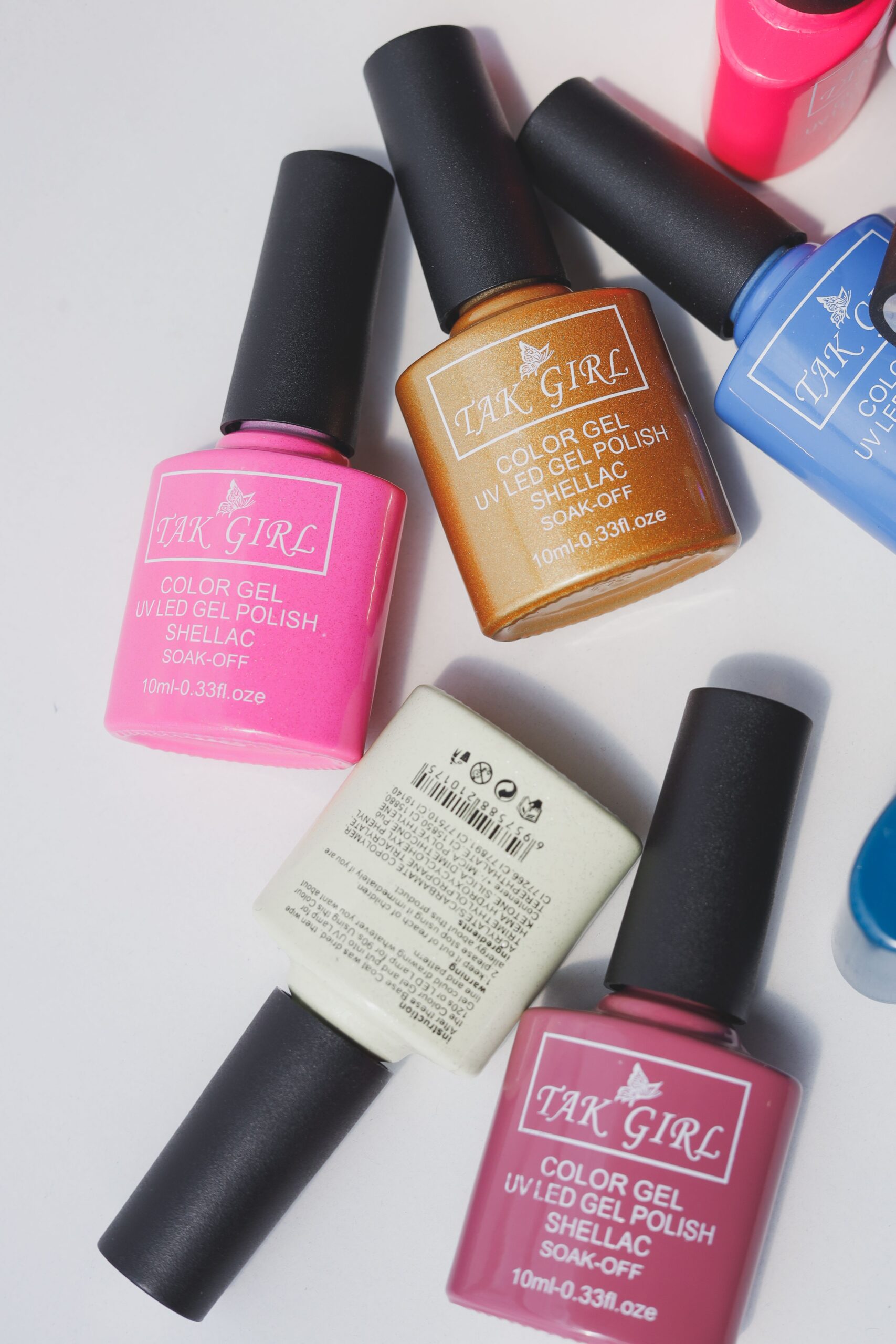
Ingredient lists on gel bottles are tiny, crowded, and printed in a font that assumes very good eyesight. Here’s a workable order.
- Read the INCI list. You’re looking for “trimethylbenzoyl diphenylphosphine oxide”, sometimes written as “diphenyl(2,4,6-trimethylbenzoyl)phosphine oxide”. If the bottle’s unreadable, the box or the product page usually carries the same list.
- Don’t confuse TPO with TPO-L. Different substance. Not covered by the ban. Several brands moved to it deliberately because it does the same job and stays legal.
- Check the batch or SKU, not the shade name. This is the one that catches people. Lots of brands reformulated shade by shade instead of all at once, so two bottles with identical labels can be different formulas depending on when they were made.
- Use the brand’s formula lookup if there is one. Some manufacturers published spreadsheets where you type in the code from the base of the bottle and get an answer back. Takes a minute.
- Just email them if it’s still unclear. Shade name plus batch code. Faster than guessing, and you’ve got something in writing if a client asks in six months.
No TPO on the label doesn’t always mean “reformulated” — some products never had it in the first place. That matters when you’re comparing brands, because “we never used it” and “we changed it last year” are two very different histories, even though the current label reads exactly the same.
TPO-free vs TPO gel polish
The performance question is the one you actually care about. Honest answer: the gap is smaller than everyone feared, but it isn’t always invisible.
| Factor | TPO formulas | TPO-free formulas |
|---|---|---|
| Cure speed | Fast, forgiving if the hand isn’t perfectly positioned | Much the same in reformulated systems — though a few want the full stated cure, not your usual shortcut |
| Shine | High gloss, well proven | Matches it in current professional lines |
| Colour stability | Very good at resisting yellowing | Generally matched — pale nudes and clears are the hardest to get right |
| Feel under the brush | Familiar after years of muscle memory | Can feel slightly different. This is the most common complaint, by miles |
| Adhesion | Down to the base and your prep, not the photoinitiator | Same. Prep and base pairing matter far more than the swap does |
| Available in GB | Until 14 February 2027 | What’s left afterwards |
A common transition problem is a simple one: the formula changes, but the application habit doesn’t. Same layer thickness, same slightly-shortened cure, same base pairing — and then lifting that gets blamed on the client’s hand cream for a fortnight.
Which means the fix usually isn’t dramatic either. Thinner first layer, the full stated cure rather than your usual one, and a base matched to the new formula instead of the old one. Boring advice. Normally the right advice.
If you’re changing systems professionally, trial the new formula for a full wear cycle before moving your entire client base across. Four weeks tells you more about flex and lifting than any product page will — and the learning curve happens somewhere it costs you nothing.
Does BIAB contain TPO?
Some of it did. And this is the section that caused the most upset in the UK nail community this year, so it’s worth laying out properly.
BIAB — Builder In A Bottle, from The GelBottle Inc — was originally made with TPO, like basically every soak-off builder of that generation. During 2025 the brand started moving shades to an updated formula that removed both TPO and HEMA, describing it as part of longer-term regulatory planning. The EU range went first, ahead of the September 2025 deadline over there. The brand set out its own position on the switch, including the move to TPO-L, in its TPO explainer.
But the row wasn’t really about chemistry.
It was about being told. The change happened gradually rather than as an announced relaunch, so some techs got a reformulated bottle of a shade they’d used for years with no heads-up — and then spent weeks troubleshooting lifting they had absolutely no reason to expect. Second-guessing your own prep for a fortnight, only to find the product had changed underneath you, is a frustrating way to lose two weeks. The brand has since apologised for the lack of clarity, published guidance so you can identify your formula from the SKU on the base of the bottle, and kept original-formula stock available in the UK while it lasts. Professional Beauty covered the reformulation and the response in full, if you want the timeline.
So: it depends entirely on which bottle you’re holding. Older BIAB may well contain TPO. Current BIAB sold as TPO and HEMA-free doesn’t. If you’re in builder gel every day, checking your codes is worth an afternoon.
And if your BIAB has been behaving oddly lately, these cover the wear and application issues that come up most — a few of them are the exact symptoms people mistook for a bad batch during the changeover.
Which gel nail brands are TPO-free?
Rather than hand you a shopping list that’ll be out of date by Christmas, it’s more useful to sort brands into three groups — because the group tells you how much checking you still have to do yourself.
Some salon groups have quietly put real money into this too. Townhouse, the London luxury nail brand, has talked about working directly with manufacturers and chemists on TPO-free systems, with the stated aim that clients shouldn’t have to pick between results and peace of mind. Which is a fair summary of where the better end of the market landed — the reformulation cost them something, but it didn’t cost the finish.
Ask every supplier one question, in writing: is this TPO-free, and from which batch onward? A “yeah, definitely” at a trade stand isn’t something you can show a client, an insurer, or an environmental health officer. A dated email is.
What should UK nail techs do now?
You’ve got six months. That’s a transition, not an emergency — so it’s worth working through in order rather than reacting to whichever headline lands next.
- Audit what you own. Bases, builders, colours, tops. Note what has TPO in it. You can’t plan a changeover without knowing where you’re starting from.
- Stop buying what you can’t rebuy. Anything TPO you restock now is something you’ll have to replace before February 2027 anyway. New money goes to compliant formulas from here.
- Trial systems during quiet weeks. One line properly, not five badly. Judge it over a full wear cycle, not on application day when everything looks perfect.
- Write your client answer down. One short, accurate paragraph you can paste into a message. Covers most of what you’ll be asked and stops you improvising when you’re already running late.
- Keep the paperwork. Invoices and formula confirmations are your proof that stock was bought lawfully inside the transition window.
What none of this touches is the craft. Prep, apex, cure time, structure — the things that decide whether a set goes four weeks or four days were never controlled by the photoinitiator. If you’re good at those, you’ll be good with the new formulas too. It’ll just feel wrong under the brush for a fortnight first.
FAQ
Is my current gel manicure unsafe?
No. Cured gel on the nail isn’t affected, and there’s no recall of applied product or of what’s on your shelf.
Do I have to throw away my TPO gel polish?
No. Professionals in Great Britain can keep using what they bought before the deadlines. The restriction is on sale and supply, not use.
Can I still buy TPO gel polish after 15 August 2026?
Stock already placed on the GB market can be sold until 14 February 2027. After that it can’t be made available for purchase.
Does this apply in Northern Ireland?
Northern Ireland has followed the EU rules since the EU ban in September 2025, so the change there happened before the GB dates.
Is TPO-L banned too?
No. Different substance, not covered — which is exactly why several brands switched to it.
Does TPO-free mean HEMA-free?
Not automatically. Separate ingredients, separate reasons. Some products dropped both at once, but plenty of TPO-free products still contain HEMA. If a client has a confirmed HEMA sensitivity you need a full HEMA-free system regardless.
Will TPO-free gel cure in my existing lamp?
Usually yes — as long as you follow the cure time stated for that system rather than the timing you’d got used to with the old formula.
Does at-home gel count?
Yes. Home kits are cosmetic products under the same regulation, so shops can’t sell TPO-containing kits once the deadlines pass. Kits already sitting in a drawer are fine to use.
So that’s the shape of it. A small change in chemistry, a fairly large change in routine, landing on an industry that’s already absorbed a few of those in a short space of time. If you’re tired of it, that’s fair enough — nobody asked for another thing to relearn this year.
But the ingredient list is the only part that has to change. The work is still the work.