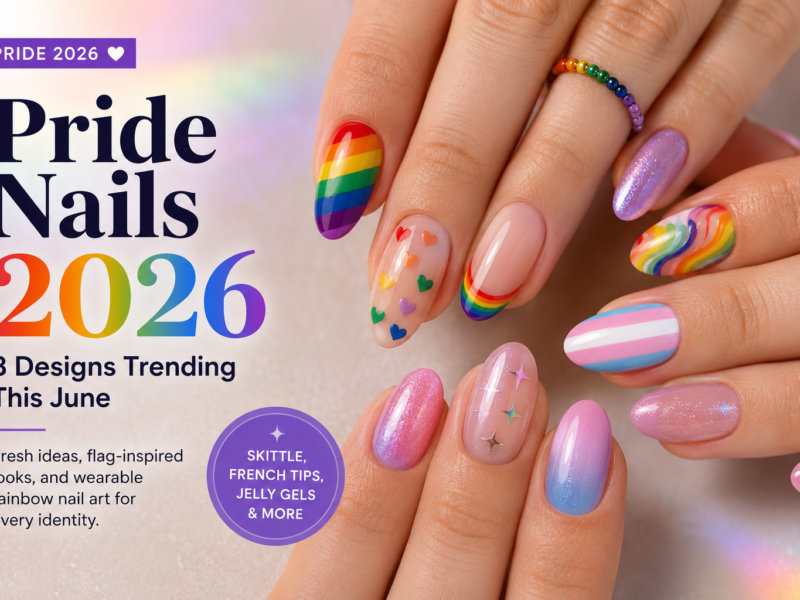
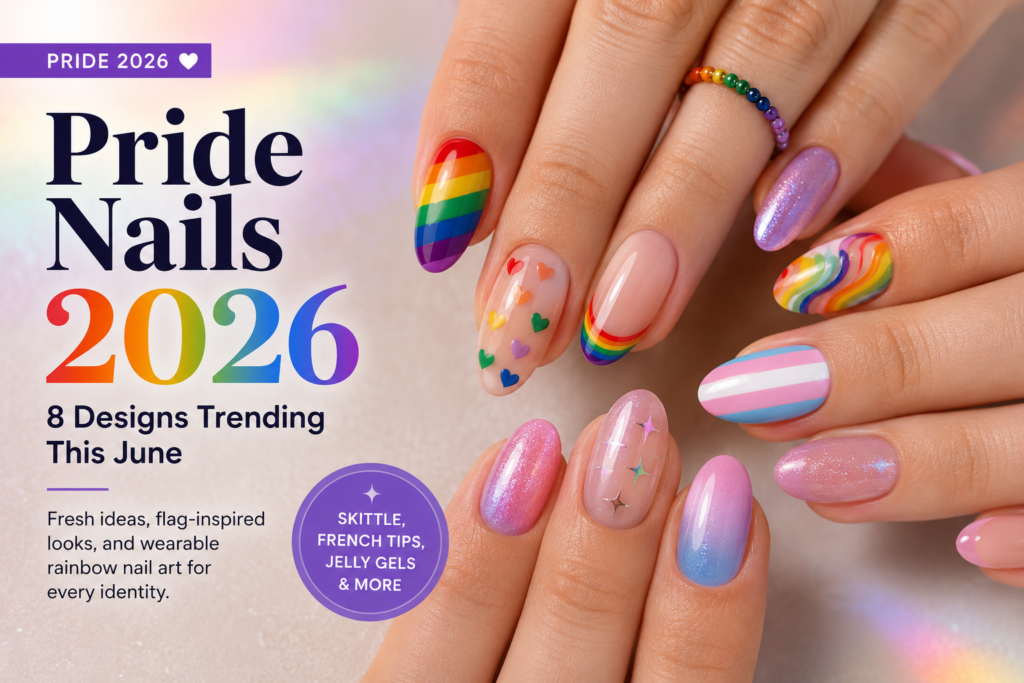
Pride nails in 2026 go well beyond the classic six-stripe rainbow. Some of the most visible pride nail ideas this June include skittle nails, rainbow French tips, jelly gel in flag colours, and identity-specific designs for bi, trans, non-binary, and other pride flags. For lasting wear through parades and outdoor summer events, gel holds up significantly better than regular polish — it typically lasts two to three weeks without chipping.
June is the one time of year when the nail world collectively decides that restraint is optional. And from what’s appearing on inspiration boards and in salon request lists this season, that energy has arrived earlier than usual in 2026.
Pride nails have always been a form of visibility — a way to signal identity, community, and solidarity before you’ve said a word. What feels different this year is how much the broader nail trend moment is meeting pride aesthetics halfway. Aura nails, jelly finishes, mismatched colour-per-nail sets — the techniques that have been showing up in salons all spring translate directly into pride palettes. You don’t have to choose between being on trend and being visible.
Whether you’re heading to a parade, wearing something intentional to work through June, or just want a set that feels like yours — here’s what’s worth doing this year, how difficult each design actually is, and how to make it last.
Pride Nail Ideas for 2026
The generic rainbow-stripes roundup has had its run. What’s getting pinned and shared this June looks noticeably different — at least based on what’s appearing on nail inspiration platforms and in current salon content.
A few things seem to be converging. Maximalism has been building in nail culture since late 2025 — crystals, layered textures, bold colour combinations — which makes a full rainbow hand feel current rather than costumey. There’s also been a visible shift toward identity-specific flag designs rather than a generic rainbow placeholder: people searching for bi pride nails, trans pride nails, non-binary nails. And the big technique trends of the year — aura, jelly, mismatched manis — happen to map well onto pride colour palettes.
Whether that adds up to a “trend” in a measurable sense is hard to say. What’s clear is that there are more options worth considering this June than in previous years, and more of them are achievable at home.
Flag-specific searches — bi pride nails, trans pride nails, non-binary nails — appear more frequently in nail inspiration content this year than in previous June cycles. Whether that reflects growing community visibility or shifting search behaviour (or both) is hard to separate, but the designs themselves are worth knowing.
8 Pride Nail Designs Worth Trying This June
One colour per nail, each finger a different shade from the rainbow or flag palette. It sounds simple — and it is — but the effect on a full hand is genuinely striking. Photographs better than almost anything else because every angle shows something different.
The more personal version paints each nail in the exact colours of your specific flag rather than the generic ROYGBIV order. That shift from decorative to intentional makes a noticeable difference.
One thing worth knowing: glossy top coat almost always looks better than matte on skittle sets, especially outdoors. Matte flattens the colours in sunlight in a way that gloss doesn’t.
Easy. No art skills required — just solid colours, clean cuticle application, and a glossy top coat.
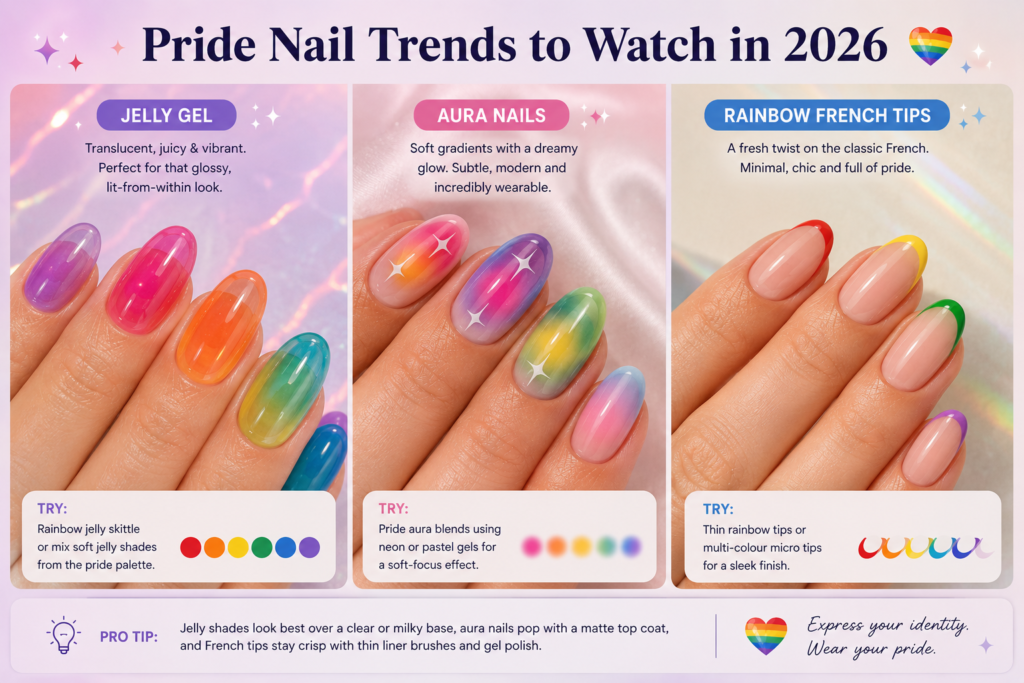
The classic white French tip replaced with a colour arc — each nail a different shade, so the whole hand reads as a spectrum from the front. One of the more editorial-looking pride designs, and it works on short nails just as well as long ones. It doesn’t read as costumey in the way that a full rainbow hand sometimes can.
The angled version — slanted tips rather than curved — tends to look more considered. Adding a tonal outline around each tip takes it from cute to deliberate.
Moderate. Nail guides or tape help get clean lines. The curved version forgives imprecision more than the straight-cut style.
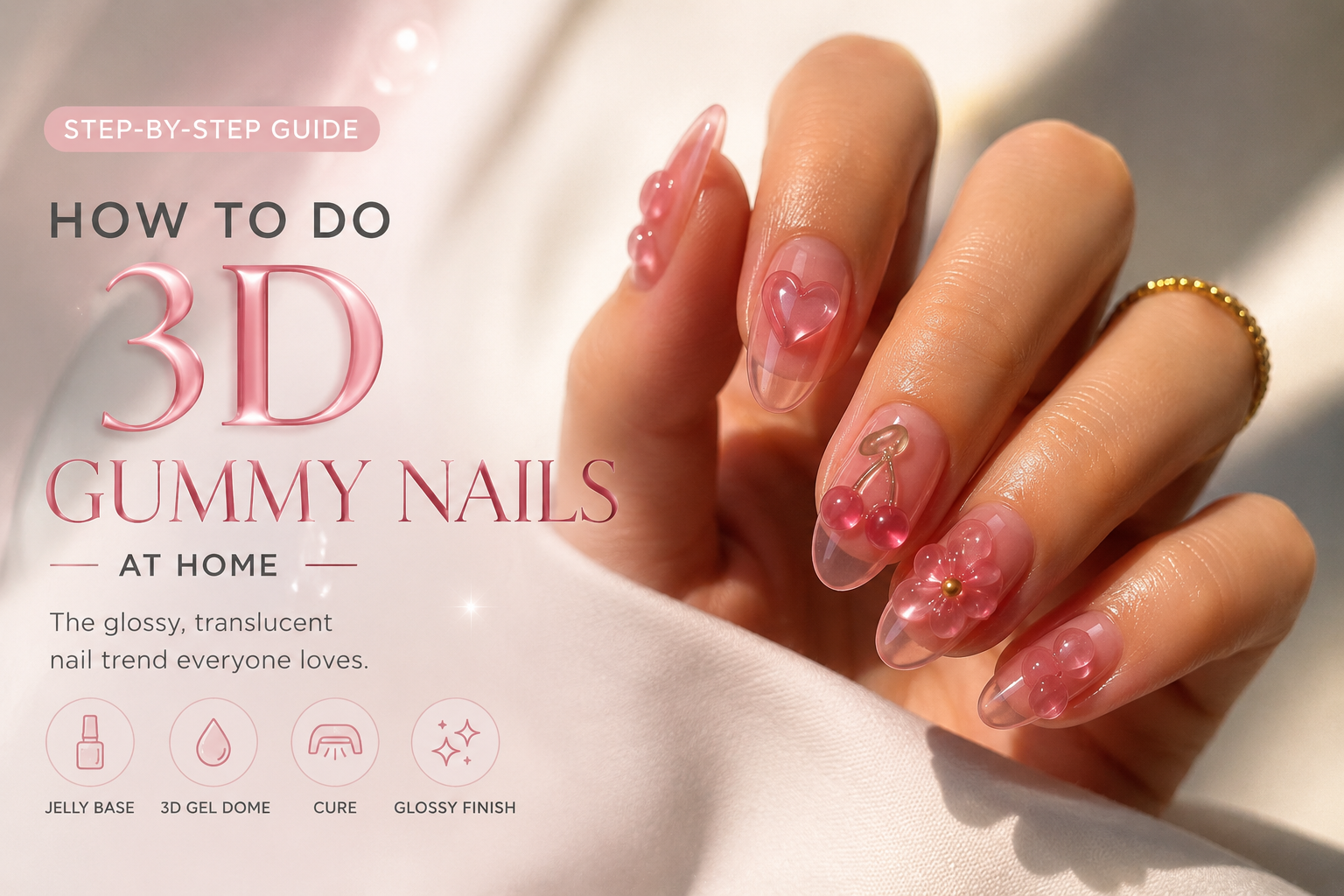
Jelly gel — sheer, glass-like finishes where the nail shows through the colour — has been one of the more consistent gel stories this year. It translates well into pride palettes: a translucent bi-flag pink, a barely-there lavender, a sheer light blue in trans colours. The effect is soft and modern rather than loud, which makes it genuinely office-appropriate while still being intentional.
This works particularly well for bi and trans flag palettes, where the pastels suit the translucent finish naturally.
Easy if you already do gel at home. Apply in thin layers — jelly formulas need two to three coats to build depth without losing translucency.
Aura nails have appeared frequently in nail content this year — a soft, hazy halo of colour dabbed over a base for a blurred, dreamlike effect. The pride version paints each nail a different base colour and adds a softer matching halo on top. Rainbow without being literal about it.
This suits people who want something expressive without being maximalist. The pastel version is the more wearable option for everyday June use; the bright version is better for events.
Moderate. The technique involves stippling colour with a small brush or sponge rather than painting — it takes a few attempts to get the halo effect right without it looking muddy.
A thin band of colour across each tip — different shade per nail — finished with gloss or a chrome top coat. The minimal version of pride nail art: barely-there but reading as the full spectrum when the hand opens.
Chrome top coat looks incredible in sunlight but shows uneven application fast. If your tip lines aren’t clean, gloss is the more forgiving finish.
Easy. One of the few nail art designs that genuinely requires no tools beyond nail guides.
Each nail in its own base colour, deeper matching polka dots layered on top — mint with emerald spots, baby blue with navy, coral with deep red. The whole hand still reads as a spectrum, but the pattern adds texture and makes the set look more considered than a flat skittle.
This sits in an interesting middle ground: maximalist enough to stand out, structured enough to not read as chaotic. The tonal dot approach (each nail’s dots are a deeper shade of the base) tends to look cleaner than mixing unrelated colours.
Easy-moderate. A dotting tool produces more consistent results than a toothpick, but both work.
A full rainbow gradient across all ten nails with glitter through the colour transitions. This is the parade nail — designed to be seen from across the street, to last through eight hours of outdoor heat. It’s not subtle and it isn’t trying to be.
Anyway, the glitter layer compensates for slight imprecision in the colour blending, which makes this more forgiving than it looks. In direct sunlight each nail catches the light differently, which is most of the point.
Moderate-hard. A sponge gradient technique produces softer colour blends and is more beginner-friendly than trying to blend six shades with a brush.
A sheer nude or milky base with a small hand-painted rainbow arc near the cuticle or tip. The quiet version of pride nail art — chic and office-appropriate, but unmistakably intentional to anyone who looks closely. This design has been appearing more frequently in nail inspiration content as people look for ways to show visibility in contexts where a full rainbow hand isn’t practical.
It pairs well with one accent nail in a bolder flag colour — nine nails with the micro arc, one nail in full colour, scales up or down depending on the occasion.
Hard for the hand-painted arc. A nail art pen or the finest brush you own makes this achievable — freehand with a standard brush requires significant practice.
Flag-Specific Nail Designs
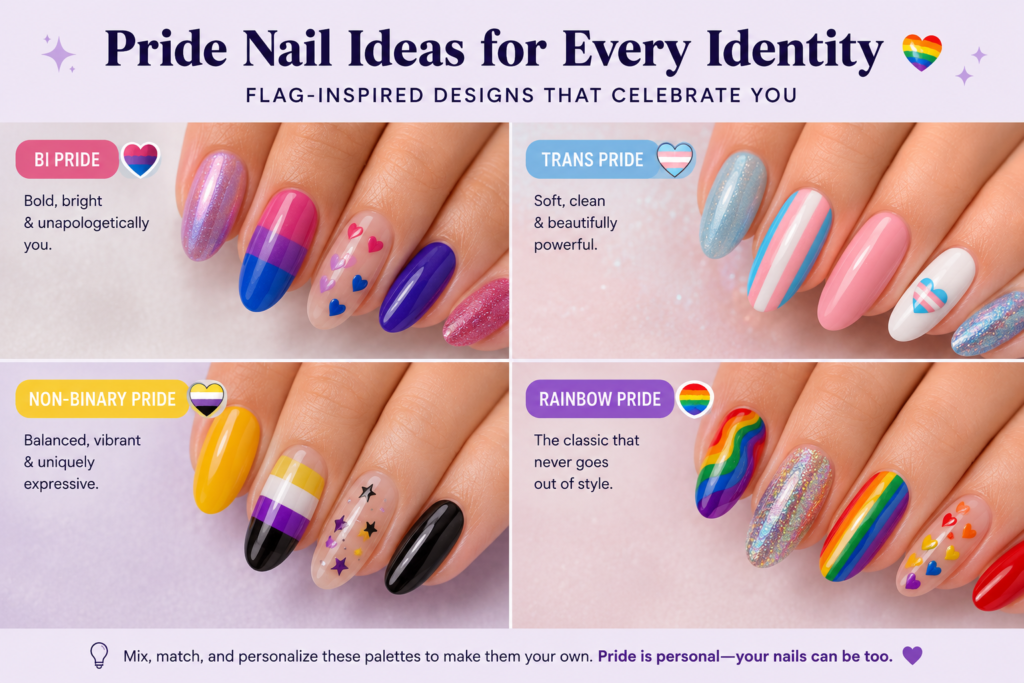
One of the clearest shifts in recent pride nail content is how many people are looking for their specific flag rather than a generic rainbow. Here’s how the most common flag palettes translate into nail art.
The Progress Pride Flag — which adds trans colours and brown/black stripes to the original rainbow — is increasingly used in nail art that represents the wider community rather than a single identity. It’s a more complex palette to work with, but it produces some of the most visually interesting sets when each stripe gets its own nail.
Which Designs Are Actually DIY-Friendly
| Design | Difficulty | Tools needed | Verdict |
|---|---|---|---|
| Skittle nails | ⭐ | Solid colours, top coat | Easy DIY |
| Coloured French tips | ⭐⭐ | Nail guides or tape | Easy DIY |
| Jelly gel (pride colours) | ⭐⭐ | UV/LED lamp, gel colours | Easy DIY |
| Pride polka dots | ⭐⭐ | Dotting tool | Easy DIY |
| Pride aura nails | ⭐⭐⭐ | Small brush or sponge | DIY with practice |
| Rainbow glitter ombre | ⭐⭐⭐ | Sponge, 6+ colours | DIY with practice |
| Micro rainbow arc | ⭐⭐⭐⭐ | Nail art pen or fine brush | DIY with practice |
| Chrome rainbow nails | ⭐⭐⭐⭐⭐ | Chrome powder, no-wipe gel top coat | Salon recommended |
Chrome rainbow nails require a specific rubbing technique applied over a fully cured no-wipe gel top coat. The application is unforgiving — mistakes are visible and difficult to fix at home. If you want the chrome effect for parade day, this is the one design worth booking a salon appointment for specifically.
Why Gel Lasts Longer at Pride Events
Pride month involves conditions that are genuinely hard on nails: outdoor heat, dancing, water, sunscreen, hours of continuous wear. Regular nail polish chips under that kind of use. It just does.
Gel polish cures under an LED or UV lamp into a hard, sealed surface that bonds to the nail plate. It repels water, resists impact, and holds colour saturation for two to three weeks in normal conditions. For the specific demands of a parade or outdoor event, the difference in durability is noticeable.
The jelly gel finish in particular tends to look better than opaque polish in direct sunlight. Opaque colours can wash out in bright outdoor light; the translucent jelly finish deepens slightly, which makes the colour richer as the day goes on rather than flatter.
Salon appointments for pride nail art in June fill up faster than most other times of year. If you want a complex design — chrome, hand-painted flag details, full ombre — two weeks ahead of your event date is a reasonable minimum.
Prep Tips for Pride Nail Longevity
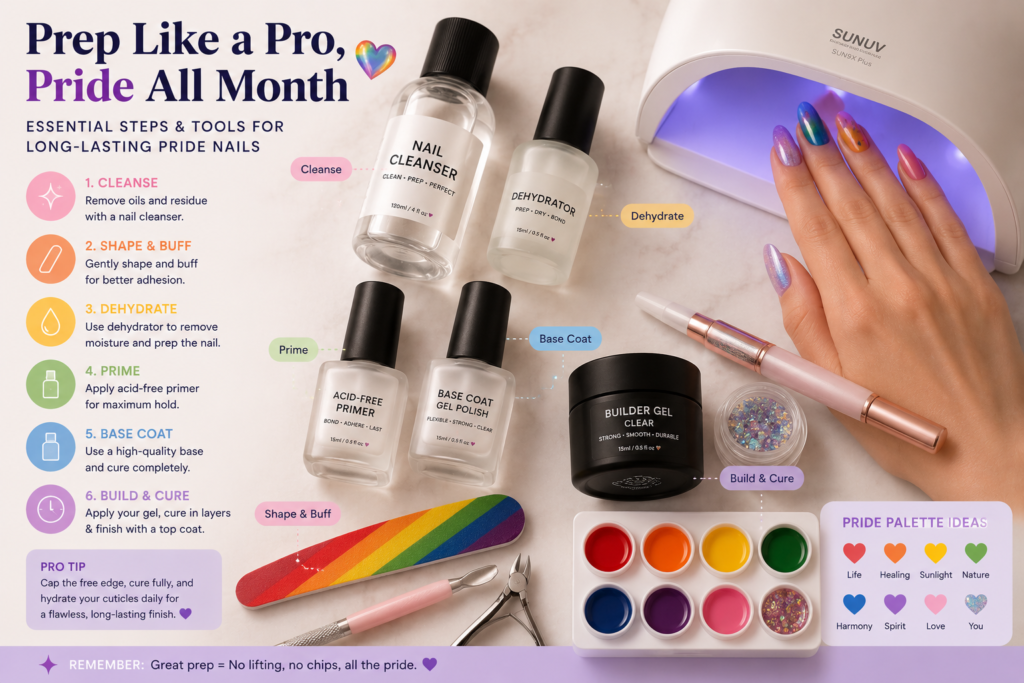
A design that chips by day two is worse than no design at all when you’re wearing it for visibility. Pride events involve outdoor heat, water, and hours of continuous wear — which means the prep routine matters more than usual, not less.
The mistakes that cause early lifting and chipping are the same ones that cause gel to fail in general. Most of them happen before the colour goes on.
- Clean the nail plate thoroughly. Oil and dead cuticle tissue on the nail surface are the primary reasons gel lifts early. Wipe each nail with a lint-free pad and 99% isopropyl alcohol or a nail dehydrator immediately before applying base coat — and don’t touch the plate after that step.
- Cap the free edge on every layer. For designs involving multiple colours, each layer needs its own edge seal. Water gets underneath unsealed tips faster than any other entry point.
- Use a rubber base on naturally flexible nails. A rigid base coat on a flexible nail will crack under movement. A rubber or soft builder base absorbs flex rather than resisting it.
- Apply thin layers and cure fully between each one. Thick layers cure unevenly — the surface hardens while the layer underneath stays soft, which causes peeling rather than lifting.
- Avoid prolonged water exposure in the first 24 hours. Applying the set the night before your event gives it time to fully stabilise before outdoor conditions.
Frequently Asked Questions