Short answer: nail printers do work, but not the way most listings imply. They are inkjet devices that print onto a prepared white or light layer, not onto a bare nail, cured BIAB or a dark gel colour. The print itself takes seconds; the manicure around it does not. They handle bold, high-contrast images well and struggle with white, metallic, fine-edge and edge-to-edge designs. Whether one makes sense depends far more on consumables, surface prep and nail shape than on the DPI figure in the listing.
Nail printers have been on sale for over a decade, and the pitch has barely changed: pick an image on your phone, slide a finger in, and the machine does the art. What has changed is the volume of near-identical listings, many quoting 2400 or 4800 dpi, “10-second” prints and ten thousand designs. This guide sets those claims against what manufacturers say in their own manuals and help pages, what the underlying patents reveal about inkjet printing on nails, and what users report after purchase.
What Is a Nail Printing Machine?
A nail printing machine is a small inkjet printer with a finger bay instead of a paper tray. A camera locates the nail, software fits the chosen image to its outline, and a print head moves across the nail spraying tiny droplets of cosmetic ink without touching it.
Two very different things get sold under the same name. Consumer printers such as Preemadonna’s Nailbot pair with a phone and are designed around regular polish and a proprietary primer. Gel-workflow printers, the category led by O’2NAILS and a large number of unbranded clones, are built around a salon gel system: base gel, base colour gel, a dedicated “print gel”, then a top seal. A third category, robotic painters like Nimble, applies solid polish colour rather than printing images, and is out of scope here.
How Does a Nail Printer Actually Work?
The mechanics are borrowed from paper inkjet printing, and so are the limitations. A 2015 Casio-family patent for a nail print apparatus spells out the core problem plainly: inkjet heads were designed to print on white paper, so the ink’s true colour does not appear unless a white base sits underneath it, which also rules out designs that rely on a clear nail 8. The same patent notes that inkjet nozzles only tolerate inks with very fine pigment particles, which is why gold, silver and white inks with the right coverage are difficult, and why inkjet nail prints can look light and flat without extra layers.
That single fact explains most of what follows. Printed ink is thin and translucent. It needs a light, uniform, receptive surface to sit on, and it needs a protective layer on top.
What Happens Between Choosing a Design and Getting It Onto the Nail?
O’2NAILS describes its V11 process as: basic manicure, base gel or base colour gel as a background, print gel, then print 3. Its own V11 packing list confirms the scale of that system: base gel, base colour gel, print gel, shape gel, top seal gel, cleaner and remover pads, plus the cartridge 1. The smaller M1 ships with its own FM10 cartridge, a print gel and a top seal gel.
Preemadonna’s route is polish-based. Its listing states that the supplied primer is mandatory for the prints to work, and that a white “canvas” polish and top coat are included 6. The same listing adds that printing on light-coloured polishes can leave a slight hazy finish that remains even under top coat.
In both cases, the printer is one step in the middle of a layered manicure, not a replacement for it.
Can Nail Printers Print Directly on Natural, Gel, BIAB and Acrylic Nails?
Listings routinely say “natural or artificial nails”. Read closely, the manufacturers themselves describe something narrower: every system above prints onto a prepared layer. The matrix below separates what is printed on from what sits underneath.
| Surface | Classification | Why |
|---|---|---|
| Bare natural nail | Supported after preparation | Nail plate colour is uneven and not white; patent literature and both manufacturers call for a white/light base plus primer or print gel. Direct printing on a bare nail is not what the systems are designed for. |
| Gel polish (light shade) | Supported after preparation | Requires print gel (gel systems) or primer (Nailbot). Cured gel alone is not described as ink-receptive. |
| Gel polish (dark shade) | Not recommended for colour designs | Translucent inkjet ink does not show colour correctly without a white base (patent US9056491B2). |
| BIAB / builder gel | Supported after preparation | The ink lands on a print layer over the BIAB, not on the BIAB itself. See below. |
| Acrylic | Supported after preparation | Preemadonna names acrylics for its 2.0 universal primer (manufacturer claim). Colour/whiteness of the acrylic still matters. Length limits apply. |
| Gel-X / soft gel extensions | Uncertain / insufficient evidence | No manufacturer documentation found that addresses soft gel tips specifically. Length and curvature are the likely constraints. |
| Press-ons | Supported after preparation | Named by Preemadonna; O’2NAILS ships a single-tip holder. Printing off the hand removes positioning problems, which makes this the most forgiving surface in principle. |
The BIAB question: does the printer print on BIAB?
We found no manufacturer documentation showing direct printing onto cured BIAB without an intermediate printable layer. In every documented workflow, the ink lands on a receptive layer applied over the base. None of the manufacturer material reviewed lists cured builder gel as a print surface, and the gel workflow explicitly places base colour and print gel above the base layer.
For a BIAB wearer, that changes the workflow in three ways. First, a clear or sheer-pink BIAB overlay cannot act as the “canvas”; you need an opaque light colour on top of it, which changes the look many BIAB clients are paying for, since BIAB colours tend to work best when they stay sheer. Second, every extra layer adds thickness at the apex and free edge, so the structure you built with BIAB carries two or three more coats. If you rely on a correctly placed apex for strength, that extra bulk is worth planning for. Third, at the next infill, the printed layer and its supporting colour have to be filed back along with the top seal. That is routine gel removal, but it means printed art does not “grow out” as a separate layer you can refresh without touching the colour underneath.
How Long Does Nail Printing Really Take?
Quoted print times range from Preemadonna’s roughly five seconds to O’2NAILS’ “only 30 seconds” per image. Those numbers describe the print head crossing one nail. They are not manicure times.
Here is what a ten-nail gel print involves, following the O’2NAILS layer sequence with a standard LED lamp:
- Prep. Cuticle work, shaping, dehydrating: the same as any gel manicure.
- Base gel, cure. One coat and one cure cycle.
- Light base colour, cure. Usually two coats for an even white, so two cures.
- Print gel, cure. The receptive layer.
- Print, ten times. Each nail needs insertion, camera detection, fit check, possibly a manual size or position adjustment, and the print pass. Thumbs and pinkies are the slowest to seat.
- Top seal, cure. One coat and one cure.
At 30 seconds per print, the print passes alone total five minutes. Positioning adds to every nail, and the base-colour and print-gel steps add at least three cure cycles that a plain gel manicure would partly include anyway. The honest comparison is therefore not “10 × 30 seconds” but “a full gel colour manicure, plus one extra coat and cure, plus roughly five to ten minutes at the printer”. The printer replaces the nail-art stage, not the manicure.
The polish route shifts the bottleneck. Nailbot’s print may be dry to the touch straight away when the primer is used, according to the manufacturer, but the white canvas polish underneath still has to dry before a finger can be pressed into a cradle without denting it.
How Good Is the Print Quality?
Resolution figures of 2400 and 4800 dpi appear constantly on marketplace listings. They are rarely backed by a named print head or independent measurement, and they matter less than three other factors.
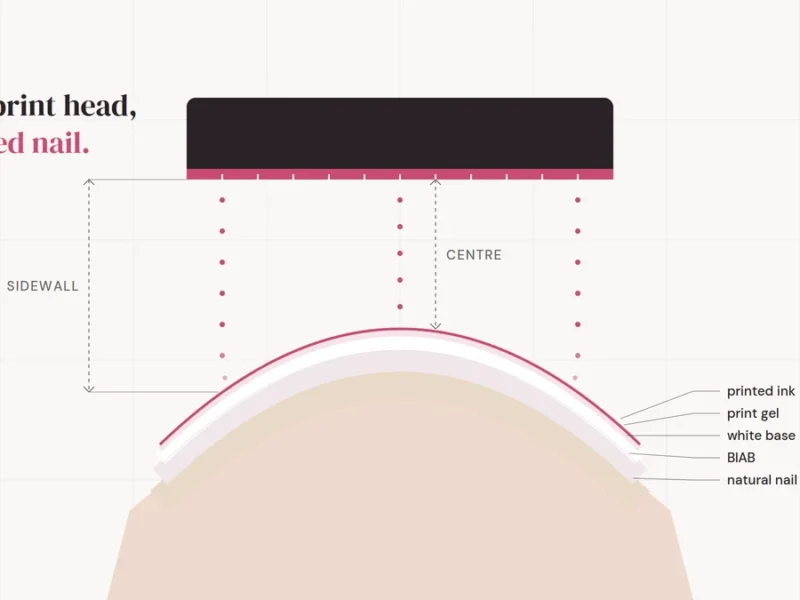
Curvature. A flat print head is sprinkling droplets onto a curved surface. Because the centre of a curved nail can sit closer to the print head than the sidewalls, edge detail may be more vulnerable to softness or placement error, particularly on pronounced C-curves. O’2NAILS reseller guidance asks users to lay the fingertip flat and keep at least 5 mm between nail and nozzle, which shows how sensitive the process is to distance.5
Opacity. Inkjet ink is translucent. The whiteness and evenness of the base decides how saturated the colours look. A cream or pale pink base shifts every colour in the design. Patent literature on inkjet white bases, outside nails, makes the same point: uneven white causes visible streaks and weaker colour in the image printed over it.11
Positioning. Automatic shape detection fits the image to the outline the camera sees. If the finger rolls slightly, the image is placed correctly relative to the photo but wrongly relative to the nail. O’2NAILS acknowledges this indirectly by offering manual adjustment of position and size on top of auto-detection.
Which Designs Print Best?
The NailStyleLab design difficulty framework ranks design types by how many of the known constraints they run into. These are predictions from technical reasoning and the sources above, not results from test prints, and they are the first thing our test protocol is designed to confirm or overturn.
High-contrast line art
Dark ink on a white base is the condition inkjet is designed for. Small misalignment should be less visible than with filled designs.
Simple icons
Centred, bold, with space around them, so they avoid the curved edges where problems are most likely.
Gradients
Soft transitions tolerate slight blur, but lighter tones depend on the base underneath and may show banding.
Photographs
Supported by every app reviewed. Fine facial and background detail is likely to be lost when a full photograph is scaled to a 10–15 mm nail area.
Detailed illustration
Detail should hold best across the flatter centre of the nail and be more vulnerable to softness toward the sidewalls.
Fine typography
Letter strokes at nail scale are very thin, so curvature or a slight finger roll would be expected to affect legibility before it affects bolder shapes.
Skin-tone images
Subtle warm tones are likely to be the most sensitive to an off-white base, and Preemadonna itself notes haze on light polishes.
Metallic-look graphics
Real gold, silver and white inks are hard to jet (patent US9056491B2). Printed “metal” is a flat colour imitation.
White details
Standard CMY/CMYK cartridges have no white. White areas are just unprinted base.
Dark design on dark base
Translucent ink over a dark colour is unlikely to show clearly, which is consistent with the white-base requirement in patent literature.
Edge-to-edge designs
Sidewalls and the cuticle area are where curvature, masking and positioning errors would all be expected to show first.
What the Specification Sheet Doesn’t Tell You
The design library lives in an app
Every system reviewed is operated through a manufacturer app: O’2NAILS over Wi-Fi, Nailbot over Bluetooth with the phone docked. The “1,000 designs” or weekly style updates are a service, not a feature of the hardware. If an app is withdrawn from the stores or a cloud gallery closes, the printer’s usefulness depends on whether local photo printing still works. That is a question to put to the seller, because no listing reviewed answers it.
Proprietary cartridges and generation changes
Preemadonna’s help centre states that only Nailbot cartridges work in the Nailbot system.10 Its current cartridge is sold as the “Nailbot 1.0” cartridge, while the company is promoting a Nailbot 2.0 with upgraded ink and a new primer. Anyone buying a first-generation device should check how long cartridges for their model will be supplied. Third-party refill kits for Nailbot and Casio cartridges do exist on marketplaces, which is a user workaround rather than a supported option.
Cartridge drying and storage
Preemadonna’s yield estimates are conditional: roughly 1,500–2,500 prints, provided the device is used regularly and stored properly. Its help centre recommends warming the cartridge after long idle periods because the ink settles.9 O’2NAILS reseller guidance for the FM10 cartridge is more specific: once opened, print one or two test patterns at least once a week to keep the nozzles moist; unopened cartridges carry a 13-month shelf life. For an occasional home user, that weekly test print is a cost of ownership that never appears in the yield figure.
Nail length limits
O’2NAILS states the V11 does not print beyond 3.3 cm2 and suggests finishing longer nails by hand or with decoration. Long sculpted sets and stiletto extensions can exceed the printable window, which contradicts the “any nail” framing on many clone listings.
Thumbs, pinkies and short nails
Preemadonna describes the Nailbot 2.0 cradle as redesigned to fit all finger sizes, thumbs included. A manufacturer rebuilding the cradle around that point suggests fit was a limitation of the earlier hardware. Narrow pinkies give the camera a small outline to fit; short nails leave little flat area before the curve.
Wear time depends on the system, not the printer
Preemadonna quotes 3–5 days of wear with a top coat, noting that the polish usually chips first. O’2NAILS quotes a retention period of more than a month under its gel top seal. The large difference in quoted wear time appears to come primarily from the protective system over the print rather than the printer itself.
How Much Does Nail Printing Really Cost?
Price checked: September 2026. Cartridge prices from O’2NAILS Italy (official distributor store); kit pricing from Preemadonna. Prices vary by country and change often, so treat these as a dated snapshot.
Current cartridge prices and stated yields
O’2NAILS FM10 (M1, H1): €584, with the Italian distributor quoting approximately 200 prints per cartridge. A US reseller quotes around 450 nails for the same cartridge, measured on a 10 × 19 mm test image, and notes that colour choice and storage reduce the real number.5
O’2NAILS SM10 (F1, V11, X11, X12 series): €78 on the distributor’s product listing (the same site’s page description shows €88, so confirm at checkout), quoted at approximately 500 prints. O’2NAILS’ own V11 page claims 700–800 nails per cartridge.1
Nailbot: the 2.0 kit lists at an MSRP of $299.99, with early-access pricing of $149.99.7 No current published price for the replacement cartridge could be found, so it is left out of the calculation rather than estimated.
Ink cost per nail, from those figures
FM10: €58 ÷ 450 ≈ €0.13 per nail (reseller figure) to €58 ÷ 200 ≈ €0.29 per nail (distributor figure), or roughly €1.30–2.90 per ten-nail set.
SM10: €78 ÷ 800 ≈ €0.10 per nail (manufacturer claim) to €78 ÷ 500 ≈ €0.16 per nail (distributor figure), or roughly €1.00–1.60 per ten-nail set.
These assume prints close to the test size and a cartridge used up before it dries. Weekly maintenance prints, failed prints and edge-to-edge designs all push the real figure higher. Even then, ink is not the largest cost. Each printed set also uses base colour, print gel and top seal, and the machine itself has to be paid off.
Break-even, as a formula rather than a guess: machine price ÷ (what you currently pay for nail art per set − extra consumables per set) = number of sets before the printer pays for itself. A home user who would otherwise add a small nail-art charge at a salon needs many dozens of sets. A salon replacing several minutes of paid hand-painting per client gets there faster, provided clients accept printed art at the same price.
Nail Printer vs Hand-Painted Nail Art
Precision: printers can reproduce photographic detail no brush can, but the curved edges are their weakest area. Hand painting controls the edges and cuticle line far better, and it is the only option for anything built on opaque white, such as a thick 2000s-style French tip.
Speed: for complex imagery, the printer is faster. For simple accents such as a dot, a line or a French edge, a practised hand is often quicker than seating a finger and running the app.
Creative flexibility: printers win on imagery (photos, logos, patterns). Hand art wins on texture, white, chrome, glitter, 3D and anything that relies on real pigment opacity.
Repeatability: ten identical nails, or the same set for three bridesmaids, is where a printer is strongest.
Learning curve: the printer lowers the skill needed for the art, not for the manicure underneath it. A poor base still ruins the result.
Maintenance: a brush needs cleaning; a printer needs cartridge care, firmware and app updates, and supply of proprietary parts.
Is a Nail Printer Practical for Home Users?
For someone who already does gel at home and wants graphic designs occasionally, a printer can work, with two caveats: the cartridge ages between uses, and the white-base requirement shapes every look. For someone hoping to skip manicure skills entirely, the evidence points the other way. The prep, base and top layers are still manual, and they decide how long the print lasts, just as they decide whether builder gel holds up.
Is a Nail Printer Practical for Nail Techs and Salons?
The stronger case is commercial. O’2NAILS positions its desktop series for commercial nail art service, with store-customised pattern libraries. Printed art can be an add-on that takes minutes of tech time rather than the longer time of hand-painted detail. The questions a salon should answer first are client acceptance of the flatter, printed look, the cost of proprietary gels across every client, and service support if the printer is out of action on a booked day.
What We Would Test Before Recommending a Nail Printer
This is the NailStyleLab testing protocol. It has not yet been run; no scores exist. It is published so that any future results can be checked against a fixed method.
Six fixed designs, identical files on every machine: simple black line art; high-contrast floral; fine text (a 6-character word); full-colour photograph; two-colour gradient; detailed nail-art illustration.
Four surfaces: light (white) base; dark base; BIAB overlay with the manufacturer’s required print layer; press-on tip.
Recorded for every print: setup time (base to ready-to-print), print time per nail, full ten-nail time, alignment error (image centre vs nail centre, measured from a scaled photo), edge coverage, visible pixelation at 30 cm, colour match against the source file, failed or repeated prints, cleaning needed, and appearance after top coat and after 7 days of wear.
Scoring: each measure scored 0–4 against written criteria, averaged per design and per surface, so a printer that excels at icons but fails at text cannot hide behind one average. All prints photographed under the same light, same camera distance, with failures published alongside successes.
Questions to Ask Before Buying a Nail Printer
- What exactly must be on the nail before printing? Primer, print gel, white base: are they proprietary, and what do they cost per set?
- Does the app work without an account or cloud gallery? Can you print your own images if the online library disappears?
- Are cartridges proprietary, and for how long will they be sold? Especially for older-generation models.
- What happens to a cartridge left unused for a month? Ask for the cleaning or warm-up procedure in writing.
- What is the maximum printable nail length and width? Check against your longest and smallest nails, including thumbs and pinkies.
- Who repairs it, and where? Warranty terms, service points and parts availability in your country.
Conclusion
Nail printers do what they say at the print head: they put a detailed image on a nail in seconds. The gaps are in what surrounds that moment. The ink needs a light, receptive surface, and none of the systems reviewed documents direct colour printing onto bare nails, dark gel or cured BIAB without a prepared printable layer. The design library depends on an app. Cartridges are proprietary and age between uses. Long, very curved and very small nails sit at the edge of what the hardware handles. For bold, repeatable graphics on a light base, especially in a salon, a printer is a workable tool. For white, metallic, textured or edge-to-edge art, a brush remains the better instrument.
Sources
- O’2NAILS — Mobile Nail Printer V11, official product page — accessed September 2026
- O’2NAILS Digital Mobile Nail Art Printer V11 — Amazon listing (usage instructions, 3.3 cm limit) — accessed September 2026
- Preemadonna Nailbot — Amazon listing (primer requirement, haze on light polish, wear time) — accessed September 2026
- O’2NAILS Italy — Print cartridges FM10 and SM10, price and yield — accessed September 2026
- Nailplayer — FM10 ink cartridge listing (450-nail yield, test area, weekly test print, shelf life, 5 mm distance) — accessed September 2026
- Preemadonna — Nailbot 2.0 overview (universal primer, supported surfaces) — accessed September 2026
- Preemadonna — Nailbot 2.0 Printer Kit (MSRP, redesigned finger cradle) — accessed September 2026
- US9056491B2 — Nail print apparatus (Google Patents) — accessed September 2026
- Nailbot Help Center — Ink Cartridge FAQ (yield, warming, settling) — accessed September 2026
- Nailbot Help Center — Why is my Nailbot not printing? (cartridge compatibility) — accessed September 2026
- US 2021/0363367 — White ink, ink set, and recording method (Justia Patents) — accessed September 2026
FAQ
Can a nail printer print on BIAB?
Not directly, based on manufacturer documentation. It prints on a primer or print-gel layer applied over a light, opaque colour, which sits on top of the BIAB.
Can nail printers print white or gold?
Generally no. Standard nail printer cartridges are colour inks without white, and patent literature explains that white and metallic inks are difficult to jet through fine inkjet nozzles.
How long does a printed nail design last?
Preemadonna quotes 3–5 days on polish with top coat; O’2NAILS quotes over a month under its gel top seal. Longevity depends on the protective system, not the print.
Do nail printers work on dark nail polish?
Colour designs do not show properly on dark bases because inkjet ink is translucent. A white or light base is needed.
How much does it cost per nail to print?
At September 2026 prices for O’2NAILS cartridges (€58–78) and their stated yields, ink works out to roughly €0.10–0.29 per nail, or about €1–3 per ten-nail set, before gels, primers and the machine itself.