
Let me tell you about the time I watched a client’s beautiful BIAB set start peeling at the edges — just nine days after her appointment. She’d done everything right, or so she thought. Good product, reputable salon, no extreme activity. And yet, there it was: a corner lift on her ring finger, spreading slowly like a secret it couldn’t keep.
That moment is what made me obsessed with understanding how to make BIAB last longer — not just in theory, but in the real, everyday way that clients actually live in their hands. I’ve tested preps, tweaked apex angles, watched sets survive dishwashing marathons and ones fail during a single beach holiday. What I’m sharing here is everything that actually moved the needle.
The uncomfortable truth? If your BIAB keeps lifting, peeling, or chipping before the three-week mark, the product is rarely the problem. It’s the process — and almost always, it’s something that happens in the first ten minutes of application.
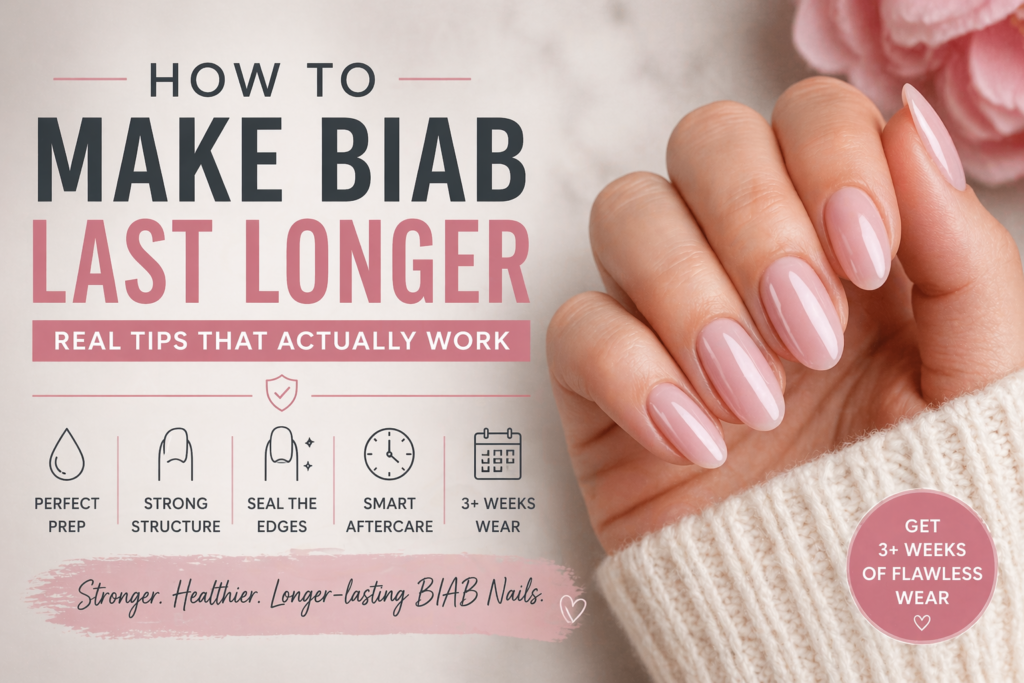
To make BIAB last longer, focus on three things: thorough nail prep (dehydrate and prime every time), proper apex structure that distributes pressure away from the free edge, and complete free-edge sealing at every layer. Pair that with water-smart aftercare and you can reliably hit 3–4 weeks of wear.
Why BIAB Doesn’t Last — The Real Causes
Before we fix anything, let’s name what’s actually going wrong. Most “BIAB failure” stories trace back to four core culprits:

Quick Diagnosis Table — Find Your Problem Fast
Not sure what’s going wrong with your set? Match your symptom to the cause and fix below:
| Problem | Root Cause | Fix |
|---|---|---|
| Peeling after shower | Moisture penetrating unsealed edge; nail expansion under heat | Seal free edge at every layer; wear gloves for hot water |
| Lifting at cuticle | Cuticle film or product applied too close to skin | Remove pterygium; keep a 0.5–1mm skin gap |
| Chipping at tip | Free edge not capped; thin application at apex | Cap the free edge by brushing under the tip; build the apex |
| Snap/break mid-nail | No structural apex; nail too thin | Build a proper apex above the stress zone in zone 2 |
| Yellowing or dullness | Incomplete cure; UV/household chemical exposure | Use a quality top coat; cure fully; apply sunscreen to hands |
| Lifting on one or two nails only | Uneven pressure or dominant-hand use pattern | Reinforce those nails with extra apex; check daily habits |
How to Make BIAB Last Longer — Step by Step
Here’s the full system I recommend, from bare nail to finished set. Each step is non-negotiable if you want consistent 3-week wear.
Prep — The Make-or-Break Stage
Push back and gently remove the pterygium (the thin skin on the nail plate — not the cuticle itself). Buff the surface lightly with a fine file to remove shine. Apply nail dehydrator, let it evaporate fully, then apply primer. These two steps remove oil and moisture and create a chemical key for the gel to bond to. Skip either one and you’re building on sand.
Application — Thin Layers, Full Cure
Apply BIAB in controlled thin layers. Flood the entire nail plate and pull the product to within 0.5–1mm of the skin — never touching it. Thin layers cure more completely and bond more evenly. Thick blobs cure on the outside while remaining soft inside, creating a weak layer that lifts later.
Structure — Build the Apex
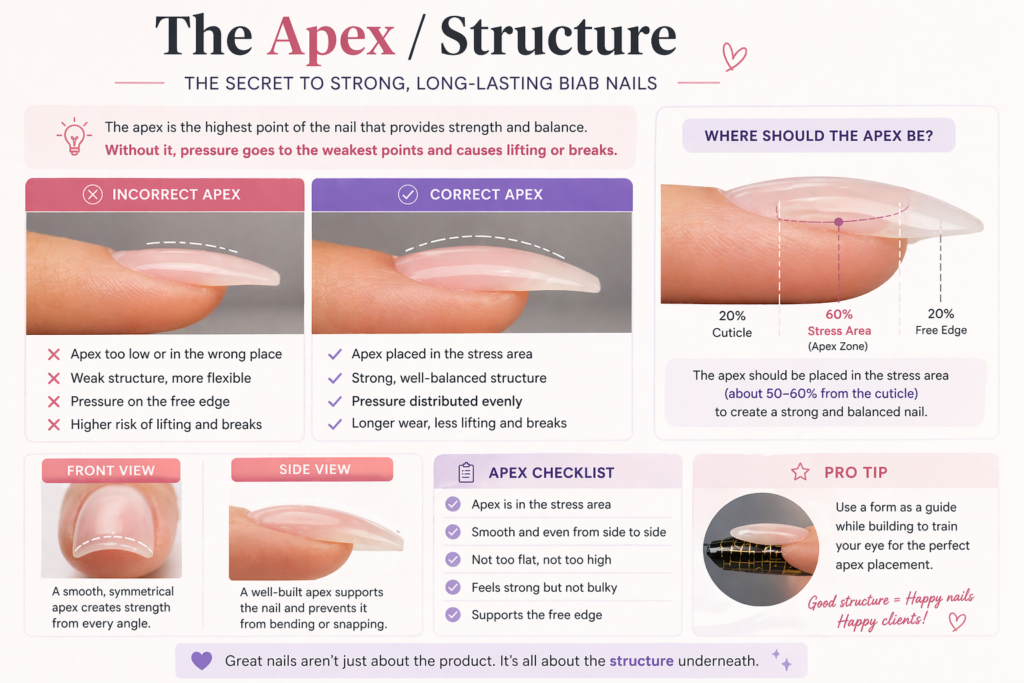
The apex is the highest point of the nail, sitting in zone 2 (the middle third). It’s not just an aesthetic choice — it’s structural engineering. A proper apex redirects mechanical stress away from the cuticle and free edge toward the strongest part of the nail. Without it, every finger tap and jar-opening becomes a micro-lift event.
Sealing — Cap the Free Edge Every Time
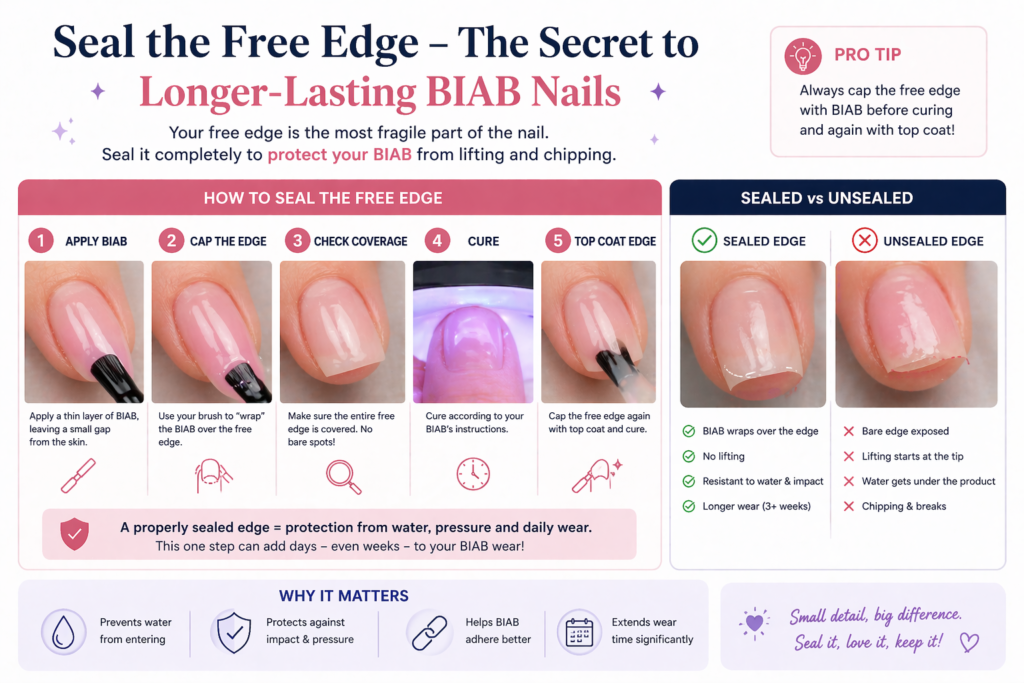
After every gel layer — including the base coat and top coat — drag the brush underneath the free edge to seal it. This is often called “capping” or “wrapping.” It closes the most vulnerable entry point for water and mechanical stress. If you’re only doing this on your final coat, you’re leaving every underlying layer unsealed.
Aftercare — Protect Your Investment
Wear gloves for washing dishes and cleaning. Use cuticle oil daily (it keeps the skin around the nail supple and prevents dry-cuticle pulling at the product edge). Avoid opening cans, peeling stickers, or using your nails as tools. The gel is strong — but it’s not designed for impact from the side of the nail.
Apply a thin layer of gel top coat over your BIAB at the 2-week mark. It refreshes the shine, reseals the free edge, and can add 5–7 extra days of wearable life without a full removal.
Long baths and swimming are the fastest way to break down BIAB adhesion. Hot water causes the natural nail to expand beneath the gel — doing this repeatedly creates micro-gaps that turn into full lifts. Keep soaks short or apply a thin layer of cuticle oil as a barrier before getting in the water.
Never pick or peel lifting BIAB. Even a tiny lift that looks harmless is peeling away a layer of your natural nail with it. File down the lifted edge and seal it, or have it professionally repaired. Picking is the single fastest route to thin, damaged nail plates.
BIAB vs Builder Gel — Which Lasts Longer?
One of the most common questions I get is whether BIAB or traditional builder gel is the more durable option. The honest answer: it depends on your nail type and lifestyle. Here’s a clear comparison:
| Feature | BIAB | Builder Gel |
|---|---|---|
| Flexibility | High — moves with the natural nail | Medium — more rigid structure |
| Durability on short nails | Medium — less edge stress, but thin nail = thin product | High — rigid layer adds more protection |
| Lifting risk | Medium — prep-sensitive | Lower — better for clients with oily nail beds |
| Removal ease | Soak-off in 15–20 minutes | Requires more filing / e-file |
| Nail health impact | Lower — no aggressive removal | Higher if hard gel; lower if soft gel |
| Best for | Natural nail overlay, nail biters, growth | Nail extensions, clients with weak nails |
Why Only Some Nails in Your Set Fail
This is a question that frustrates so many people: most of the set looks perfect, but one or two nails keep lifting or chipping. It’s not random — it’s usually one of three things:
Dominant-hand nails take more mechanical stress from daily tasks. Index fingers and thumbs are the most frequent offenders. Build extra apex thickness on these nails intentionally.
Fan-shaped or very wide nail plates distribute product unevenly, leaving thin spots at the edges. The shape of the nail bed itself changes how gel adheres across the surface.
Scrolling, typing, opening jars — we all have repetitive movements that concentrate force on specific nails. Pay attention to which nails fail first; they’ll tell you exactly which habits to protect against.
If the same nail fails every single time, it’s a structural tell — not bad luck. Ask your nail tech to build that specific nail with a slightly thicker apex and reinforce its free edge seal. Targeted reinforcement beats a full redo every time.
No top coat, no sealing technique, and no premium product will compensate for skipped prep. Dehydration and priming are the foundation — everything else is built on top of them. If you’re troubleshooting a longevity problem, always start there.
✅ How to Make BIAB Last 3+ Weeks — Full Checklist
Frequently Asked Questions
With correct prep and application, BIAB should comfortably last 3–4 weeks. Many clients with good aftercare habits push to five weeks with a fresh top coat applied at week two.
One-week peeling is almost always a prep issue — usually skipped dehydrator or primer, or a pterygium that wasn’t fully removed. It can also be caused by product applied directly onto skin at the cuticle area.
Yes — and it’s one of the most underrated aftercare steps. Cuticle oil keeps the surrounding skin supple, prevents it from drying and catching on the gel edge, and maintains the health of the nail bed underneath the product.
Absolutely. Apply a layer of gel top coat over the existing set at the two-week mark, reseal the free edge, and cure it fully. This refreshes the protective layer and buys you another week without a full removal and redo.
BIAB is significantly more durable than regular gel polish because it builds actual structural thickness on the nail. Regular gel polish is a colour product with minimal structural benefit — BIAB is a builder that happens to come in colours.
Your dominant hand takes more mechanical stress from daily activities. This is normal and expected — the fix is to build a slightly thicker apex on the dominant-hand nails and be more mindful of how you use those fingers in the first week after application.