You’re in the chair, the file’s already in her hand, and she asks what shape you want. Your brain goes blank. So you say “same as last time” — and last time you said the same thing.
Most of us do this. And it’s a shame, because nail shapes aren’t a finishing touch. The shape you file to changes where the nail breaks, how it wears through the month, and whether you spend the next fortnight catching a corner on the inside of a coat pocket.
What follows is the version with the mechanics included — because once you understand how a fingernail is actually built, most of the shape advice floating around either makes sense or falls apart.
Start with what a fingernail actually is
A fingernail isn’t one solid sheet of keratin. It’s a laminate — three bonded layers, and they don’t behave the same way.
The dorsal layer on top is only a few cells thick. The ventral layer underneath is thinner still, just a couple of cell layers, and its job is to interlock with the nail bed. Sandwiched between them is the intermediate layer, which does most of the structural work: it’s roughly two-thirds of the plate’s thickness, with the three layers sitting at about a 3:5:2 ratio.1,2 The whole thing is only around 0.25–0.6 mm thick on a fingernail.2
Here’s the part that matters for shape. In that thick intermediate layer, the keratin fibres run transversely — across the nail, parallel to the free edge, rather than along the direction of growth.1,3
Which has a consequence you’ve probably experienced without knowing why.
When researchers at Manchester tore fingernail clippings and measured how they fractured, cracks were consistently diverted transversely — parallel to the free edge — rather than running lengthwise down into the nail bed.3
That’s the transverse fibre alignment doing its job. A crack tries to travel between fibres, and between-fibre is sideways. It’s a genuinely elegant bit of engineering: your nail is built so that damage peels off the end rather than tearing into living tissue.
It also explains lamellar splitting — that horizontal, layers-peeling-apart fraying at the tip that dermatology calls onychoschizia.4 You’re not doing anything unusual. You’re seeing the nail fail along its designed plane.
Two decisions, seven names
Every shape you’ve heard of comes down to two variables: how straight the sidewalls run, and how much material comes off the corners. Squoval, ballerina, “soft square” — all of them are just different answers to those two questions.
And there’s a published position on the answer, which surprises most people. The American Academy of Dermatology’s guidance is to cut fingernails almost straight across, then slightly round the corners — their phrasing is “for maximum strength,” and they add that rounded corners stop nails catching on clothing and furniture.5,6
Read that carefully. Straight edge, softened corners. That’s a squoval. The strongest everyday geometry, according to the leading general dermatology body, is the shape most people think of as the boring default.
Square
Straight sides, sharp cornersFiled straight across, corners left at a true right angle. It’s what you drift into when nobody’s steering, because straight across is the easiest thing to do with a file.
The corners are the problem, and the AAD names it explicitly — unrounded corners catch on clothing and furniture.6 A caught corner is a sudden off-axis load on a very thin laminate, and that’s where a lot of breaks begin.
Styling-wise, the convention is that square suits longer, narrower nail beds and exaggerates width on short wide ones. That’s an aesthetic observation rather than a measured effect, but it holds up well enough in practice that most technicians work from it.
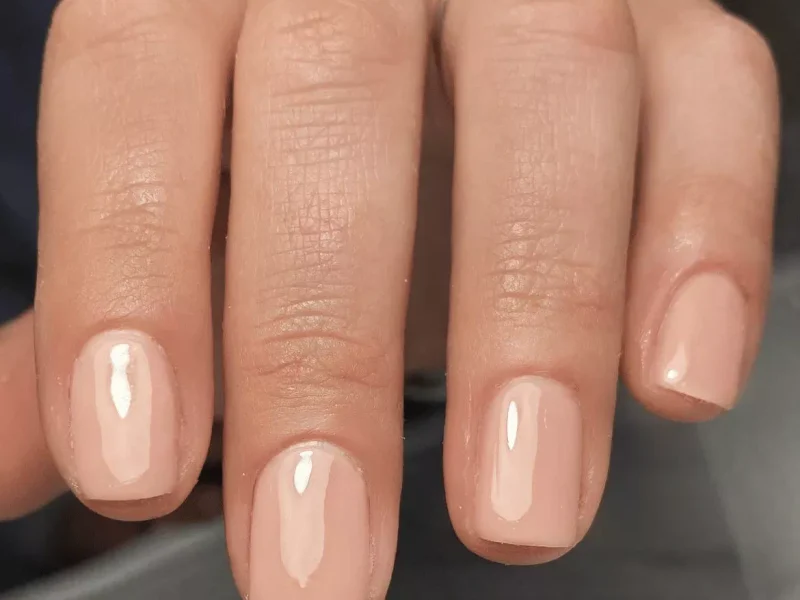
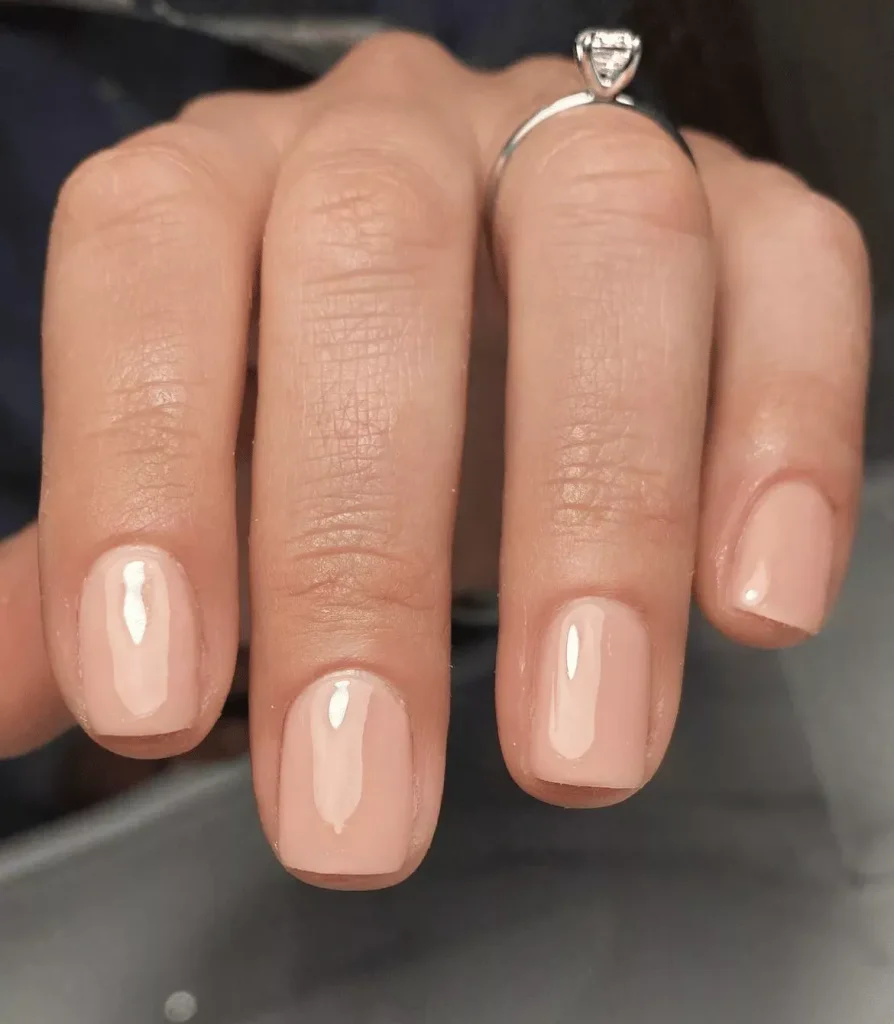
Squoval
The dermatology-endorsed defaultA square with the corners softened into a shallow curve. This is, almost exactly, the AAD’s described geometry.5,6
Rounding those two corners removes the snag point while keeping the clean straight edge that makes a manicure read as deliberate rather than grown-out. It suits nearly every nail bed, and it costs you very little visually.
People dismiss it as safe. It’s safe in the way a good foundation is safe — it lets everything else be the interesting part.
Round
Short nails, minimal exposureThe edge follows the fingertip’s curve, with no straight section at all.
Round sits closest to the AAD’s underlying logic taken to its conclusion: no corners, minimal free edge extending past the fingertip, so there’s very little nail available to be levered against in the first place. It’s the shape for anyone who types all day, gardens, lifts, or plays anything with strings.
It doesn’t elongate the finger the way oval does. But it looks tidy at every stage of growing out, which quietly matters more than people expect.
Oval
Elongating, at a liveable lengthRound, but you carry the curve up the sidewalls rather than stopping at the tip. The result is an egg-shaped outline that visually stretches the nail bed.
This is where technique starts to show. You’re removing material from the sidewalls, and it’s easy to take slightly more from one side than the other — which reads as a nail that looks faintly rotated on the finger. You won’t be able to name what’s wrong. It’ll just look off. File from directly above rather than from the side, where the asymmetry hides.
Almond
Tapered to a soft pointSidewalls taper towards a rounded peak. Currently the most-requested shape in salons, and frequently the most disappointing — because a convincing almond needs length to taper into. On a short nail the taper begins too near the tip and you get a pinched oval instead.
Here’s the trade-off, and I want to be clear that this is mechanical reasoning rather than a measured finding: tapering removes width from the sidewalls while the length stays. Narrower cross-section, same everyday loads. It’s the same logic as thinning any beam, and it’s consistent with why tapered shapes need reinforcement in practice — but no one has run the fracture tests on filed shapes specifically. Treat it as sound reasoning, not established data.
Practically, this is why almond and builder gel appear together so often. The overlay restores structural width the shape gave away.
Coffin (ballerina)
Tapered, then squared offAlmond’s tapering sidewalls with the point filed flat. Nobody’s nails grow this way, which is rather the point — it’s meant to look constructed.
It combines the two things that cost you strength: narrowed sidewalls and a squared-off edge with corners. On natural nails, at the length the shape actually needs, it rarely survives a fortnight.
Stiletto
Full taper to a pointAlmond taken to its logical extreme. It photographs beautifully and functions badly.
Realistically an occasion shape — worn for an event, filed back afterwards. If you want the elongated line without the consequences, a well-filed almond gets you most of the way there.
Which nail shapes suit which hands
A note on what this table is. The strength column is grounded in the AAD’s rounded-corner guidance and the fracture behaviour above. The flattery column is styling convention — technicians work by contrast, matching a shape that opposes the nail bed’s dominant dimension. It’s craft knowledge, not measured, and worth taking as such.
| If your nails are | Conventionally suits | Approach with care |
|---|---|---|
| Short and wide | Oval, round, soft almond | Square — emphasises width |
| Long and narrow | Square, squoval | Stiletto — over-elongates |
| Very short beds | Round, squoval | Coffin — no room to taper |
| Thin and flexible | Round, squoval, short oval | Anything tapered at length |
| Thick and strong | Almond, coffin, squoval | Few restrictions |
Most guides collapse them into one, and then the advice contradicts itself. Long fingers with short, wide nail beds is a very common combination — and “long fingers, go square” pulls directly against “wide beds, go oval.”
When they clash, follow the nail bed. That’s the surface people actually look at.
Choosing yours, in five decisions
- Look at one nail from directly above. Is the bed wider than it is long, or longer than it is wide? This single observation rules out more shapes than anything else.
- Be honest about length. Almond, coffin and stiletto all need free edge to taper into. If you live at or just past the fingertip, you’re choosing between round, oval and squoval — which is a good shortlist, not a compromise.
- Audit your week. Keyboards, small children, gardening, instruments, boxes. And water: repeated wetting and drying is a recognised contributor to brittle nails and splitting.4,7 Gloves for washing up are unglamorous and they work.
- Check the corners against your habits. If you’re constantly catching a nail, square is working against you and softening the corners solves it with almost no visual cost.6
- Judge at week three, not day one. Fingernails grow at roughly 3 mm a month, taking about six months for a full replacement.2 Give a new shape a real portion of that cycle before deciding.
Sawing back and forth. The AAD is unambiguous on this: always pull the file across the nail in the same direction, because back-and-forth filing weakens nails.5,6
The mechanism follows from the laminate structure — sawing shears across bonded layers whose fibres are already aligned transversely, encouraging exactly the separation that shows up as lamellar splitting at the tip.1,4
One direction, sidewall inwards, each side separately. It’s slower. It’s also the difference between an edge that holds for three weeks and one that frays by Thursday.
Where shape stops being separate from structure
Past a short round or squoval, you can’t really discuss shape without discussing what’s holding the nail together.
Remember the numbers: a fingernail is a laminate of well under a millimetre, and its strength comes largely from that transversely fibred middle layer.1,2 Every filing decision that narrows the plate takes away material from a structure that didn’t have much to spare.
Which is why two clients can get identical product from the same technician on the same day, and one wears it four weeks while the other lifts by week two. Frequently it isn’t the gel. One of them asked for coffin at length on a naturally flexible nail.
How to ask for a shape without being misunderstood
Shape names travel badly between salons. One technician’s almond is another’s oval, and “not too pointy” isn’t a measurement. Two phrasings that survive translation:
Describe the sidewalls and the tip separately. “Straight sides, and soften the corners just enough that they don’t catch” produces a squoval every time, whatever your technician calls it — and it happens to be the geometry dermatologists describe.5
State length first, shape second. “Keep the length where it is, taper the sides slightly” is far safer than “almond please,” which some technicians hear as permission to add length.
If a shape has broken in the same spot more than once, raise it at the start of the appointment rather than the end. It usually points to over-thinned sidewalls or a length the shape can’t support — a two-minute adjustment, not a re-do.
Moving within a family is easy — round to oval, square to squoval — because you’re only removing material. Coffin back to square is the one that needs patience: the sidewalls have already been narrowed, so you’ll need to grow that width back before a straight edge stops looking pinched. At roughly 3 mm a month,2 budget a couple of months.
Frequently asked questions about nail shapes
Which nail shape is strongest?
A straight edge with slightly rounded corners — a squoval — is the strongest everyday shape, and it’s what the American Academy of Dermatology recommends for maximum strength, because rounded corners stop nails catching on clothing and furniture.5,6 Round follows the same principle with even less exposed edge.
Why do my nails split across rather than down?
Because the keratin fibres in the thick middle layer of the nail plate run transversely, across the nail rather than along it, so cracks are diverted sideways parallel to the free edge instead of running into the nail bed.1,3 Horizontal layering at the tip is called onychoschizia and is strongly linked to repeated wetting and drying, chemical exposure and nail cosmetics.4
What nail shape makes fingers look longer?
Almond and oval are conventionally considered the most elongating, because narrowing the sidewalls draws the eye lengthwise. This is styling convention rather than a measured effect — but oval delivers most of it at a far more practical length.
Can you do coffin nails on short natural nails?
Not convincingly. Coffin needs enough free edge for the sidewalls to taper before the flat tip begins, so on short natural nails it reads as a narrow square while combining both structural weak points — narrowed sides and squared corners. Extensions or a builder gel overlay are what make the shape viable.
How often should nails be reshaped?
Every two to three weeks suits most shapes. Fingernails grow at roughly 3 mm per month,2 so the widest point of the nail bed moves forward steadily and the original outline stops matching what’s underneath — which is why a manicure can look subtly wrong without anything having chipped.
The strongest shape and the safest filing technique are both published, both boring, and both free: straight edge with softened corners, filed in one direction.5,6
Everything past that is styling — worth doing, worth enjoying, but worth doing with your eyes open about what each taper costs you.
- Wang B, Yang W, McKittrick J, Meyers MA. Keratin: structure, mechanical properties and biological function — nail plate layers and transverse fibre orientation.
- Agno Pharmaceuticals. Skin and Nail: Barrier Function, Structure and Anatomy — plate thickness, 3:5:2 layer ratio, growth rate.
- Farren L, Shayler S, Ennos AR. The fracture properties and mechanical design of human fingernails. Journal of Experimental Biology, 2004.
- Medscape. Brittle Nail Syndrome — onychoschizia, precipitating factors.
- American Academy of Dermatology. Tips for healthy nails.
- American Academy of Dermatology. How to trim your nails.
- Mayo Clinic. Fingernails: do’s and don’ts for healthy nails.