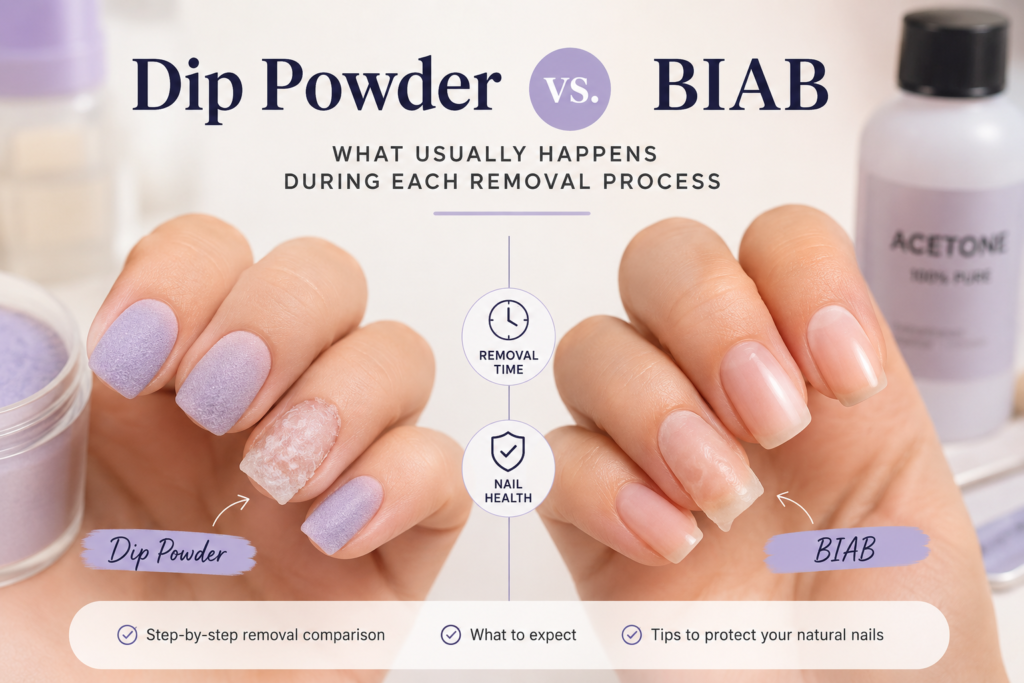
Dip powder removal usually takes longer and needs more filing before the product softens in acetone. BIAB tends to soften more evenly once the top seal is broken, which is why it’s often perceived as the gentler, more straightforward option. In both cases, nail damage comes mostly from rushing or forcing product off — not from the product itself.
Both dip powder and BIAB removal require patience, but the process does not feel exactly the same. BIAB typically softens more evenly during soaking, while dip powder often takes longer to break down and may require additional filing. In most cases, the risk of nail damage comes from peeling, scraping too aggressively, or rushing the removal process rather than the product itself. If you’re deciding between the two, BIAB removal is often perceived as the gentler and more straightforward option, while dip powder removal can feel more time-consuming and labor-intensive.
Removing nail enhancements at home often sounds easier than it actually is. You set aside some time, grab your acetone, and expect the product to slide off after a quick soak. Then 20 minutes later, you’re still scraping away and wondering if you’re doing something wrong.
At first, dip powder and BIAB removal can seem almost identical. Both involve filing, acetone, and patience. The differences usually become obvious halfway through the process, when one product starts lifting easily while the other still feels firmly attached to the nail.
That’s why someone who finds BIAB fairly straightforward to remove can still be surprised by how stubborn dip powder feels during the soaking stage. While both methods rely on similar tools and techniques, the experience can feel surprisingly different.
In this guide, we’ll break down what usually happens during dip powder and BIAB removal, how long each process typically takes, and which option tends to be easier on natural nails when removed correctly. If you want the full step-by-step walkthrough for one specific product, our guide on how to remove BIAB nails at home covers the process in more detail.
Quick Comparison
| Factor | Dip Powder | BIAB |
|---|---|---|
| Removal Time | Longer | Usually shorter |
| Filing Required | More | Less |
| Acetone Soaking | Required | Required |
| Risk of Damage | Medium | Low-medium |
| Beginner Friendly | Moderate | Easier |
| Salon Removal Cost | Similar | Similar |
Bottom line: BIAB is usually easier to remove because it softens more evenly in acetone, while dip powder often requires more filing and longer soaking times.
What Happens During Dip Powder Removal
Dip powder removal generally starts the same way as most acetone soak-offs: file down the top layer, wrap in acetone-soaked cotton and foil, wait. Where it tends to differ is in how much filing that first step actually requires. Dip powder builds up in layers — often more layers than a standard BIAB application — and the product can be denser in places, particularly near the tip where extra coats are common.
You may think the product is ready to come off, only to find stubborn layers still clinging to the nail after another round of soaking. That’s a common experience with dip powder specifically. It doesn’t always soften at the same rate across the whole nail, so by the time the edges have lifted, the center might still feel solid.
The usual fix is a second or even third soak. Most people find that a 15-minute wrap isn’t quite enough for dip powder the way it often is for other products — closer to 20–25 minutes tends to get better results, and even then some areas may need a touch more filing afterward to fully clear.
In salons, dip powder often takes longer to remove simply because more of the product needs to be filed away before acetone can do its job. It’s less about the acetone working slower and more about the extra layering standing in the way first.
What Happens During BIAB Removal
BIAB tends to behave a bit more predictably during removal. According to The GelBottle’s removal guide, the standard soak-off method involves filing down the top coat to break the seal, wrapping the nail in acetone-soaked foil, and letting it sit for 10 to 15 minutes before checking whether the product has softened enough to gently push away.
One reason BIAB is often considered easier to remove is that, after the top seal is filed away, the product tends to soften more consistently across the nail. There’s less of that patchy, some-areas-ready-others-not experience that’s common with dip powder. It still needs the same patience — rushing it or forcing product off before it’s softened is exactly what causes damage — but the actual softening tends to happen more uniformly across the nail.
- Dip powder often requires more filing before soaking
- BIAB usually softens more evenly in acetone
- Dip powder can leave stubborn patches that need additional soaking
- Nail damage is usually caused by picking or peeling, not the product itself
Side-by-Side Comparison
Putting the two side by side, the biggest practical difference is in the filing stage. Dip powder’s layered build-up means more pre-soak filing, and that filing has to be judged carefully — too little and the acetone can’t penetrate, too much and you’re at risk of thinning the natural nail before you’ve even started soaking.
Many people reach the point where the edges start lifting and assume the rest of the product is ready to come off. That’s often where mistakes happen, especially with dip powder — the outer ring softens first, but the center can still be holding firm underneath.
| Category | Dip Powder | BIAB |
|---|---|---|
| Time Required | 7/10 | 5/10 |
| Physical Effort | 8/10 | 5/10 |
| Beginner Difficulty | 7/10 | 4/10 |
| Risk of Over-Filing | 8/10 | 5/10 |
How we scored: ratings reflect commonly reported removal experiences from nail technicians, salon guidance, and manufacturer removal recommendations. Individual results vary depending on product brand, thickness, and technique used.
The extra effort required during removal is largely a trade-off for durability. Many people choose dip powder specifically because it can withstand daily wear better than softer enhancement systems.
Nail Damage Comparison
When people talk about dip powder or BIAB removal, the conversation usually ends up in the same place: protecting the natural nail. The products themselves aren’t inherently more or less damaging. The American Academy of Dermatology’s guidance on artificial nails points to the removal process — soaking and filing — as the part that carries the most risk for natural nail health, regardless of which enhancement you’re wearing.
| Concern | Dip Powder | BIAB |
|---|---|---|
| Nail Thinning | More common | Less common |
| Over-Filing Risk | Higher | Lower |
| Lifting During Removal | Common | Less common |
| Post-Removal Dryness | Similar | Similar |
Editorial note: this comparison is based on manufacturer instructions, salon removal practices, and commonly reported experiences from nail technicians. Removal difficulty and damage risk can vary depending on the specific brand, product thickness, and technique used.
- Peeling product off the nail
- Using metal tools too aggressively
- Skipping the filing step
- Rushing acetone soaking time
- Over-buffing the natural nail
If you’ve struggled with lifting before either product was even removed, it’s worth understanding why that happened in the first place — our guide on why BIAB nails lift covers the most common causes, several of which apply to dip powder too.
Which Takes Longer?
Dip powder, in most cases. The extra layering and the uneven softening mean you’re more likely to need a second soak, and the filing stage alone usually takes longer than it does with BIAB. A realistic estimate for dip powder removal at home is 30 to 45 minutes from start to finish; BIAB tends to land closer to 20 to 30 minutes when everything goes smoothly.
That said, a particularly thick or older BIAB set — one that’s been infilled multiple times, for instance — can take just as long as a dip powder removal. Thickness and how long the product has been on matter more than the product category alone.
Which Is Better for Natural Nails?
Neither is inherently better or worse — but BIAB removal tends to be gentler in practice simply because it requires less filing overall, and less filing generally means less opportunity for accidental over-filing into the natural nail plate.
If you want to minimise risk regardless of which product you’re removing, the principle is the same: file just enough to break the seal, soak fully before attempting to push product off, and never force anything that isn’t sliding away easily. That single habit matters more than which product you chose in the first place.
Who Might Prefer BIAB or Dip Powder?
Most people don’t choose BIAB or dip powder based on removal alone. Wear time, maintenance, durability, and personal preference usually play a bigger role. Choose BIAB if you do your own nails at home regularly and want a removal process that’s more forgiving for beginners, or if you’d rather spend less time filing each time you take a set off. Choose dip powder if durability and chip resistance matter more to you than removal convenience — plenty of people are happy to put in the extra filing time in exchange for a set that holds up exceptionally well day to day.
| If You Want | Better Choice |
|---|---|
| Easier removal | BIAB |
| Less filing | BIAB |
| Maximum durability | Dip powder |
| Beginner-friendly removal | BIAB |
| Longer wear time | Dip powder |
If your priority is easier removal and less filing, BIAB is usually the simpler option.
If your priority is long-lasting wear and durability, dip powder may be worth the extra removal effort.
In both cases, proper removal technique matters far more than the product itself.
Before You Start: Quick Checklist
- ☐ Acetone ready (pure acetone works faster than standard remover)
- ☐ Nail file ready (120–180 grit)
- ☐ Cuticle oil prepared for after
- ☐ Cotton pads and foil available
- ☐ 30–45 minutes set aside, depending on product
If acetone alone isn’t getting you anywhere even after proper filing, the issue is sometimes the prep underneath rather than the removal technique itself. Our piece on nail prep for beginners covers what a clean base actually involves, which can affect how product behaves both during wear and at removal.
And if you’re noticing cracking in the product before you’ve even started the removal process, that’s worth a separate look — why builder gel cracks walks through the most likely causes, several of which can make removal trickier than usual.
Estimated removal times in this guide are based on manufacturer guidance and commonly reported salon practices. Actual results vary depending on product thickness, brand, and the technique used at home.
Frequently Asked Questions
In most reported experiences, yes. Dip powder tends to be denser and often requires more filing before it softens evenly in acetone. BIAB usually softens more uniformly once the top seal is broken, which is why people often perceive it as the quicker removal.
The basic method is the same — file, soak in acetone, gently push off softened product, hydrate. What differs is the amount of filing needed beforehand and how long the soak typically takes for each.
Neither product inherently causes more damage than the other. Damage usually comes from technique — peeling, picking, over-filing, or rushing the acetone soak — rather than from the product itself. Dip powder removal involves more filing steps, which increases the opportunity for over-filing if you’re not careful.
Many people find BIAB removal more straightforward at home because it requires less filing and tends to soften more evenly. Dip powder can feel more labor-intensive, particularly for beginners who aren’t used to judging how much filing is enough.
Not effectively. Dip powder is a durable, layered product that needs acetone to break down fully. Filing alone can remove some of the surface layer, but attempting to file or peel off the rest without soaking significantly increases the risk of nail plate damage.
Most people can reapply BIAB within 24 to 48 hours of removal, once the nail has had a chance to rehydrate with cuticle oil. If the nails feel thin, dry, or sensitive after removal, waiting a few days longer and focusing on hydration tends to give better results for the next application.
Final Thoughts
If you’re choosing between dip powder and BIAB purely from a removal perspective, BIAB is usually the easier option. However, easier removal doesn’t automatically make it the better product for everyone. Wear time, durability, maintenance, and personal preference all matter just as much.
Healthy nails can usually tolerate either system well when removal is done patiently and without excessive filing. Patience, proper soaking, and avoiding aggressive scraping have a much bigger impact on nail health than whether you’re removing dip powder or BIAB.
Waiting a little longer rarely causes problems. Trying to remove product before it’s fully softened often does.