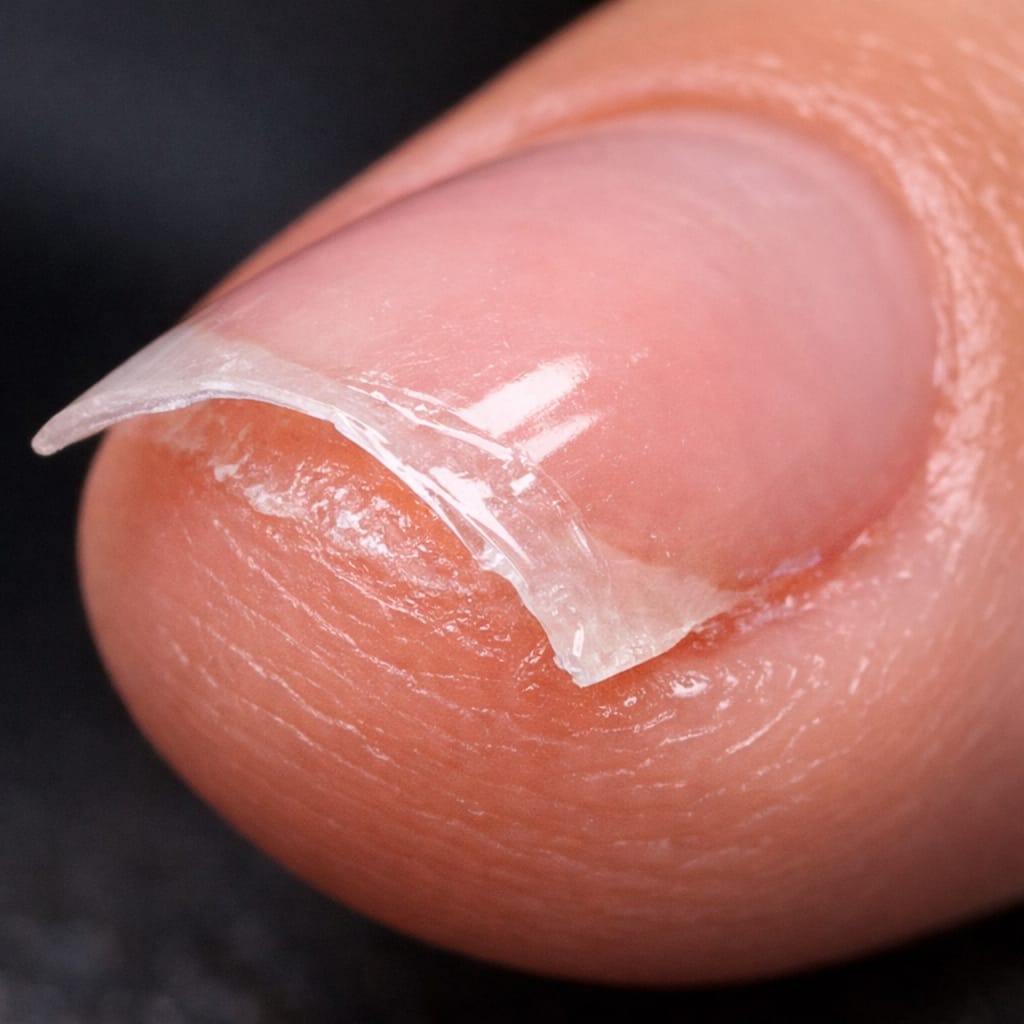
Why Builder Gel Breaks on Short Nails (Even When Applied Correctly)
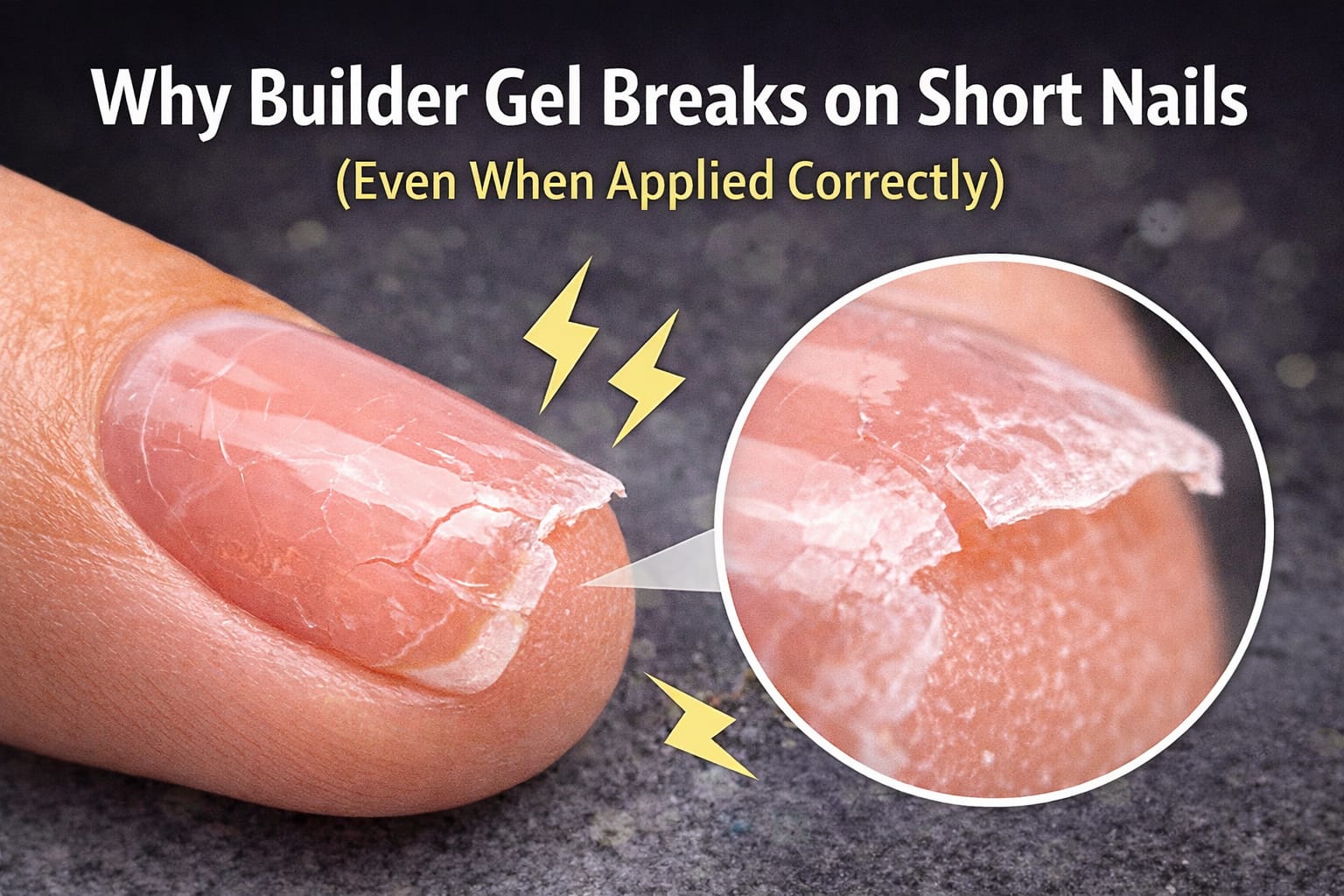
Here’s something that doesn’t get talked about enough: builder gel breaking on short nails is rarely about the nails being short. I know that sounds backwards. But in most cases, the length is not the problem — it’s what’s happening on top of it. The product thickness, the cure time, the base you’re using, the filing pressure — any one of these can turn a perfectly good short nail into a nail that cracks within a week. Let’s get into it.
First, let’s clear something up about short nails and builder gel
There’s a pretty common assumption in the nail world that short nails just aren’t “strong enough” for builder gel — that the nail needs some length to support the product. This isn’t really true. Builder gel works just fine on short nails. It works on bitten nails, on peeled nails, on nails that have seen better days. The gel doesn’t care about length. What it cares about is the surface it’s bonded to, how it’s been applied, and how much stress it’s being asked to absorb.
Short nails actually have one advantage that longer nails don’t: almost no lever force. There’s no long free edge acting as a lever arm against the bond. So if your builder gel is breaking on short nails, something else is going on — and that’s actually good news, because something else is fixable.
1. The product is too thick for the nail length

This is the most common reason builder gel breaks on short nails, and it makes sense once you think about the mechanics. Builder gel is designed to add structure — it’s rigid when cured. On a longer nail, that rigidity is spread across a larger surface area and the nail has enough length to flex slightly before the stress concentrates anywhere. On a short nail, there’s nowhere for that stress to go.
When you apply a thick layer of builder gel to a short nail, you’re essentially creating a rigid shell over a very small, very mobile surface. The fingertip moves constantly — typing, gripping, pinching — and that movement transmits directly into the product. A thick, stiff product can’t absorb it. So it cracks.
Building the apex (the thickest point of the gel) too close to the free edge on a short nail concentrates all the structural stress in the most vulnerable spot. On short nails, the apex should sit closer to the centre of the nail plate — not near the tip.
The fix is simple but it requires restraint: use less product. One thin layer of builder gel on a short nail is often all you need. Two thin layers is usually the ceiling. The nail doesn’t need the same build you’d put on a medium or long nail — it doesn’t have the surface area to carry it.
2. Over-curing is making the gel too brittle
This one surprises people. Most nail techs know that under-curing is a problem — soft, tacky product that never fully hardens. But over-curing is real too, and it’s especially damaging for builder gel on short nails.
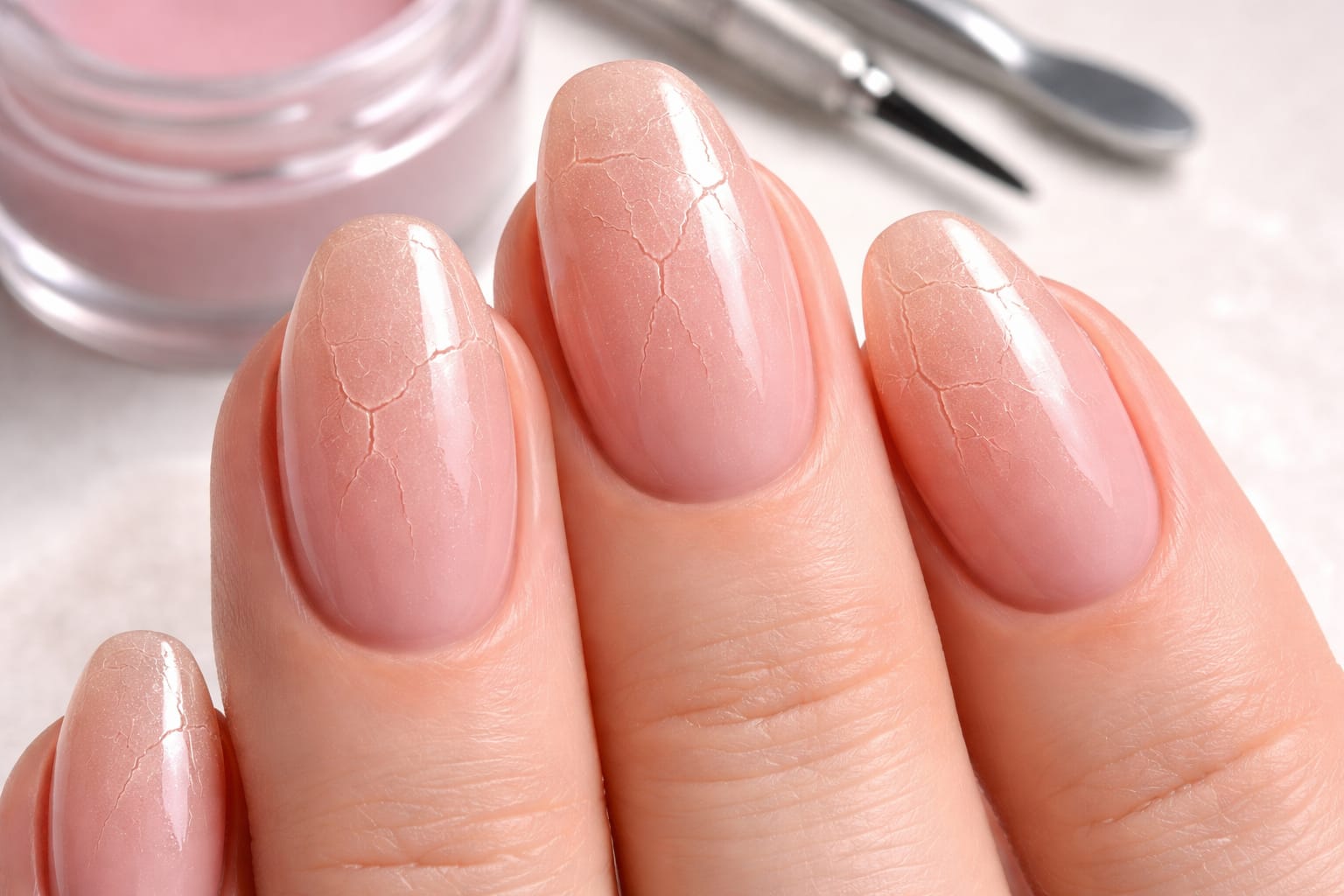
When builder gel is cured for too long or under a very high-wattage lamp at close range, the polymer chains in the gel can become over-cross-linked. The gel gets harder than it’s supposed to be — more glass-like than rubber-like. On a short nail that flexes with every touch, that extra brittleness means cracking instead of absorbing the stress.
Always cure for the time your product brand specifies — not longer. More time doesn’t mean more strength. It often means more brittleness.
Placing the hand very close to the lamp’s light source intensifies curing speed. Follow the lamp manufacturer’s hand placement guidelines.
Builder gel from one brand cured under a lamp from another brand at the wrong spectrum can cure unevenly or too aggressively. Stick to recommended pairings.
3. No flexible base coat — the overlooked fix
Builder gel is rigid by design. That’s its job — to add strength and structure. But on a short natural nail, you need a little give in the system, because the nail plate itself is flexible and it will move. If the product stack is rigid all the way through — rigid base, rigid builder, rigid top — the whole thing becomes one stiff shell sitting on a moving surface.
A flexible or “rubberised” base coat changes this. It acts as a shock absorber between the natural nail and the builder gel layer. When the nail plate flexes slightly with movement, the flexible base flexes with it — instead of transmitting that stress directly into the rigid gel above and cracking it.
This is a small change that makes a surprisingly big difference, especially on short nails or on clients who have thin, naturally flexible nail plates. It doesn’t change how the builder gel looks or how you apply it — it just gives the whole system a little more resilience.
If a client keeps breaking builder gel on short nails and you’ve already addressed thickness and curing, try switching to a flexible base coat on their next appointment. Give it two to three weeks. In most cases, the cracking stops almost completely.
4. The wrong product viscosity for the nail length
Builder gels come in a range of viscosities — from very thick and self-levelling to quite thin and runny. The thicker formulas are great for building length and creating strong structure on longer nails. On short nails, they can be overkill.
A very thick, hard-setting builder gel on a short nail creates the same problem as applying too much product: too much rigidity in too small a space. It sets harder, it flexes less, and it cracks more easily when the fingertip bends.
5. Over-filing the natural nail beforehand
This is one of those problems that happens upstream of the builder gel application but shows up downstream as cracking. When the natural nail plate is filed too aggressively during prep — buffed down to create texture, or thinned out over multiple appointments — the nail loses structural integrity.
Builder gel needs something solid underneath it. On a thin, over-filed natural nail, there’s no real foundation. The nail plate flexes more than it should, the gel can’t compensate, and the result is cracking — often in the centre of the nail where the stress is highest.
If you have a client who’s been getting builder gel for six months or more and is suddenly experiencing breakage, ask yourself: how much has the nail thinned over that time? Cumulative over-filing is a real problem and it quietly builds up appointment by appointment.
Hold the client’s nail up to a light source after removing old product. If you can see the light through the nail plate, it’s too thin. Skip the buffer entirely on that appointment — use only a light 180-grit file for surface prep and nothing more.
6. The client’s daily habits are doing the damage
Sometimes everything is done correctly at the salon and the gel still breaks — because of what happens afterwards. Short nails don’t give clients the visual reminder to be careful the way longer nails do. With long nails, you know they’re there. With short nails, it’s easy to forget you’re wearing a gel product at all and go back to old habits.
Typing with the nail tips rather than the finger pads puts repeated impact stress directly into the gel on short nails.
Gym work, carrying bags, or any activity that involves gripping with fingertips creates concentrated stress at the gel bond.
Cleaning products, acetone from other cosmetics, and prolonged water contact all weaken the gel bond over time.
Heat and prolonged soaking cause the natural nail to swell. Repeated swelling and shrinking loosens the product bond from underneath.
If builder gel keeps breaking regardless of technique, it might be worth reconsidering whether BIAB — a softer, more flexible alternative — would serve the nail better. We’ve compared both in detail.
Read: Is BIAB Better Than Builder Gel? →So how do you actually fix it?

Pull together everything above and the fix becomes a short checklist. Most clients who break builder gel on short nails need two or three of these changes, not all of them. Start with the most likely culprit — product thickness — and work down the list from there.
Reduce product thickness — one to two thin layers maximum on short nails. Let the nail do the structural work; the gel is just reinforcing it.
Move the apex toward the centre — don’t build up gel near the free edge on short nails. The thickest point should be mid-nail.
Switch to a flexible base coat — gives the system enough micro-flex to absorb movement without cracking.
Check cure times — cure for exactly as long as the brand recommends. Not more.
Ease up on prep filing — especially with repeat clients. If the nail plate is thinning, skip the buffer completely and use only a light file for surface texture.
Brief the client on aftercare — gloves for cleaning, cuticle oil daily, and no using nails as tools. Short nails forget this more easily than long ones.
Questions about builder gel breaking on short nails
The bottom line
When builder gel breaks on short nails, the nail length is almost never the real problem. It’s almost always a combination of too much product, too rigid a system, too aggressive a cure, or a nail plate that’s been gradually thinned by repeated filing. Fix one or two of those things and most breaking problems resolve on their own.
Short nails don’t need a different product. They need a lighter touch and a bit more thought about how the system as a whole will behave on a small, mobile surface. Get that right and builder gel will hold just as well — sometimes better — than it does on longer nails.