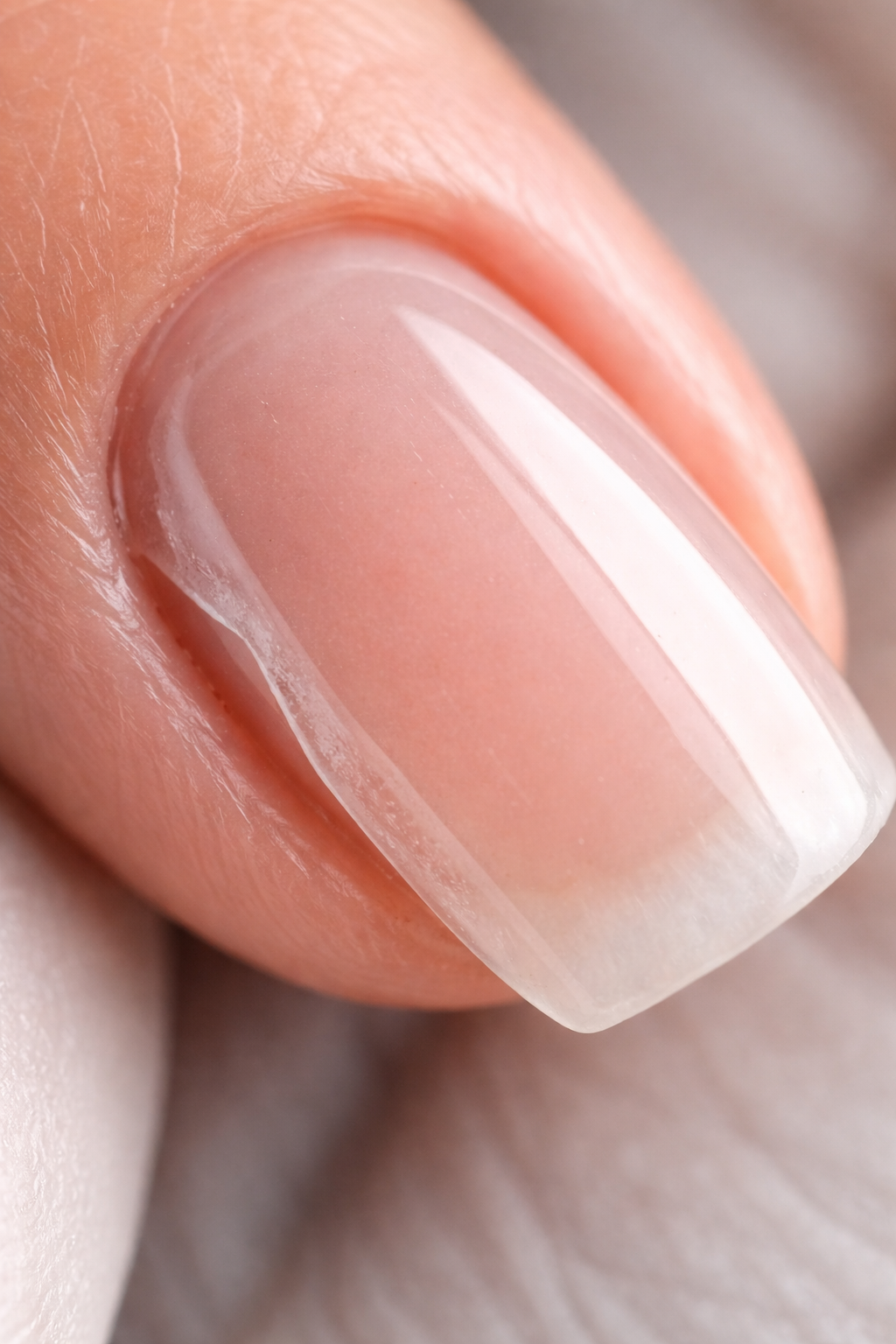

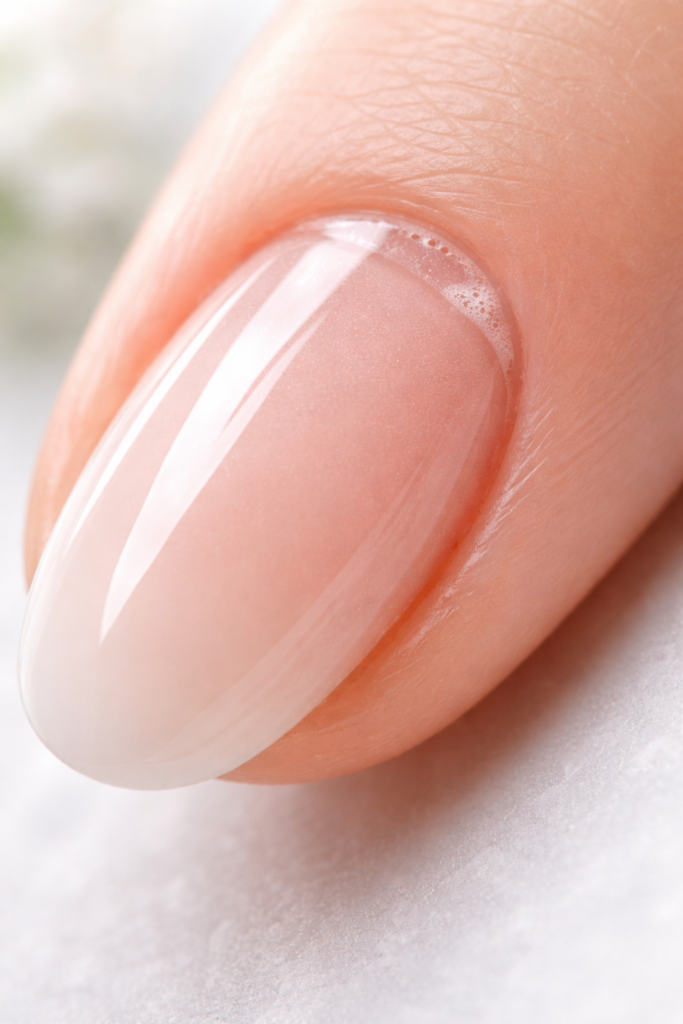
Builder gel lifting is often blamed on poor preparation. When lifting appears near the cuticle line, the immediate assumption is that something was missed during prep — leftover cuticle, oil residue, insufficient dehydration.
But what happens when prep was done correctly? Many broader adhesion failures follow predictable mechanical patterns, similar to those discussed in our guide on why gel nails lift.
When the cuticle was cleaned thoroughly, the surface was properly refined, the pH was balanced, and the product was applied precisely — yet lifting still occurs?
In these cases, the issue is rarely surface contamination. More often, it is a structural and mechanical imbalance that begins long before lifting becomes visible.
Understanding why builder gel lifts at the cuticle line — even with proper prep — requires looking deeper into how the nail plate behaves over time.
The Cuticle Line Is Not Just a Surface
The cuticle line is the most dynamic part of the natural nail.
Unlike the apex or the free edge, the cuticle zone:
- Is thinner
- Is more flexible
- Is constantly growing forward
- Experiences subtle micro-movements daily
Even perfect surface preparation cannot stop mechanical stress from acting on this area.
The bond between builder gel and natural nail is strongest when forces are distributed evenly. When stress accumulates near the base, adhesion begins to weaken from underneath.
This process is gradual, not immediate.
Micro-Movement Is the Hidden Factor
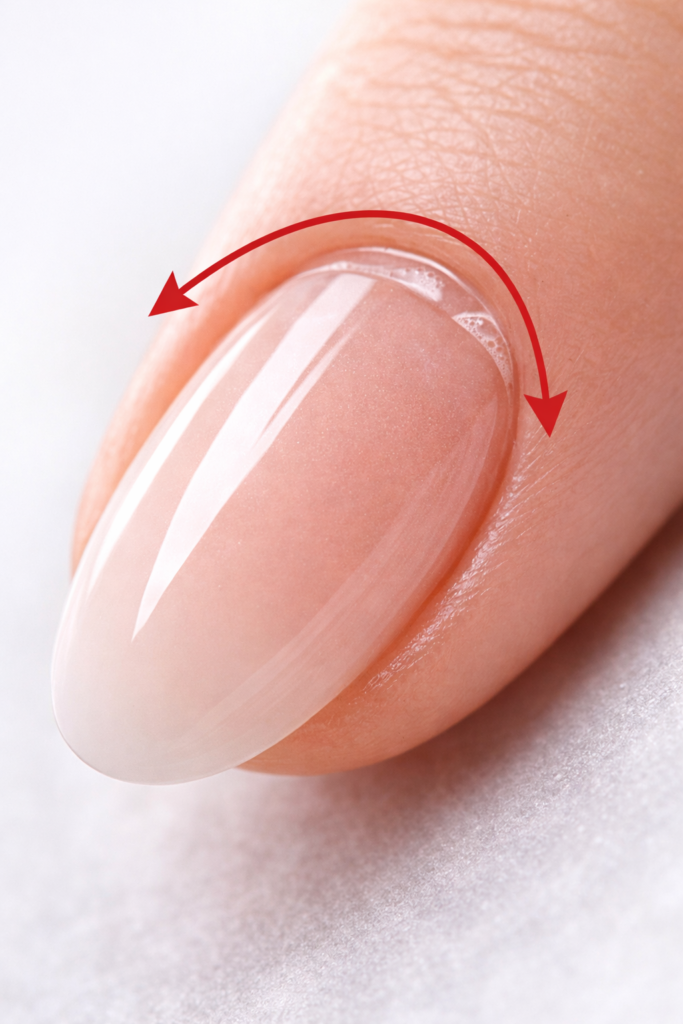
The natural nail is not rigid. Natural nail flexibility is influenced by hydration and keratin structure, as supported by cosmetic science research. It bends slightly under pressure. Every time a client types, grips an object, or applies pressure to the free edge, force transfers backward toward the cuticle line.
If the structural design does not properly absorb that force, the cuticle line becomes the release point.
This is especially common when:
- The apex is placed too far forward
- The stress area lacks reinforcement
- The base is filed too thin during refinement
Prep may be perfect.
But structure may not be balanced.
When structure and flexibility do not align, lifting begins microscopically.
Over-Refinement at the Cuticle
Another overlooked cause is post-application filing.
After curing, many technicians refine the surface to perfect the shape. During this step, it is easy to unintentionally thin the product at the cuticle line.
A base that becomes too thin cannot resist forward pressure from natural nail growth.
Within days, a small separation forms.
This often appears as:
- A faint shadow
- A slight ridge
- A visible air pocket forming from the base
The initial adhesion may have been strong.
But structural thinning compromises long-term retention.
Natural Nail Growth Changes the Tension Pattern
As the nail grows, the entire builder gel overlay shifts forward.
Even if prep was flawless, growth introduces a new mechanical direction of stress.
The cuticle line transitions from being the newest adhesion point to becoming a tension boundary.
If the gel layer was not balanced for growth, lifting accelerates around week two or three.
This is why some sets appear stable at first but begin separating despite proper preparation.
Product Rigidity vs. Nail Flexibility
Builder gels vary in flexibility.
Some formulas cure extremely rigid. Others maintain slight elasticity.
When a rigid builder gel is applied over a flexible nail plate, movement mismatch develops.
The nail bends.
The gel resists.
The weakest point — typically the cuticle line — begins to detach.
This is not a prep failure.
It is a compatibility issue.
Using a thin, flexible bonding layer beneath builder gel can significantly reduce this stress.
Invisible Contamination vs. Mechanical Failure
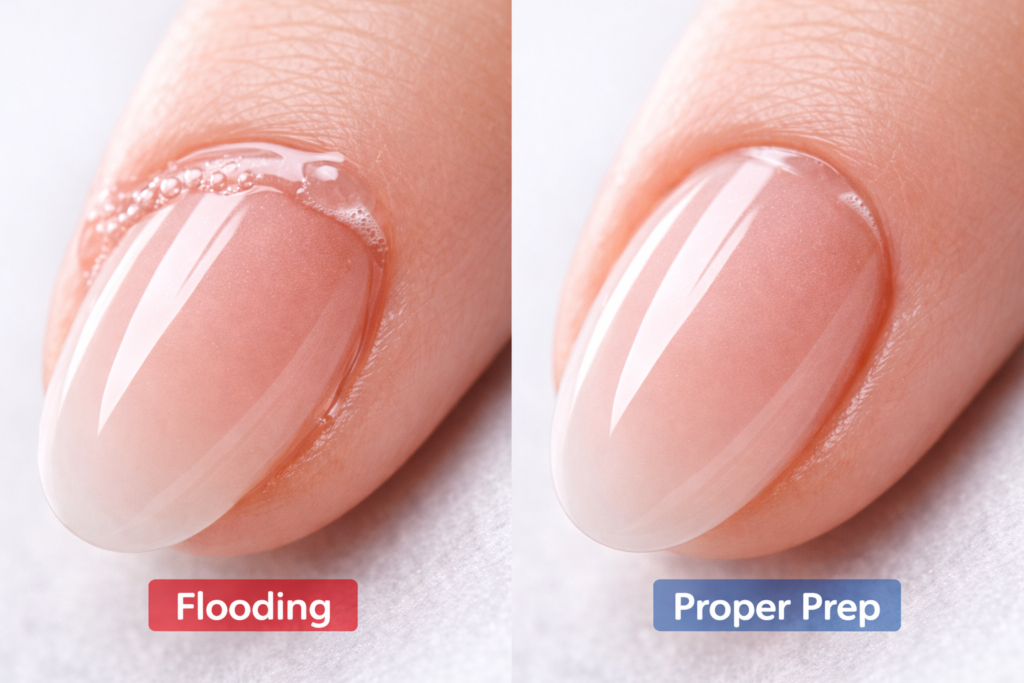
Professionals often assume lifting equals contamination. While contamination does cause lifting, mechanical lifting behaves differently.
Mechanical lifting:
- Appears gradually
- Develops after days or weeks
- Often begins at stress points
- Does not show widespread separation
Contamination lifting:
- Appears quickly
- Often spreads unevenly
- May occur in multiple areas
Understanding the difference prevents unnecessary over-prepping in future sets.
Apex Placement Directly Affects the Cuticle Line
Apex placement is critical.
If the apex is too flat or positioned too far toward the free edge, stress distribution shifts backward.
The cuticle line absorbs repeated force with no structural support.
The result is subtle detachment at the base.
Correct apex placement should:
- Support the stress area
- Reduce flexion
- Allow gradual taper into the cuticle
- Maintain structural continuity
Structure controls lifting more than surface prep does.
Environmental Stress Cannot Be Ignored
Clients expose their nails to:
- Water
- Heat
- Cleaning chemicals
- Temperature fluctuations
These factors cause the natural nail to expand and contract.
If the adhesion layer was thin or overly rigid at the cuticle, environmental shifts accelerate separation.
Even perfect prep cannot compensate for poor structural distribution under repeated stress.
How to Prevent Lifting at the Cuticle Line (Beyond Prep)
Professional prevention focuses on mechanics, not just cleanliness.
- Avoid thinning the cuticle area excessively during prep.
- Maintain controlled thickness at the base.
- Position the apex correctly — not too forward.
- Consider a flexible base layer when working on softer nails.
- Cure evenly, especially thumbs.
- Educate clients about mechanical stress and care.
When structure supports movement, lifting decreases dramatically — even in high-stress environments. This imbalance becomes even more visible on flexible nail plates, as explained in our article on why builder gel lifts on flexible natural nails.
Final Thoughts
Builder gel lifting at the cuticle line — even with proper prep — is not a mystery.
It is a mechanical response to imbalance.
The cuticle line is the most delicate and dynamic part of the nail system. When structure, flexibility, and stress distribution are not aligned, adhesion weakens gradually.
Preparation creates the foundation.
Structure ensures longevity.
Once you shift your focus from “Was prep done correctly?” to “Is the structure mechanically balanced?” lifting patterns become predictable — and preventable.